How much water is appropriate for growing bamboo in water? A detailed guide to the water-growing method
How much water does bamboo need when grown in water? There are many kinds of bamboo, so let's take lucky bamboo as an example. Let's take a look together~ Lucky bamboo was originally called Dracaena sanderiana, also known as ribbon plant and evergreen bamboo, belonging to the family Ruscaceae, genus Dracaena; it is a perennial evergreen herbaceous plant. Since lucky bamboo became widely known, it has always existed as an ornamental, with strong ornamental value and effect. How to grow lucky bamboo in a bottle with water and how water-cultured lucky bamboo performs are also covered, explaining the key points of the cultivation method for water-cultured lucky bamboo, which has stronger ornamental value than soil-cultured lucky bamboo.
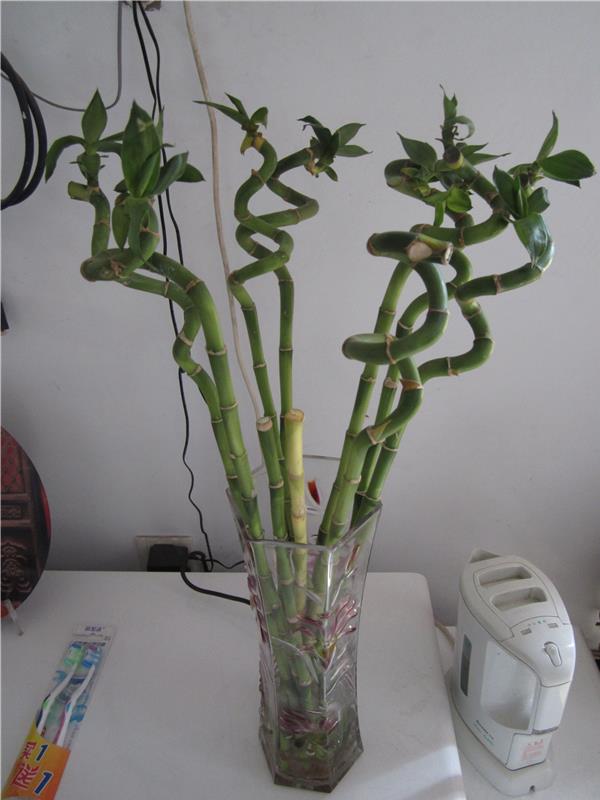
Cultivation method for water-cultured lucky bamboo
1. Remove leaves from the base and cut a slanted opening - the first step in water-culturing lucky bamboo is to remove the leaves from the base of the cuttings before putting them into the vase, and use a sharp knife to cut the base into a slanted opening; the cut should be smooth to increase the area for absorbing water and nutrients. Water-cultured lucky bamboo needs the clean water changed every 3 to 4 days, and a few small pieces of charcoal should be put into the water as a preservative. The most important point is that the position of the vase must not be moved within 10 days; in this way, silvery-white fibrous roots can grow in about 15 days.
2. Change the water, then switch to adding water: after water-cultured lucky bamboo has rooted, it should not have its water changed, because frequent water changes easily cause yellow leaves and withered branches, so after the water evaporates, you can only add water in time. The water is best if it is well water; before tap water is added to the vase, it should first be stored in a container for one day.
3. Fertilize in time: to prevent water-cultured lucky bamboo from becoming leggy, do not apply chemical fertilizer. It is best to inject a few drops of brandy into the bottle about every 3 weeks and add a small amount of nutrient solution; you can also use 500 grams of water to dissolve half a tablet of aspirin crushed into powder or one tablet of VC, and drip in a few drops when adding water, which can keep the leaves emerald green.
4. Water-cultured lucky bamboo should avoid wind: if it is often placed where it can be blown by wind, the leaf tips and leaf edges are prone to drying up.
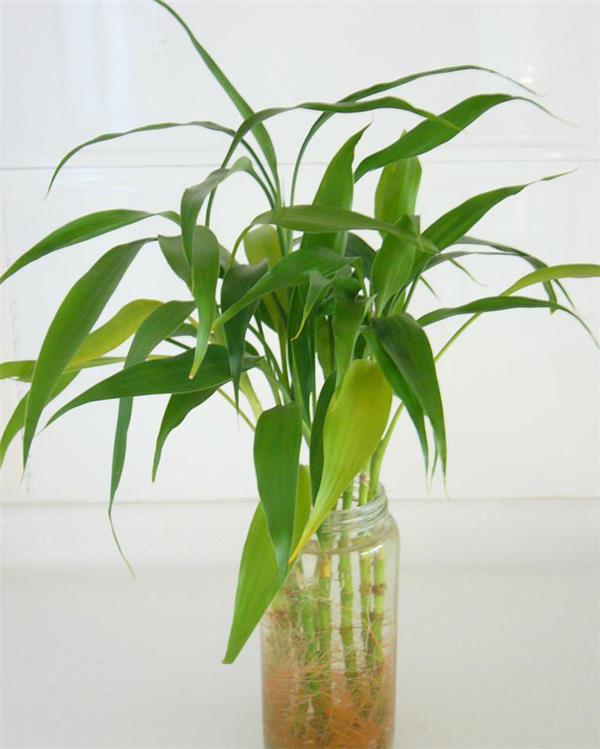
How does water-cultured lucky bamboo perform?
Lucky bamboo is an evergreen small tree, green all year round, and water-cultured lucky bamboo is even more enticingly green; its green has a touching beauty. The beauty of water-cultured lucky bamboo is inseparable from its auspicious name. It has slender and elegant leaves, an emerald green leaf color, and its stem nodes show features resembling bamboo nodes, though it is not true bamboo. Placing a bottle of water-cultured lucky bamboo at home is not only a good decoration, but also has a certain effect on improving the temperature, humidity and air quality of the local environment, bringing fresh air to the home.
1. Before placing it, cut off the leaves at the base of the lucky bamboo cuttings, and use a sharp knife to cut the base of the lucky bamboo into a slanted opening; the cut should be smooth to facilitate the absorption of water and nutrients. Change the clean water once every three to four days, and do not move the position of the lucky bamboo or change its direction within ten days; in about 15 days, silvery-white fibrous roots can grow.
2. After water-grown lucky bamboo has rooted, it should not have its water changed; only after the water evaporates and decreases should water be added in time. Frequent water changes easily cause yellow leaves and withered branches in lucky bamboo.
3. After water-grown lucky bamboo has rooted, a small amount of compound chemical fertilizer should be applied in time, then the leaves will be glossy green and the branches and stems thick and strong. If no fertilizer is applied for a long time, the lucky bamboo plant will grow thin and weak, and the leaf color of the lucky bamboo will easily turn yellow. However, fertilizer must not be applied too much, so as to avoid "burning the roots" or causing leggy growth. In spring and autumn, applying compound chemical fertilizer once a month is enough. According to reference materials, to prevent water-grown lucky bamboo from becoming leggy, do not apply chemical fertilizer; it is best to inject a few drops of brandy into the bottle about every three weeks and add a small amount of nutrient solution, which can keep the leaves of lucky bamboo emerald green.
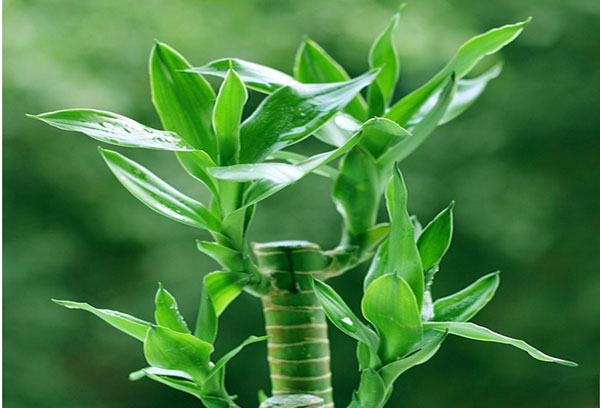
4. Do not place lucky bamboo beside a television or where an air conditioner or electric fan often blows, so as to avoid the leaf tips and leaf edges of lucky bamboo drying up.
Reasons that cause the leaves of water-cultured lucky bamboo to turn yellow:
1. Wrong placement environment. As mentioned earlier, the growth of lucky bamboo needs sufficient scattered light; if the light is too strong or too weak, it will have a certain impact on its growth. If the yellowing of the leaves is caused by light, you can first cut off the yellowed leaves and check whether the root system has rotted. If the root system has rotted, you can cut off the rotted roots as well. Then place it in a place with sufficient scattered light and good ventilation and care for it carefully. In addition, the placement location of lucky bamboo should also be far from radiators, air conditioners, electric fans, televisions, etc.; the airflow blown out by these appliances can easily dry the edges of lucky bamboo leaves.
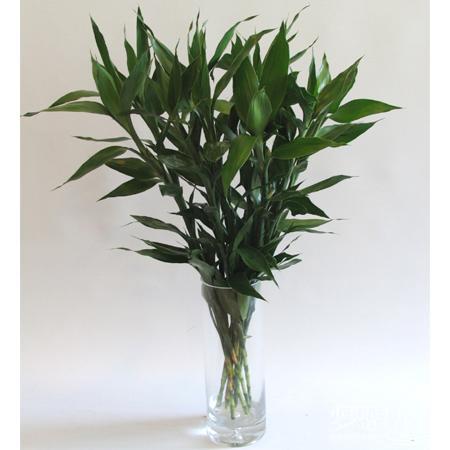
2. Water quality problem. The water for water-cultured lucky bamboo is best if it is well water or river water. If such conditions are not available and tap water is used, then the tap water must be dried in the sun before use. No matter the season, when adding or changing water for lucky bamboo, water lower or higher than room temperature must not be used to replace or add water, so as to avoid irritating the root system and causing discomfort to the plant. If the leaves turn yellow and the roots rot because of water quality problems, then cut off the yellowed leaves and rotted roots, replace the water quality again, and carry out root-promoting care.
Because water can evaporate freely in the container of water-cultured lucky bamboo, in the same environment it has a more obvious effect than plants grown in potting soil in regulating air humidity, while also saving a lot of troublesome work.