Can Spider Plants Be Grown in Water? Read This and You'll Understand
Can spider plant flowers be grown in water? The spider plant, also known as the creeping saxifrage, is a perennial evergreen plant of the lily family. Growing spider plants can be divided into two methods: hydroponic spider plants and soil-grown spider plants. The spider plant has an extremely strong ability to absorb toxic gases and can purify toxic gases such as carbon monoxide, carbon dioxide, and formaldehyde, so it is also known as the "green purifier," making it a good indoor air-purifying flower. Under conditions of high temperature and high humidity, spider plants can grow roots suitable for an aquatic environment, making them one of the good types of flowers for home hydroponics. Common varieties include the green broad-leaf spider plant, silver-edged spider plant, golden-edged spider plant, and golden-hearted spider plant, among others. These varieties are all very suitable for hydroponics, and their hydroponic forms are varied.
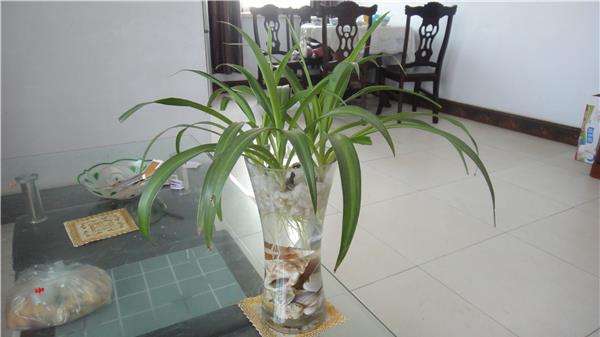
Can spider plant flowers be grown in water?
Yes
Hydroponic methods
1. Containers
Any container that can hold water can be used to grow spider plants hydroponically. It is best to use a transparent vessel for hydroponics, so you can admire the dazzling white roots in the water. Glass wine glasses, teacups, mineral water bottles, and the like around you are all economical and attractive containers for hydroponic spider plants.
The container for hydroponic spider plants can be single-layered or double-layered. A single-layer container means taking a bottomless glass bottle or plastic bottle and planting the spider plant directly in it. A double-layer container means taking a plastic sieve (also called a planting basket) as the upper layer, with a bottomless bottle as the lower layer, planting the spider plant in the upper plastic sieve and letting the spider plant's roots extend into the lower bottle.
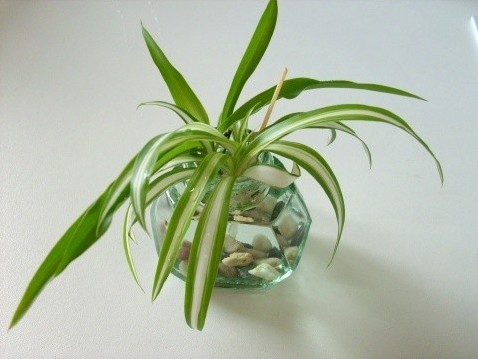
2. Steps for making a hydroponic spider plant
(1) Take a potted spider plant with a beautiful plant shape out of the pot and wash off the soil.
(2) Cut off the old roots. Cut off the withered and yellow leaves.
(3) Insert it into the plastic sieve and fill in orchid stone or maifan stone to increase permeability and to hold the plant in place. Then place it in a wide-mouthed transparent glass bottle for hydroponics.
3. Division hydroponics
Cut off from the mother plant a small spider plant with aerial roots on a creeping stolon and separate it for hydroponics.
Care and management
(1) When growing a spider plant hydroponically, just let the bottom 1/3 of the root system touch the water surface. Do not submerge all of the spider plant's white fleshy roots in water, otherwise water will accumulate and cause root rot.
(2) For a spider plant that has just been placed in water for hydroponics, change the water once a day, and reduce the frequency of water changes after roots have formed.
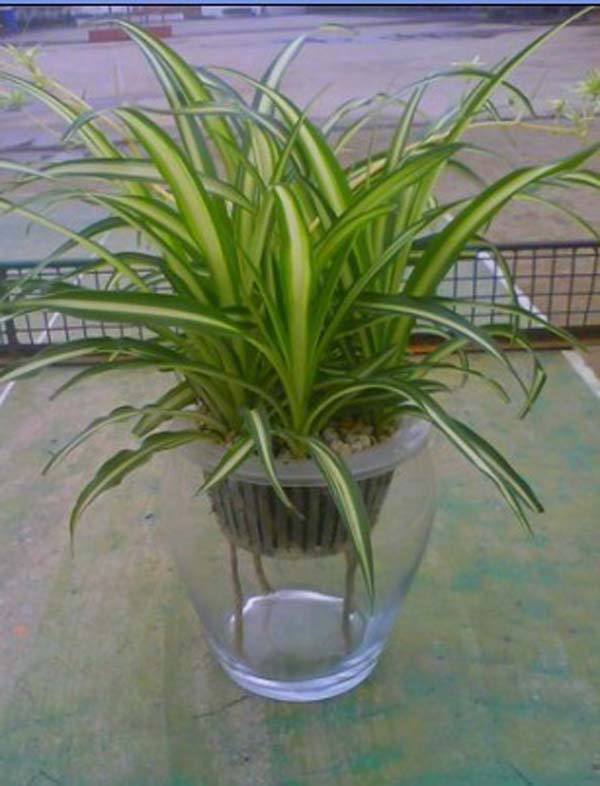
Daily management of hydroponic spider plants
① Water: When growing a spider plant hydroponically, just let the bottom 1/3 of the root system touch the water surface. Do not submerge all of the spider plant's white fleshy roots in water, otherwise water will accumulate and cause root rot.
For a spider plant that has just been placed in water for hydroponics, change the water once a day, and reduce the frequency of water changes after roots have formed. For cultivation in a single-layer container bottle, add water and flower nutrient solution once every 4 days, feeding the water in through a straw until it is full. For a double-layer bottle, change the water once a week; when changing the water, pour out the bottle water, wash the container bottle clean, fill it with clean water and flower nutrient solution, and then place the plastic sieve on top of the water bottle. You can also add ammonium nitrate and potassium dihydrogen phosphate to the water, which contain nitrogen, phosphorus, and potassium fertilizers and can promote the growth of the spider plant. The ratio is 3 parts per thousand, and add a small amount of penicillin to prevent disease. Change the water once every 10-15 days.
If the spider plant's root system has already rotted in the water, it is best to first clean the bottle and the spider plant's root system, cut off all the rotted roots, and soak them in a 500-fold dilution of potassium permanganate solution for 20 minutes to disinfect. The bottle should also be disinfected. Place the disinfected spider plant in a cool place first, and after about 2 days cultivate it again with clean water. A semi-shaded or scattered-light environment is suitable; in a shady place it will gradually weaken. In winter it needs to be placed in a sunny spot. If the temperature is 20-25°C, change the water once every 3 days; when below 20°C, it is best to change the water about once every 5 days; when above 25°C, change the water once every 1-2 days. And each time you change the water, rinse the mucus off the roots with tap water. Managed this way, it is guaranteed to grow well. Note: do not fertilize within 1 month; afterward you can apply a little less, which helps it recover.
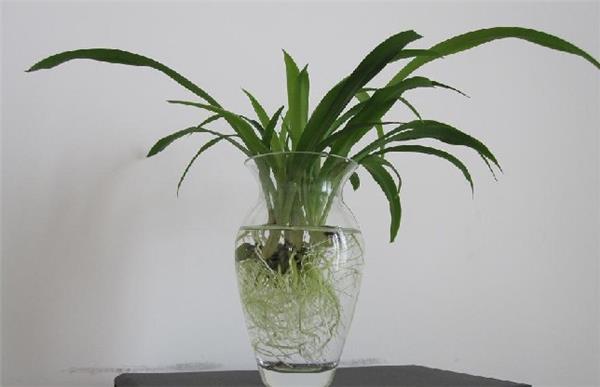
② Fertilizer: Through the roots, flower nutrient solution is added at the same time as water is added and changed; for foliar feeding, spray the branches and leaves with diluted flower nutrient solution once every 3 days.
③ Pest and disease control: If pests or diseases are found, spray the leaves with all-purpose powder mixed with water.
④ Promoting flowering: Spider plants bloom half a year after being potted. When flowering, do not spray water on the flowers, to prevent premature flower drop. After the flowers fade, cut them off from the branch tips to promote reblooming.