What Are Aquatic Flowers? A Detailed Introduction to Common Species
Aquatic flowers are generally quiet and look cleaner and tidier. There are also many types of aquatic flowers, and many of them can now be grown at home.
I. The Difference Between Aquatic Flowers and Terrestrial Flowers
In order to absorb water and nutrients from the soil, terrestrial plants must have well-developed roots. To support the body and facilitate the transport of nutrients and water, they have tough stems. Both roots and stems are wrapped in a thick epidermis to prevent water loss. Aquatic plants are surrounded by water and do not need a thick epidermis to reduce water loss, so the epidermis becomes extremely thin and can absorb water and nutrients directly from the water. As a result, the roots lose their original function, making the roots of aquatic plants underdeveloped. In some aquatic plants, the roots do not function to absorb water and nutrients but mainly serve as anchorage. Plants that can grow in water are collectively called aquatic plants. In the broad sense, aquatic plants include all marsh plants, submerged plants or floating plants. According to the depth of water required for vigorous growth, aquatic plants can be further subdivided into deep-water plants, floating-leaved plants, waterside plants, marsh plants or moisture-loving plants.
II. Common Types of Aquatic Flowers
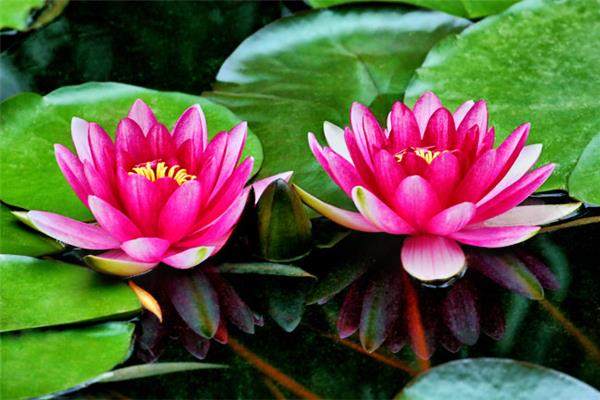
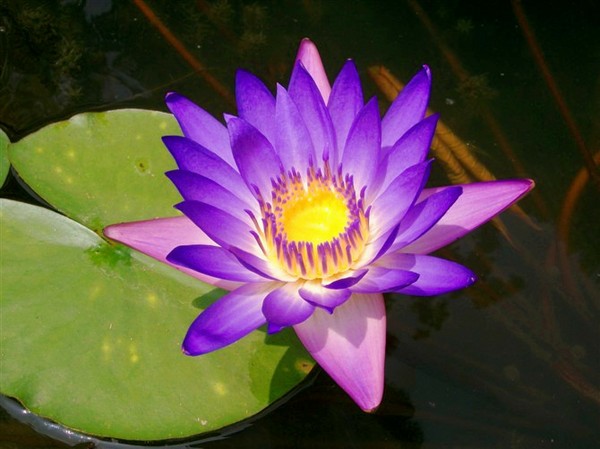
Water lily: The water lily, also known as ziwulian or watercress flower, is a plant of the family Nymphaeaceae in the order Ranunculales. It is a perennial aquatic herb; the rhizome is thick and fleshy. The leaves of the water lily are floating leaves, round or ovate, with a curved notch at the base, heart-shaped or arrow-shaped, and usually without emerged leaves; the submerged leaves are membranous and fragile. The flowers are large and beautiful, floating on or rising above the water surface; the sepals are nearly free; the petals are white, blue, and also pink. Water lilies like sunlight and good ventilation, so tropical and hardy water lilies that bloom during the day close their flowers at night and open again in the morning. They grow in ponds and lakes, and are often cultivated in the pools of some parks.
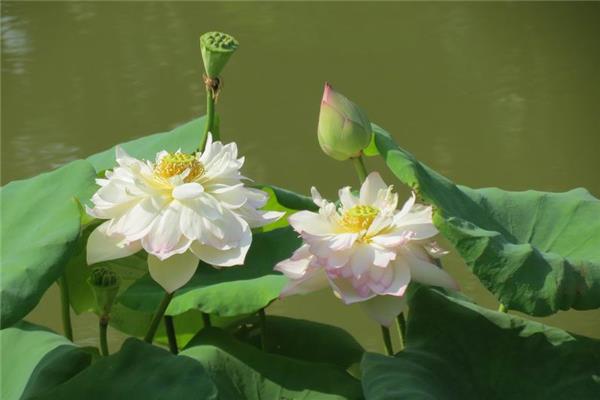
Lotus: The lotus, also known as lianhua, water hibiscus, etc., belongs to the order Nymphaeales and is a perennial aquatic herbaceous flower of the family Nelumbonaceae. The underground stem is long and thick and fleshy, with long nodes, and the leaves are peltate and round. The flowering period is from June to September, with flowers borne singly at the tip of the pedicel and numerous petals. There are also many types of lotus; what is mainly introduced here is the ornamental lotus. Throughout history, the lotus has been a subject for poets to praise and paint. The lotus is a perennial aquatic flower plant and also an aquatic herbaceous plant, with horizontal roots that are very thick and fleshy and contain many air cavities. The pedicel and the leaf stalk are of equal length. The flower is borne singly at the tip of the pedicel, held high above the water surface, with a flower diameter of 10-20 cm, beautiful and fragrant.
Hornwort: Hornwort grows for many years in the still water of small lakes. It was once common in ponds, ditches and other places, and can be used as feed for pigs, fish and poultry. The whole plant is used as medicine, can be collected in all four seasons, and is dried in the sun. Hornwort also has great medicinal effects: it mainly treats blood-heat vomiting of blood, coughing of blood, and painful strangury with heat. It is distributed throughout the world. Hornwort is a perennial submerged herbaceous plant. The flower of hornwort is about 2 mm in diameter; the bracts number 9-12, linear, 1.5-2 mm long, light green, transparent, with 3 teeth and purple hairs at the tip; the stamens number 10-16, slightly dense, and the ovary is ovate with a subulate style.
Lucky bamboo: An evergreen erect shrub of the genus Dracaena in the family Liliaceae, suitable for indoor hydroponic flowers. The leaves of lucky bamboo are emerald green and look deep green in color, and the stems are straight and round like bamboo. The leaves are ovate with pointed tips, and the base of the leaf stalk clasps the stem. It is an extremely shade-tolerant plant and can still grow well, upright and strong, under weak light conditions. It can be placed indoors for viewing for a long time and does not need special care; as long as there is enough water, it can grow vigorously. When growing it hydroponically, cut the stems of lucky bamboo into small sections of more than 20 cm as cuttings and insert them into water. As long as 1/3 of the cutting can be immersed in water, it can take root and survive.
Spider plant: A perennial evergreen herbaceous flower with perennial roots of the family Liliaceae, with clustered, linear leaves and longitudinal yellow-white stripes along the edges or in the middle. In summer and autumn, slender, flexible, drooping stolons are produced from among the leaves, and young leaves and aerial roots sprout at the tips or nodes, bearing white flowers. Spider plants can be grown indoors in water; they not only purify the air but are also attractive in appearance and easy to manage. Simply dig out a potted spider plant, remove the soil from the roots, cut off the old roots and rotten roots, keep the fibrous roots, and place it in a container or bottle filled with clean water and flower nutrient solution, letting the roots of the spider plant grow immersed in the water.
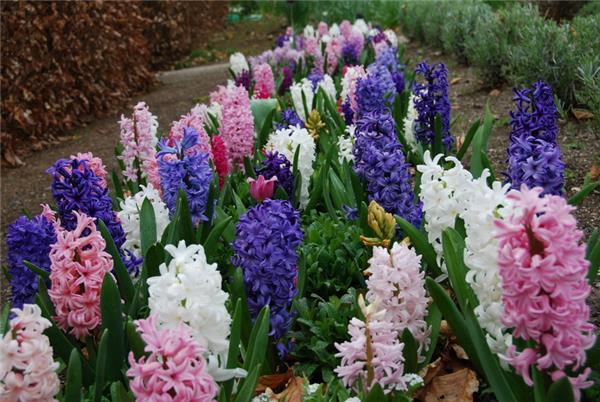
Hyacinth: The hyacinth, also known as foreign narcissus, belongs to the genus Hyacinthus in the family Liliaceae and is a perennial herb. The bulb is spherical or flattened spherical, covered outside with a skin that is purplish blue or white, etc. The leaves are basal, thick and fleshy, strap-shaped and lanceolate. The flower stem is drawn out from the center of the leaf stem, with a raceme; the flowers are delicate and lovely, colorful, brilliant and eye-catching, with a pleasant fresh fragrance. It likes a sunny, cool and moist environment, and is suitable for both potting and water culture. If you want to grow it in water, place its bulb in a hydroponic nutrient solution; its appearance is clean and highly ornamental!
Because aquatic flowers lack the step of choosing and working with soil, they are much simpler to grow than soil-cultured flowers, and also much cleaner, so if any friends are interested, you can give it a try.
Because aquatic flowers lack the step of choosing and working with soil, they are much simpler to grow than soil-cultured flowers, and also much cleaner, so if any friends are interested, you can give it a try.