What Flower Is the Cornflower? A Detailed Guide to Growing It
The cornflower often appears in love films and idol dramas of all sizes, used to express a feeling of longing, and mostly a girlish sentiment. In fact, it really is a plant with a girlish sentiment, so when caring for it, you need to tend to it carefully as well.
I. An Introduction to the Cornflower
The cornflower, which symbolizes happiness, is native to Europe. It was originally a wild flower, and after many years of cultivation by people, its "wild" nature has diminished; the flowers have grown larger and the colors more varied, with varieties in purple, blue, light red, white and so on, among which purple and blue are the most prized. In Germany it can be found everywhere on hillsides, in fields, by the water, along roadsides, and in front of and behind houses. With its fresh and lovely colors, beautiful flower shape, fragrant scent and tenacious vitality, it has won the praise and affection of the German people, and is therefore honored as the national flower. In addition, it is also the national flower of Macedonia.
II. The Flower Language of the Cornflower
The flower language of the cornflower is: encounter and happiness
There is also another interpretation: delicate, elegant, encountering happiness, the happiness of being single, rebirth, love and loyalty, longing.
III. The Morphological Characteristics of the Cornflower
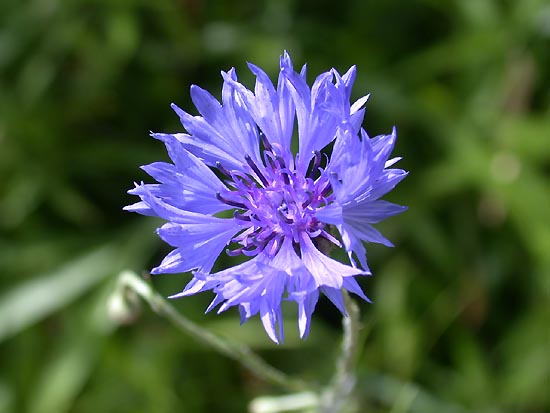
The leaves are linear and entire; the base often has teeth or is pinnately lobed. The capitulum is terminal, the marginal ligulate florets are funnel-shaped with toothed petal edges, and the central florets are tubular, in colors such as white, red, blue and purple, but mostly blue. The flowering period is April and May. An annual or biennial herbaceous flower, it has tall and dwarf varieties, with a plant height of 30-90cm. The branches are slender and much branched. The stems and leaves have white down. Seeds are collected in July-August: pick the dried inflorescences, dry them in the sun, thresh them and store them.
IV. The Growth Habits of the Cornflower
It has strong adaptability and likes sufficient sunlight; it is not tolerant of shade and dampness, and must be planted in a sunny spot with good drainage, otherwise it often dies from shade and dampness. It is relatively cold-tolerant, prefers cool conditions and dislikes intense heat. It likes fertile, loose and well-drained sandy soil.
V. How to Grow the Cornflower
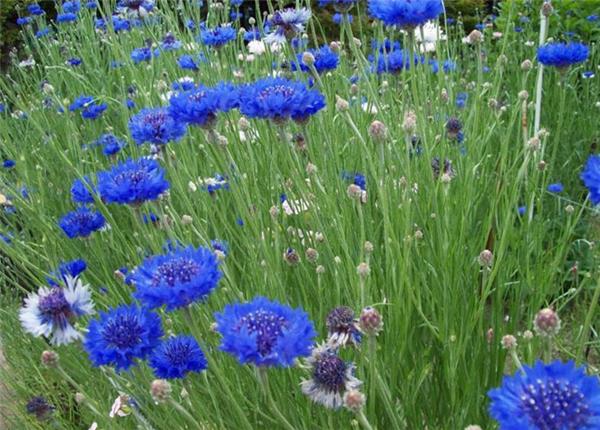
Sowing: cornflower seeds are generally sown in spring and autumn, with autumn being the best, roughly from mid-August to mid-to-late September. When planting, sow the seeds in an open-air seedbed, press them down gently, then water an appropriate amount, cover with grass, which allows rapid germination, and remove the grass on top once the sprouts appear. Once the leaves have grown to 6-7, they can be transplanted; they can be planted out in November, after which apply a 1:5 diluted decomposed human manure liquid once every 10 days or half a month, until February-March of the following year. For sowing in pots, fertile and loose soil is needed; it is recommended to add a mixed soil with things like leaf mold.
Soil: for the soil, it is best to choose a fertile sandy soil with good looseness and drainage. The growing medium should preferably maintain good ventilation to facilitate drainage; if the soil is on the heavy, clayey side, 30%-40% tree fern fiber or perlite can be mixed into the soil.
Watering: as a principle, watering once a day is already enough, but in drier summer weather, you can water once in the morning and once in the evening to keep the potting soil moist and lower the temperature of the potted plant, but avoid waterlogging.
Fertilizing: the cornflower likes plenty of fertilizer, and during the growing period a diluted liquid fertilizer of the three elements should be applied once a month. If the leaves are too luxuriant, the proportion of nitrogen fertilizer should be reduced; before flowering, more phosphorus and potassium fertilizer should be applied, so as to obtain larger flowers with beautiful colors.
Flowering period management: this plant grows side branches, and too many of them are not good for the growth of the flowers, so unnecessary side buds can be appropriately removed, keeping some of the small branches, so that the flowers grow large and vigorous. Since the cornflower needs long-term light and winter sunlight is insufficient, a grow light can be used to make up for the lack of sunlight and promote its flowering.
That is all for the introduction to the cornflower; how much have you learned? Growing a pot of cornflowers at home and watching it quietly bloom one bud after another in your room must surely be a very enjoyable thing. So if you have developed a fondness for cornflowers, go and grow a pot right away.