What is the flower language and symbolic meaning of the canna lily?
The canna lily's flower shape is very simple and unadorned, and its colors are very pure. When it is not in bloom, its leaves are broad and large, and it stands quietly in its own corner, not attracting attention. But once the flowering season arrives, that bright and passionate beauty, which can never be faked, makes everyone who once overlooked it feel their eyes burned by the splendor before them. The understated boldness of the canna lily brings the most high-profile beauty, and this fits perfectly with the meaning in the canna lily's flower language of symbolizing a beautiful future. So what is the flower language of the canna lily?
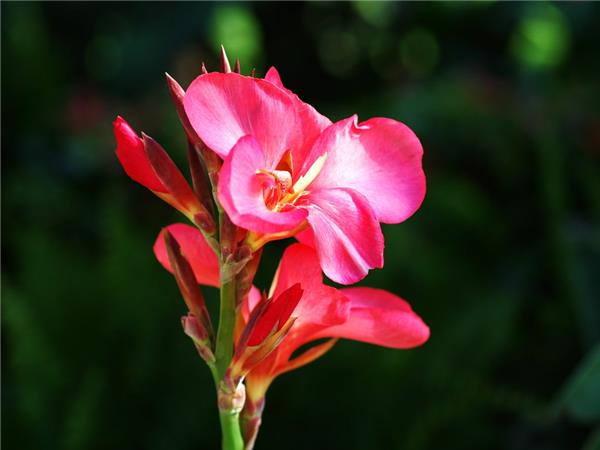
The flower language of the canna lily: a solid future
The canna lily is native to India, tropical South America and tropical Asia, and was developed by hybridizing plants of the same genus native to South America and the subtropics. It likes warmth and ample sunlight, and is not cold-tolerant. When planting it, the soil is required to be deep and fertile; for pot cultivation, the soil is required to be loose with good drainage. Fertilize regularly during the growing season. In the north, the underground tubers must be dug up before frost and stored in an environment at about 5°C. Because its flowers are large and brightly colored, its colors are rich, its plant form is good, and it is easy to cultivate. The most suitable temperature for open-field cultivation is 13-17°C. It is not strict about soil requirements, grows best in loose, fertile, well-drained sandy loam, and also adapts to fertile clay soil.
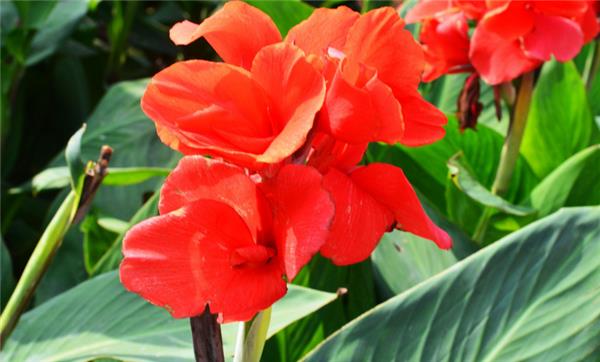
In Jiangnan, it can overwinter outdoors in a wind-sheltered spot. Propagate by division or by sowing seeds. Division propagation is carried out in April-May when the buds begin to sprout, cutting the rhizomes into sections with 2-3 buds each and planting them separately.
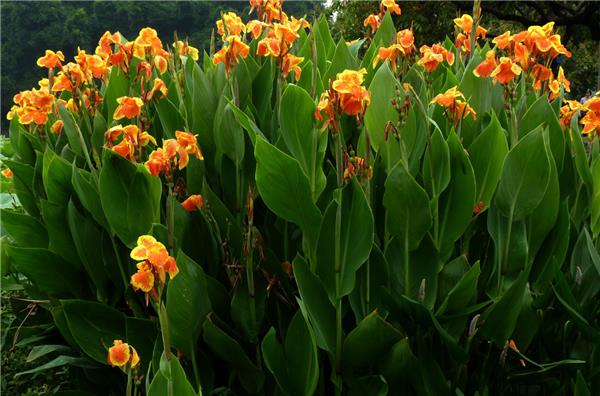
How to grow the canna lily
The canna lily, in the genus Canna, is native to tropical America, Africa and other places. Canna is a perennial bulbous rhizomatous herbaceous plant, with thick, fleshy rhizomes lying horizontally underground. In warm regions it has no dormant period and can grow year-round, growing best at 22-25°C; growth stops at 5-10°C, and cold damage occurs below 0°C. Because the canna lily likes moisture and dislikes dryness, in the hot summer, if it is exposed to direct sunlight or hit by dry, hot winds, the leaf edges may become scorched; excessive watering can also cause the same phenomenon. Also known as "red brilliant canna", "tanhua", etc., it is a large-flowered plant. Buddhism holds that the canna lily was transformed from blood that flowed from the Buddha's toe. The flower language of the canna lily is "a solid future". The canna lily likes warmth and ample sunlight, and is not cold-tolerant. It requires deep, fertile soil; for pot cultivation, the soil is required to be loose with good drainage. Fertilize regularly during the growing season. The whole plant is green and can reach 2 m in height.
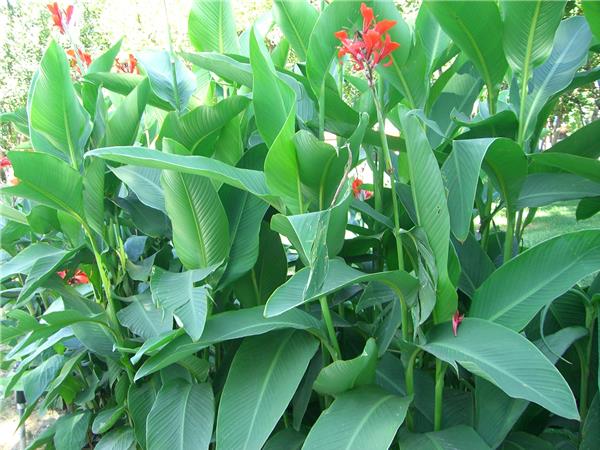
Leaf blades ovate-oblong, 10-30 cm long, up to 10 cm wide. Racemes with sparse flowers; slightly exceeding the leaves; flowers red, solitary; bracts ovate, green, about 1.2 cm long; sepals 3, lanceolate, about 1 cm long, green and sometimes tinged red; corolla tube less than 1 cm long, corolla lobes lanceolate, 3-3.5 cm long, green or red; outer staminodes 3-2, bright red, of which 2 are oblanceolate, 3.5-4 cm long, 5-7 mm wide, and the other, if present, is particularly small, 1.5 cm long and only 1 mm wide; labellum lanceolate, 3 cm long, curved; fertile stamen 2.5 cm long, anther locules 6 mm long; style flattened, 3 cm long, half united with the filament of the fertile stamen. Capsule green, long ovate, with soft spines, 1.2-1.8 cm long. Flowering and fruiting period: March-December.