How to Grow Portulaca grandiflora? A Detailed Guide to Care Tips and Uses
The name Portulaca grandiflora gives a feeling of something hidden and shy, but when it blooms it has none of that bashful quality; instead, its flower discs are full and round and its colors are vivid and delicate, making it highly ornamental. Today let us introduce this flower.
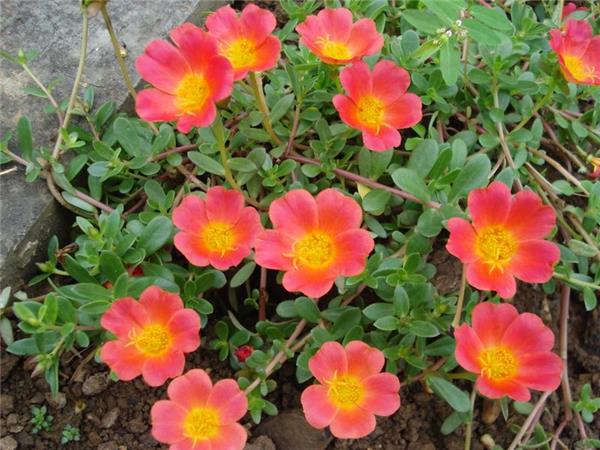
I. What Is Portulaca grandiflora
Portulaca grandiflora is also known as Dragon-whisker Peony, Pine-leaf Peony, "Undying", Opening Grass, Large-flowered Purslane, Foreign Purslane, and Sunflower. It originates from Brazil, prefers warmth, and is highly adaptable. Its best ornamental flowering period is June to July. It is an annual succulent herbaceous flower, with a low, nearly prostrate plant habit, reaching 10 to 25 cm in height. The leaves are thick and fleshy and needle-shaped. The flowers have 5 to 6 petals and come in a rich range of colors, including red, white, yellow, purplish red, and orange-red. The flowers need strong light to open, blooming at noon and closing in the morning and evening or when light is insufficient.
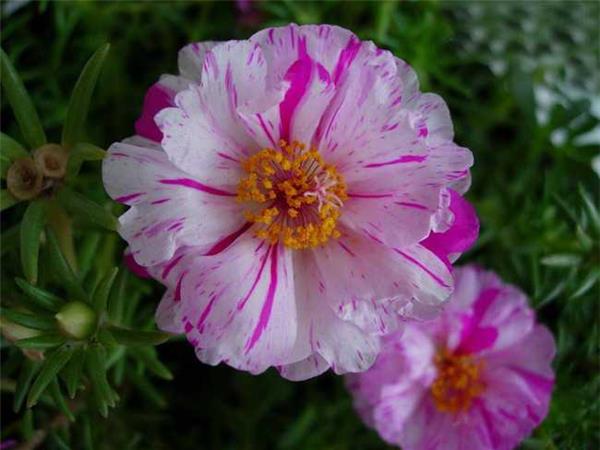
II. Uses of Portulaca grandiflora
1. Antibacterial effect: A 50% decoction of Portulaca grandiflora, tested by the plate ditch method, has an inhibitory effect on Staphylococcus aureus, Shigella flexneri, Salmonella typhi, Pseudomonas aeruginosa, and Escherichia coli.
2. Antispasmodic and expectorant effect: The safflower yellow contained in this product has a relatively strong effect against histamine-induced smooth muscle contraction and also has a good expectorant effect.
3. Antitumor effect: Screening tests using the methylene blue test tube method show that this product has a very mild inhibitory effect on acute granulocytic leukemia cells; screening experiments using the cell respirometer method show an inhibition rate greater than 75% against acute granulocytic leukemia blood cells.
4. Immunomodulatory effect: The polysaccharides contained in this product can promote ConA-induced lymphocyte transformation of mouse spleen cells in vitro, with an optimal concentration of 400 r/ml. After 1 week of Sc administration, it can significantly increase the percentage of esterase-positive cells among peripheral blood lymphocytes in mice and promote DNCB-induced delayed-type hypersensitivity. However, high-dose administration (200 mg/kg) can suppress the mouse thymus index, with no effect on the spleen index.
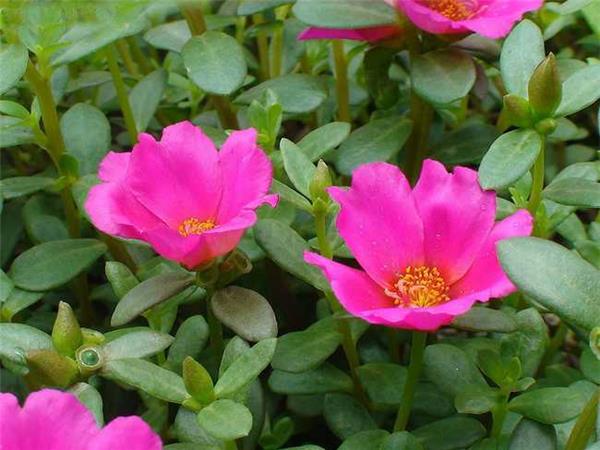
III. How to Grow Portulaca grandiflora
Environment: It prefers a warm, dry environment with ample light, is drought-tolerant, dislikes waterlogging, and is highly adaptable.
Planting: Cuttage propagation is the main method. After cutting off the branches, place them in a shaded environment for 1 day, then insert them directly into plain sand the next day; after watering, they will root in a warm environment, and rooting is easy.
Temperature: It prefers warmth, and the suitable growing temperature is 20-30°C. It is not cold-tolerant, and the minimum temperature should not be lower than 8°.
Light: It is sensitive to light and is a strongly sun-loving flower. It is not shade-tolerant, and throughout the growing period it needs ample light for the plant to grow and bloom normally. During hot summer weather, which is exactly the peak period for plant growth and flowering, sufficient sunlight is also needed for the plant to bloom abundantly and for the flower colors to be vivid.
Watering: Because the succulent stems and leaves can store water, it has a relatively strong drought resistance and can still grow and bloom under relatively dry conditions. However, to enable the plant to grow and bloom well, appropriate water must also be supplied. It dislikes excessive moisture and standing water; when there is too much water, the stems and leaves are prone to excessive growth, and there may even be root rot and death.
Pests and diseases: It is affected by pests and diseases such as rust disease and hawk moths.
Courtyard pairing: Portulaca grandiflora has vivid flower colors and is easy to cultivate, so it is widely used in courtyards. It can be planted along grass edges and beside small paths, and can also be used as ground cover in south-facing yards. Grown as a hanging pot plant at a porch entrance, it is also an excellent material for roof greening.
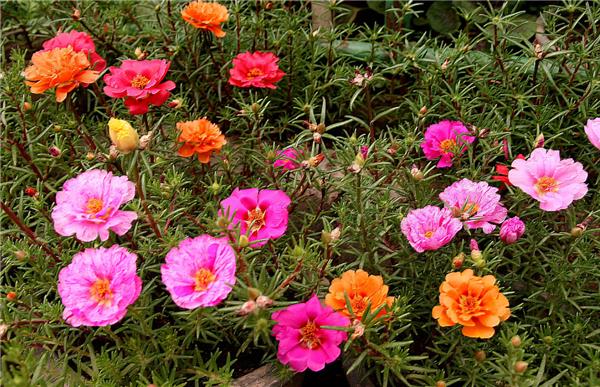
Portulaca grandiflora is a very good flower for beautifying and decorating. Its bright, moving flower colors and graceful, skillful flower posture make it a very good choice for decorating rooms and courtyards, so friends who are interested should hurry and grow a pot.