What to Do When a Clivia Loses Its Leaves? Teach You the Correct Care Methods
When care and management are improper, the plump, tender leaves of the clivia (Clivia miniata) will turn yellow and even wither. Some flower lovers ignore it and let it grow as it pleases, while others take relevant measures to correct it. But if the specific root cause is not found and treatment is blindly applied, the final result will be futile. So what should be done when a clivia has root rot? What should be done when the leaves of a clivia turn yellow and drop?
What should be done when the leaves of a clivia turn yellow and drop?
1. Shading: In summer, place the clivia under a shade canopy outdoors. It is most ideal if the direct sunlight can be blocked at noon while sunlight can still be received in the early morning and evening.
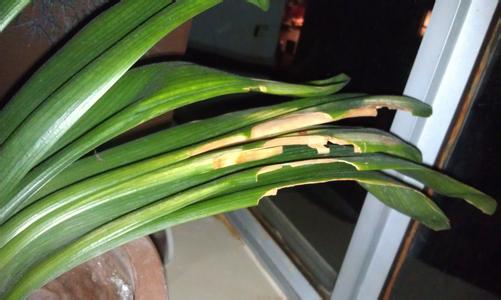
2. Cooling: Besides placing the clivia in a ventilated spot, also place the clivia pot on a water pool or water platform (with a wooden board underneath it), and frequently spray water around the placement area and on the plant's leaf surfaces, and spray the leaf surfaces with New High-Fat Film, which can prevent viral infection of the leaves and keep the branches and leaves lush and green.
3. Reducing fertilizer: When the temperature at the clivia's growing location is above 25°C, fertilizer should be appropriately reduced or stopped to avoid burning the fleshy roots from too much fertilizer. If a lot of fertilizer was applied in spring, in summer half of the potting soil can be replaced from the top. If the temperature can be lowered below 20°C, fertilizer can still be applied as usual.
4. Watering: Adhere to the principle of watering when half-dry, and watering thoroughly once you water. Never let water run into the leaf center, to avoid rotten heart disease and cause "beheading."
5. Pest prevention: If harmed by scale insects, use 1000--1500 times diluted dichlorvos solution + New High-Fat Film, and spray on the leaf surfaces.
What should be done when a clivia has root rot
If clivia seedlings turn yellow and the leaves have yellow spots, it may be root rot, and you can break the soil to check. If root rot is found in the clivia, rinse it clean with clear water, place it in a 1/1000 potassium permanganate solution (mixed to a light purple color) and soak for one hour, then take it out, rinse clean with clear water, and after drying in the shade, cut off the rotten root parts, then apply plant ash to the cut areas, plant into a new pot of soil, and place in a ventilated spot at 25°C. Be sure not to water too much. In about 30 days new roots will grow.
If new roots grow from the leaf axils of the bottom leaves, causing the leaves to turn yellow, this is normal metabolism and there is no need to worry too much.
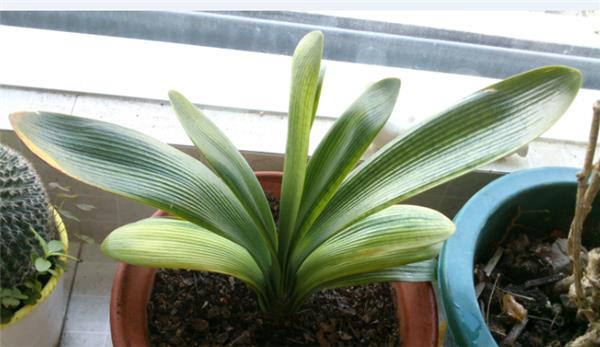
What should be done when clivia leaves turn yellow
1. Clivia leaves turn yellow, and the small leaves in the middle turn black and rot
Solution: When this symptom appears, you first need to use the above 9 methods to treat the root cause. If the small leaves in the middle turn black and rot, further judgment is needed. Pry apart two leaves to check. If the gap between the leaves is black and exuding decayed juice, it can be judged that the formed clivia flower scape did not have time to grow out from between the leaves and directly rotted in the middle of the leaves.
There are many causes of flower scape rot: one is that when the flower was in the owner's hands, too much water was sprayed, causing dirty water to flow into the gaps and cause bacterial infection leading to rot; another situation is that careless watering caused dirty water to splash into the gaps and thus cause rot. Consequences: Generally it will not affect the life of the orchid, but in high-temperature and high-humidity weather, it can easily cause the head to be cut off and the whole plant to rot. Treatment method: Use toilet paper or tissue paper to absorb the decayed juice, use a suitable method to remove the filth that can be cleaned, and usually keep the environment relatively dry. It is recommended to use the soak-pot watering method.
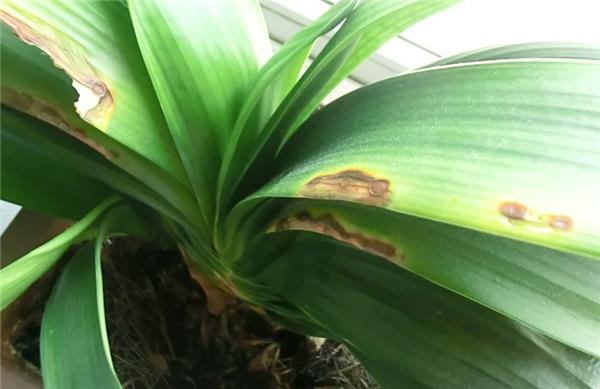
2. All leaves of the clivia turn yellow
Solution: Turning completely yellow is often a symptom of sunburn. Solution: Shade immediately, and cut off the yellow leaves.
3. Clivia leaves wither, yellow, and droop
Solution: Withered, yellow, or drooping leaves are a symptom of water shortage. Watering should follow the principle of not watering when not dry, and no water accumulation in the pot.
4. Part of a clivia leaf turns yellow
Solution: Local yellowing is very likely caused by fire scorching, cold wind, hot water, or acid-base erosion. Simply eliminate the external cause in time. Sometimes, insufficient nitrogen fertilizer may cause the plant to suffer from chlorosis. The reduction of chlorophyll leads to yellowing of the leaves. In this case, apply more fermented cake fertilizer water. (The methods of cultivation also differ with the seasons.)
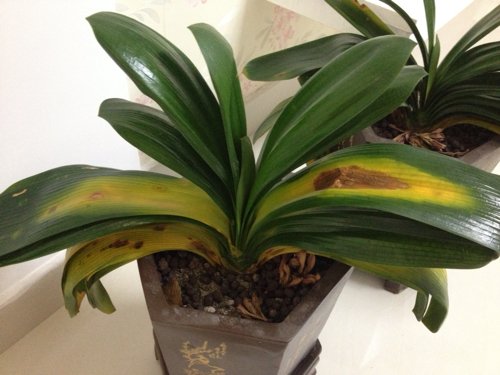
5. Clivia leaves wrinkle and develop yellow spots
Solution: Excessive fertilization causes root burn. Immediately change the soil, and use a 0.1% potassium permanganate aqueous solution to soak the roots for 20-30 minutes, then rinse with clear water, and after drying, cut off the rotten roots, apply plant ash to the wounds, and replant;
6. The two outer leaves of the clivia turn yellow (grown for 4 years)
Solution: This is normal metabolism, and you only need to trim off the 2 outer leaves.
7. Clivia leaves appear grayish-yellow
Solution: The main cause of grayish-yellow clivia leaves is excessive direct sunlight, and the clivia needs to be shaded
Solution: This is normal metabolism, and you only need to trim off the 2 outer leaves.
7. Clivia leaves appear grayish-yellow
Solution: The main cause of grayish-yellow clivia leaves is excessive direct sunlight, and the clivia needs to be shaded