Is Lithops toxic? This is how to grow Lithops well
Lithops plants are small and often used in bonsai and floral arrangements, so is Lithops toxic? This question troubles many flower lovers; many flower lovers like Lithops, but are afraid that Lithops is toxic and do not dare to grow it at home. So is Lithops really toxic? Below we will tell everyone whether Lithops is really toxic.
Is Lithops toxic?
I can tell you for certain that Lithops is not toxic, because I tried eating it; not only is it non-toxic, it also has no taste at all, it just contains a lot of water. As long as the planting medium has an appropriate moisture level, relatively fresh Lithops seeds will germinate within a week after being sown, while overly old seeds have a fairly low germination rate. As for how long it takes to grow up and how long until it blooms, that depends on your level of care; expert Lithops growers have had plants bloom within two years.
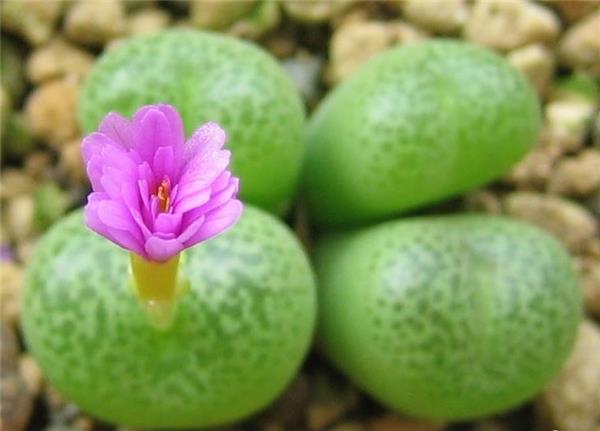
Photosynthesis of Lithops
At night, CO2 from the atmosphere enters the cytoplasm through the stomata, is catalyzed by phosphoenolpyruvate (PEP) carboxylase, combines with PEP to form oxaloacetate, and is then reduced to malate by the action of malate dehydrogenase and stored in the vacuole, where its concentration can reach 100 millimoles per liter. The entry of malate from the cytoplasm into the vacuole through the tonoplast is an active process, while its return from the vacuole to the cytoplasm is a passive process. During the day, after malate is released from the vacuole, it undergoes decarboxylation to form CO2 and C3 compounds (see C4 plants). Two decarboxylases can catalyze this reaction. In some plants, NADP (coenzyme II)- or NAD (coenzyme I)-malic enzyme catalyzes oxidative decarboxylation, forming CO2 and pyruvate; in other plants, PEP carboxykinase catalyzes the formation of oxaloacetate, which is decarboxylated to produce CO2 and PEP. After CO2 is produced, it is re-fixed through the photosynthetic carbon cycle and ultimately forms sugars such as starch. Under weak light, especially when the temperature is high, a portion of the CO2 will be released into the atmosphere.
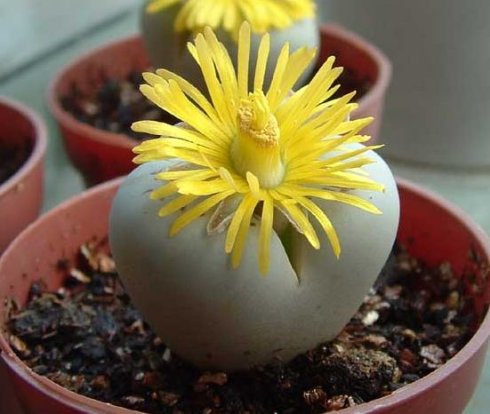
How to grow Lithops
Lithops prefers a climate that is warm in winter and cool in summer, and likes a warm, dry environment with plenty of sunlight. It is afraid of low temperatures and avoids strong light. It likes ample sunlight, and the suitable growing temperature is 10-30°C. It is best grown in loose, neutral sandy loam. Remember to reduce watering appropriately in winter and summer to help with molting.
It likes sunlight, and the suitable growing temperature is 20°C-24°C. In spring and autumn, it is best placed on a south-facing balcony or windowsill for growing, as this is its peak growing period; at this time it is best to water once every 3-5 days to encourage growth and flowering. The growth pattern of Lithops is that it begins growing between March and April, pauses growth in the hot season, enters a summer dormancy period, then continues growing and blooms after the autumn cools, and after the flowers fade it enters the overwintering period.
Lithops is native to the extremely arid, rain-scarce desert gravel areas of Cape Province, South Africa, with annual rainfall below 250mm, an average winter temperature of 10°C, and summer temperatures of 20-25°C. It goes dormant in the dry season, and the body gradually shrinks and buries itself in the soil, leaving only the top surface exposed above the ground to resemble gravel. This kind of "mimicry" has the effect of preventing birds and animals from eating it.
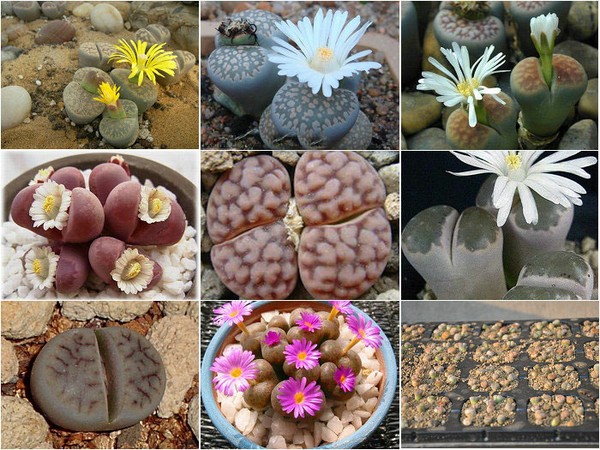
In order to adapt to the environment, it evolved from a dicotyledonous plant into a succulent, typical bulbous-leaf plant, surviving on the little water it can get by storing it in the water-storage tissue within the cortex. Its top surface is called the "window." Inside the window there is chlorophyll for photosynthesis. The top is slightly flat, with a slit in the middle, and plants 3-4 years old produce yellow, white, or pink flowers from this slit in autumn.
Lithops goes dormant or semi-dormant during the high temperatures of summer, and should be slightly shaded with watering restricted.
Lithops is native to the arid regions of southern Africa and southwestern Africa, in rock crevices or gravelly soil. During the dry season the plant shrinks and becomes buried in the gravelly sandy soil, or only its top surface is exposed, with light entering the body only through the light-transmitting top surface (the window). When the rainy season arrives, it quickly restores its original shape and grows larger. Therefore, if it is not growing and flowering during the rainy season, Lithops in the gravel of its native habitat is very hard to find. This is a self-protective instinct it developed to prevent small animals from preying on it, called "mimicry" (mimicrp). The genus name Lithops is composed of the Greek words Lithos (stone) and ops (appearance). Its earliest Chinese name was "Shiguan" (see Yang's Horticultural Name Dictionary), and the currently commonly used Chinese name in China is "Shengshihua" (Lithops).
Lithops likes sunlight, and the suitable growing temperature is 20°C-24°C. In spring and autumn, it is best placed on a south-facing balcony or windowsill for growing, as this is its peak growing period; at this time it is best to water once every 3-5 days to encourage growth and flowering. The growth pattern of Lithops is that it begins growing between March and April, pauses growth in the hot season, enters a summer dormancy period, then continues growing and blooms after the autumn cools, and after the flowers fade it enters the overwintering period. It naturally likes sunlight and tolerates high temperatures, but requires good ventilation, otherwise the roots rot easily. It dislikes waterlogging. In winter the temperature must be kept at 8-10°C.
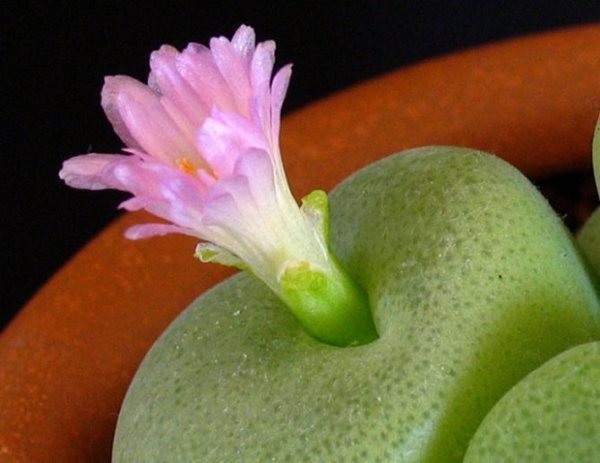
Native to the extremely arid, rain-scarce desert gravel areas of Cape Province, South Africa, with annual rainfall below 250mm, an average winter temperature of 10°C, and summer temperatures of 20-25°C. It goes dormant in the dry season, and the body gradually shrinks and buries itself in the soil, leaving only the top surface exposed above the ground to resemble gravel. This kind of "mimicry" has the effect of preventing birds and animals from eating it. In order to adapt to the environment, it evolved from a dicotyledonous plant into a succulent, typical bulbous-leaf plant, surviving on the little water it can get by storing it in the water-storage tissue within the cortex. Its top surface is called the "window." Inside the window there is chlorophyll for photosynthesis. The top is slightly flat, with a slit in the middle, and plants 3-4 years old produce yellow, white, or pink flowers from this slit in autumn.
In the wild, Lithops only blooms and grows after the rainy season begins. Under cultivation, most varieties can begin resuming watering in early to mid-August. Often an effective level of soil moisture can prompt Lithops to enter its growth phase. Because Lithops has a taproot, a thorough watering in autumn is more beneficial than a light watering. It is very important to let the soil dry out between waterings: when you water again, the soil must not still be moist. The soil needs to be a type that drains well and dries quickly. Soil that is not breathable will cause the plant to rot. After the flowering period, watering should be regularly reduced, and by late September watering should be stopped so the soil dries out in preparation for the arrival of harsh winter.
Wild Lithops resumes growth according to rainfall, and under cultivation watering can be gradually started in late August. The obvious sign is that it is about to bloom. At the same time its new leaves begin to form. Watering during this period should go from small amounts to large amounts, with thorough watering, and the soil must be kept completely dry once between two waterings.
In winter, Lithops is still growing, and the new body will gradually grow to a certain size while the outer old leaves shrivel. No matter how wrinkled the plant is, no water is needed in winter, and the soil should be kept dry. In fact, the new leaves absorb water and nutrients from the old leaves, so do not cut off the old leaves.
The new leaves of Lithops absorb the water and nutrients stored in the old leaves until the old leaves become a papery shell. This papery shell can be easily removed. At this point the plant enters its spring growth, and it can safely be watered again to promote plant growth. At the beginning, water only a little, then gradually increase it, and by mid-spring you can water thoroughly. Of course, make sure the soil is dry between two waterings. When the hot summer arrives, the amount of water needs to be reduced in preparation for the plant's summer dormancy.