Are the flowers of the Christmas cactus poisonous? Read this and you will understand
Recently I have heard many netizens discussing whether it is true that the Christmas cactus is poisonous? So can the Christmas cactus be kept in the bedroom? What are the uses of the Christmas cactus? Are the flowers of the Christmas cactus poisonous?
Are the flowers of the Christmas cactus poisonous
First of all, let me tell you that the Christmas cactus is not poisonous, and it can be kept indoors without any problem, because the Christmas cactus is a succulent-type plant and can absorb some harmful substances from the indoor air, so you can care for it with peace of mind.
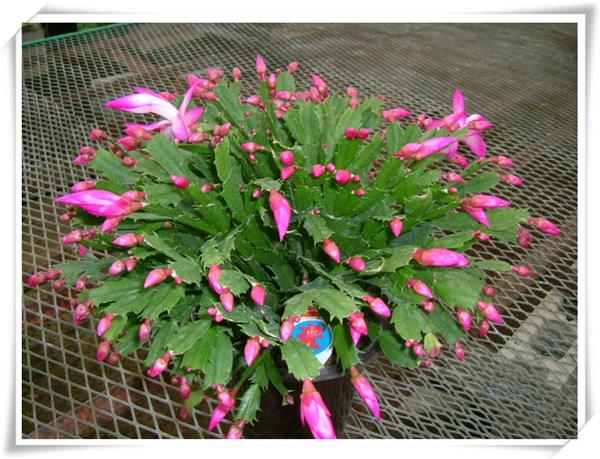
Christmas cactus varieties include bright red, pink, apricot yellow, and pure white. Because the joints connecting its segments are shaped like a crab's claws, it is named the Christmas cactus. The stem segments often become pendulous because they grow too long, so it is also often made into a hanging plant for decoration. It can be placed in the bedroom.
Uses of the Christmas cactus: it has the effect of detoxifying and reducing swelling, and is mainly used for: sores and swellings; mumps. Nature and flavor: bitter; cold in nature, entering the spleen and stomach meridians. The Christmas cactus blooms right around Christmas and New Year's Day, with a trailing plant shape and bright, lovely flowers, suitable for decorating windowsills, entranceways, and exhibition halls, making them lively and instantly brightening the whole room. However, due to cultivation methods, some Christmas cacti are regulated to bloom in October.
Plant morphology of the Christmas cactus: a succulent plant, often shrub-like, much branched. The flower stems are woody, somewhat cylindrical, and the young branches and branches are flat; the stem segments are short, oblong or somewhat ovate, 3-6cm long, 1.5-2.5cm wide, bright green, more or less tinged with purple when young or in winter, with a truncate apex, each side having 2-4 thick and somewhat inward-curving teeth, and both surfaces having a thick midrib. No leaves. The flowers are borne at the tips of the young stem segments, rose red, bilaterally symmetrical, 6-9cm long; the calyx is in 1 whorl, fused at the base into a short tube, with teeth at the apex; the petals are in several layers, the lower part forming a long tube, the further inward the longer the tube, the upper part separate, reflexed outward or curved backward; the stamens are numerous, in 2 whorls, curving upward; the style is longer than the stamens, deep red, with the stigma 6-9-lobed; the ovary is pear-shaped or broadly ovate. The berry is red, about 1cm in diameter.
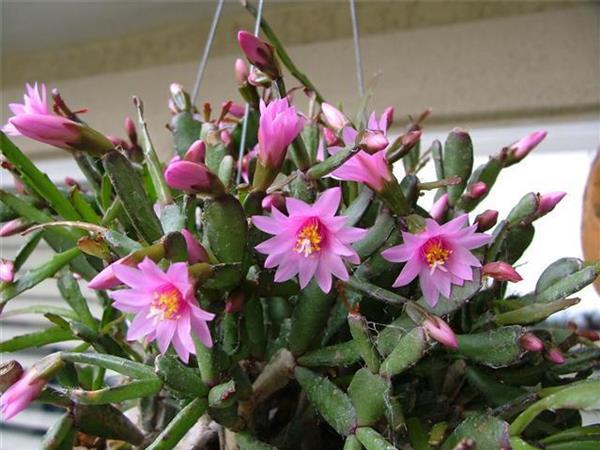
The Christmas cactus's influence on the home environment
The Christmas cactus, as its name suggests, is a very lovable plant. Even when it is not blooming it has a distinctive charm. The stems of the Christmas cactus are flat and leaf-like, thick and juicy, and look completely jade-green and ready to drip, with flowers borne at the tips of the stems and the flower parts opening and curling back. At the tips of the green stems grow red, or yellow, or light purple, or orange or pink flowers, looking delicate and uniquely distinctive.
The Christmas cactus has many cultivated varieties. Common ones include the white-flowered Christmas White, Dosse, Gena, and Snowflake, and the yellow Golden Charm, Christmas Flame, Golden Fantasy, and so on. The Christmas cactus can effectively absorb carbon dioxide from the air and can purify the air very well. The flowering period of the Christmas cactus runs from September to April of the following year, and the bright, gorgeous Christmas cactus brings people the breath of spring. Whether on days spent waiting for the flowers to bloom or on days bathed in the faint fragrance of the flowers, it can make people feel joyful. Especially since the Christmas cactus blooms right around the festive and lively holidays of Christmas and New Year's Day, with a trailing plant shape and bright, lovely flowers in various colors such as bright red, pink, apricot yellow, and pure white, hanging it in midair on windowsills, at entranceways, and in exhibition halls as decoration will make things look extraordinarily lively and instantly brighten the whole room. If improved or artificially controlled, some Christmas cacti can be regulated to bloom in October. The flowers are delicate and graceful, radiant and elegant, bright and moving, and are especially loved and praised by people.
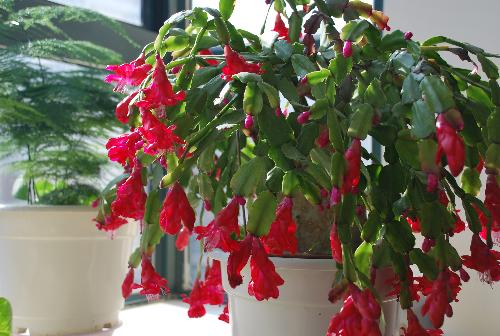
The Christmas cactus is best propagated by grafting, preferably carried out in May-June or September-October. It is best to choose a cold-resistant and robustly growing cactus as the rootstock, and select two healthy, thick modified stem segments as the scion, cutting the lower end into a duckbill shape and using the splice-grafting method; each rootstock plant can take 3 scions. After grafting, place it in a cool, shady spot. If after 10 days the scion is still fresh and upright, it has successfully taken. In the process of caring for its growth, you will unintentionally gain a lot of unexpected pleasure.
Place a pot of Christmas cactus in your room, and you will cannot help but marvel at why such a potted flower can give you so many unexpected experiences and feelings.
How to grow the Christmas cactus
First, watering. The Christmas cactus is not tolerant of waterlogging. If watered too much, it is very easy for the roots to rot, so there must be no standing water. Water only after the potting soil has dried. For example, in winter, watering once a week is enough. In addition, it is not advisable to spray water directly on the leaves.
Second, sunlight. The Christmas cactus likes light and is also quite shade-tolerant, and it does not have high light requirements. Indoor light is enough to keep it growing normally. In summer, be sure to prevent it from being exposed to direct sunlight, otherwise it will be greatly damaged. In other seasons, as long as it is placed in a bright spot such as near a window, it can grow very well. After flowering, place it in a cool, shady spot to extend the flower-viewing period.
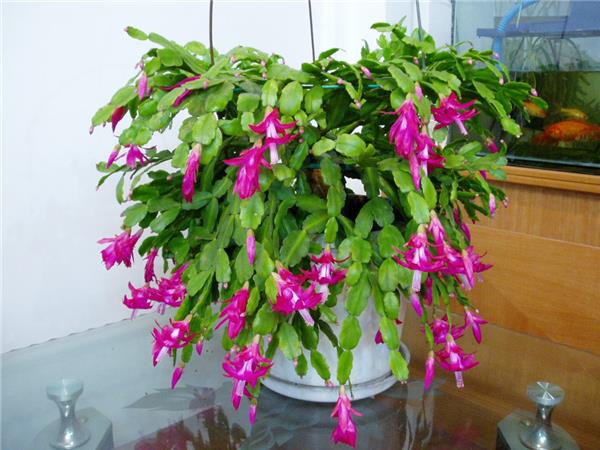
How to graft the Christmas cactus
(1) Select a one-year-old cactus branch that is strip-shaped, not too thick and fleshy but growing vigorously, and free of pests and diseases, as the rootstock, with a length between 8 and 12cm. Remove it from the mother plant, cut the lower end into a flat opening, insert it into sandy loam, and cultivate it for 2 to 3 months. Once it has taken, it can be used as a grafting rootstock.
(2) Select a healthy mother Christmas cactus plant, and from it choose a relatively tender top branch of the current year that has joints as the scion, with a length of 3 to 4cm (if the scion is too long, its growth vigor after sprouting will be weaker). Use a blade sterilized with alcohol to cut both sides of the lower part of the scion into a wedge shape, with the cut length about 0.8 to 1.2cm.