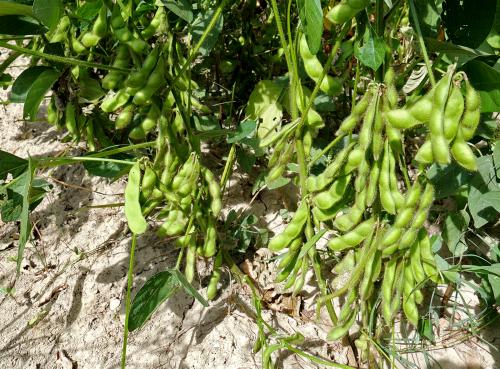
Plant Characteristics of the New Green Manure Soybean Variety Tainan No. 4
The new green manure soybean variety Tainan No. 4 was selected by the Tainan District Agricultural Improvement Station through single-plant selection from the green-seeded local soybean landrace. It has the characteristics of small seeds, rapid growth, high fresh herbage yield and high nutrient content, and a long covering period. It is suitable for green manure cultivation in spring and summer crops and for seed production in autumn crops. In December of Republic of China year 88, it was approved for promotion by the Crop New Variety Registration and Naming Review Panel convened by the Council of Agriculture, Executive Yuan.
After the implementation of the Paddy and Upland Field Utilization Adjustment Program, providing farmers with long-term diversified green manure crop options has become an important current task. In particular, the area of fallow land planted with green manure has greatly increased, surpassing 100,000 hectares by year 90. At present, only one green manure crop, sesbania, is promoted on such a large area of fallow fields, and all of its seeds must be imported from abroad, which not only increases foreign exchange expenditure but also makes pest and disease problems more likely. In addition, sesbania green manure is suitable only for short-term cultivation; it must be incorporated 50-60 days after planting to avoid lignification of the plants, which would make mechanical incorporation unsuitable. As a result, a single fallow period of 4-4.5 months requires two consecutive plantings of sesbania to achieve the green manure application and long-term covering effect, relatively increasing the burden on farmers cultivating green manure. In response to this, in the first crop of year 89, Xuejia Township replaced its original sesbania green manure with green manure soybean Tainan No. 4, with a period from planting to incorporation of up to 150 days, solving the problem of needing to plant green manure twice in a single-crop fallow field. After the development of this variety, it not only provides an excellent variety for green manure cultivation in both the first and second crops domestically, but also, together with local seed production, expands land use and alleviates part of the problem of converting miscellaneous grain crops. Tainan No. 4 is a variety developed through conventional breeding, not a genetically modified crop. In terms of uses, besides green manure, it can be processed into healthy foods such as bean sprouts, tofu, and soy milk.
Characteristics of the New Variety
I. Agronomic Characteristics
1. Growth habit: Germination occurs about 3-7 days after sowing. The flowering period is about 70-80 days in spring crops, 55-63 days in summer crops, and about 38-48 days in autumn crops. The number of growing days is 150-160 days in spring crops, 125-135 days in summer crops, and 94-104 days in autumn crops. The plant is sensitive to light; under long days the stems and leaves grow densely, making it suitable for green manure cultivation, while under short days it tends to flower and set seed, making it suitable for seed production.
2. Maturity: A late-maturing variety, with uniform and consistent maturity; leaf drop at maturity is good.
3. Suitable planting periods
(1) Green manure cultivation: For green manure cultivation in the first and second crops of paddy and upland field utilization, the sowing period runs from early February to August.
(2) Seed production: In the Tainan area, from mid-August to late September, with mid-September being the best sowing period.
4. Incorporation period: For spring green manure cultivation, the suitable incorporation period is 80-160 days after sowing, while for summer crops it is 80-135 days after sowing.
5. Disease resistance: Without inoculation with pathogens and without pesticide control, this variety showed no purple seed stain disease, and its infection rates for downy mildew and rust were lower than those of Kaohsiung Selection No. 10.
6. Insect resistance: Although the incidence of stem leafminer is high, its impact on fresh herbage yield is limited; the proportion of area damaged by other pests is lower than that of Kaohsiung Selection No. 10.
7. Adapted soils: Not demanding in soil selection; sandy loam or loam is most suitable, and the best soil pH is 6.0 to 7.0.
8. Yield(1) Green manure fresh herbage yield: At 80 days of growth, the fresh herbage yield is 21,000-37,000 kg per hectare in spring crops and 20,000-36,000 kg per hectare in summer crops; the total nitrogen content of the plant body is 113-251 kg per hectare, phosphorus pentoxide 20-36 kg, and potassium oxide 122-245 kg.
(2) Seed yield: The manually harvested yield in autumn crops is 2,200-2,800 kg per hectare.
II. Plant Characteristics
1. Plant: The plant height is 60-107 cm in spring crops, 70-108 cm in summer crops, and about 39-75 cm in autumn crops; the number of branches is about 3-7, and the number of nodes on the main stem is 17-20.
2. Seedling: The young stem is purple.
3. Stem: The mature stem is green.
4. Leaf: Trifoliolate; the leaflets are ovate, and the leaf color is emerald green.
5. Flower: Purple.
6. Pod: The pod shape is sickle-like, yellowish brown, covered with brown pubescence, with 2-3 seeds per pod.
7. Seed: Elliptical; the seed coat is yellow-green, the cotyledons are yellow, and the hilum is brown; the 100-seed weight is 6-10 g.