How to Grow Dieffenbachia: Tips from Experienced Growers
Dieffenbachia can be placed on windowsills or tabletops for viewing, or set in a living room corner or beside a sofa as a decoration, comfortable and elegant, filling the room with vitality. Let's take a look at how to grow Dieffenbachia:
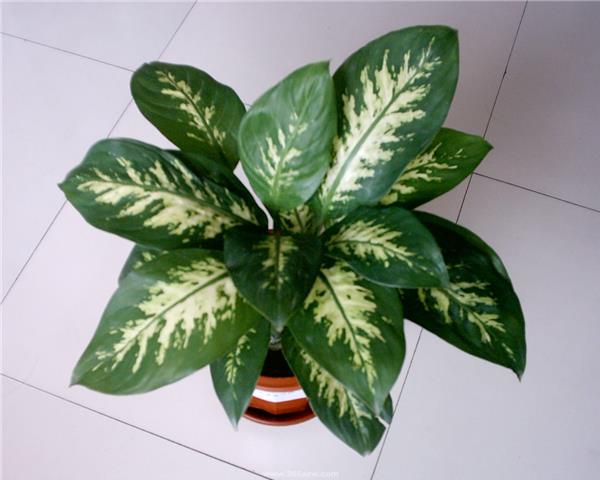
Basic information about Dieffenbachia:
Dieffenbachia (scientific name: Dieffenbachia picta Lodd.), also known as dumb cane, is a plant in the genus Dieffenbachia of the family Araceae. This genus has about 30 native species, mainly distributed in tropical America. It was introduced to the UK in the 1860s and quickly spread throughout Europe, the Americas, and Oceania. It is widely cultivated around the world, with many cultivated varieties, and has entered thousands of households.
Dieffenbachia is an evergreen shrub-like herb with thick, fleshy stems, and the plant can reach a height of 1.5 m. The leaves are large and glossy, borne on the upper part of the stem, elliptical-ovate or broadly lanceolate, with acuminate tips and entire margins, 20-50 cm long and 5-15 cm wide; the broad leaves are dark green on both sides, inlaid with dense, irregular spots, markings, or patches in varying colors such as white, milky white, and pale yellow; the leaf sheath has a petiole below the middle. The peduncle emerges from the leaf axil and is shorter than the petiole; the flowers are unisexual, in a spadix inflorescence, with an elliptical spathe that is tubular at the lower part. Its [5] horticultural varieties are numerous, and different varieties have different patterns on the leaves.
How to grow Dieffenbachia:
1. Soil: The ideal cultivation soil for Dieffenbachia is fertile, loose, well-drained loam rich in organic matter. For potting soil, use a mix of leaf mold and coarse sand, for example, mix 2 parts leaf mold, 1 part sawdust or peat, and 1 part sand.
2. Watering: Dieffenbachia likes moisture and fears dryness. The potting soil should be kept moist. During the growing season, water thoroughly, spray water around it, and mist the plant. If it is not misted for a long time, the leaf surface becomes rough and loses its luster. Soil moisture is best kept alternating between dry and wet. Water more in summer, and control watering in winter; otherwise, if the potting soil is too wet, the roots easily rot and the leaves turn yellow and wither.
3. Sunlight: Dieffenbachia tolerates shade and fears strong sun. If the light is too strong, the leaf surface becomes rough, and the leaf margins and tips easily scorch, or even suffer large-area sunburn. If the light is too weak, the yellow-white patches turn green or fade. It grows best under bright, indirect light, and the leaf color is brighter and more beautiful.
4. Temperature: The suitable growth temperature for Dieffenbachia is 25-30°C. The effect is good when the daytime temperature is 30°C and the nighttime temperature is 25°C. The possible growth range is 18-30°C from February to September, and 13-18°C from September to February of the following year. Because it is very intolerant of cold, it must be moved into a greenhouse in mid-October. If the winter temperature is below 10°C, the leaves are prone to cold damage.
5. Fertilizing: June to September is the vigorous growth period for Dieffenbachia. Apply cake fertilizer water once every 10 days. After early autumn, apply phosphorus and potassium fertilizer 2 more times. From spring to autumn, applying nitrogen fertilizer once every 1-2 months can promote a glossier leaf color. If the room temperature is below 15°C, stop fertilizing.
6. Pests and diseases: Dieffenbachia is mainly harmed by bacterial leaf spot, brown spot, and anthracnose, and can be sprayed with a 500-fold dilution of 50% carbendazim wettable powder. Sometimes root rot and stem rot occur; in addition to paying attention to ventilation and reducing humidity, a 800-fold dilution of 75% chlorothalonil wettable powder can be sprayed for prevention and control.
Dieffenbachia leaves are lushly green, elegant, and beautiful. It is a relatively refined indoor foliage plant. Many people like to place it in the home living room, study, and other places, and it can give people a quiet and comfortable feeling. The methods for growing Dieffenbachia have all been introduced to everyone. I believe everyone can also grow a beautiful Dieffenbachia to decorate the home.