How to grow string of pearls? Growing it well can add color to your home
String of pearls is a variety of spider plant, and because of its particularly attractive appearance, many people grow some string of pearls at home. But how do you grow string of pearls? People who have never grown this plant before will surely be puzzled, so let's take a look at the related knowledge introduced below.
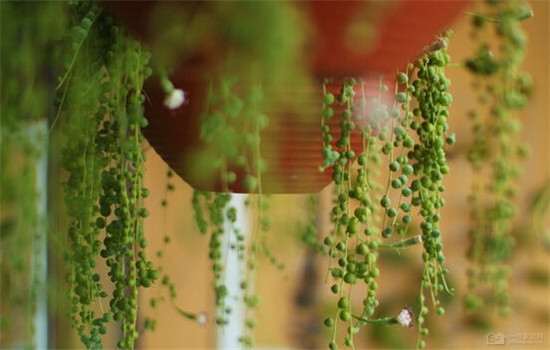
String of pearls likes a warm and humid environment and should not be exposed to direct sunlight. Water it once every 2 or 3 days. You can also use diluted leftover milk mixed with water, or water it with rice-washing water. Because the leaves are fleshy and juicy, string of pearls is very drought-tolerant. When watering during cultivation, it is better to keep it dry than wet, and this is one of the keys to success. When the weather is dry, you can spray more water on the leaves and vines to make up for the lack of moisture and keep the beads green and plump. Spider plants like a semi-shady environment. If the placement site has too strong or too little light, the leaves will easily turn light green or yellow-green, lose their vitality, lose their proper ornamental value, and even wither and die. If there is direct sunlight and dry air, it is most likely to cause the spider plant to scorch, so it should be placed in a cool and ventilated place, and care should be taken to maintain environmental humidity. That is, exposure to the sun may burn the beads, while too weak light will result in poor growth.
String of pearls has a very shallow root system and can be planted in a shallow pot. Generally, a tile is used to cover the bottom hole, and a layer of cinder or coarse sand is spread on top to increase air permeability and drainage (especially when using the commonly seen plastic pots for planting). For the soil, it is best to use leaf mold (mix fallen leaves from trees in autumn and winter with a certain amount of broken soil and a certain amount of sand; the ratio of soil to sand is about 1:3.
String of pearls likes warmth and humidity, is relatively cold-tolerant (when cultivated in the Jianghuai region it can tolerate a low temperature of 0°C), and is heat-tolerant. The most suitable temperature is about 20°C~28°C. Growth is slow under both high and low temperatures, and it almost goes dormant in a high-temperature environment above 30°C, so watering and fertilizing should be reduced, otherwise the roots are prone to rot -- this is also one of the keys to successful cultivation.
In spring and autumn, when growth is vigorous, fertilizer should be applied "thinly and frequently." Spraying 1-3‰ nitrogen fertilizer and potassium dihydrogen phosphate on the leaf surface often helps make the beads greener and plumper and improves their ornamental value.
There are rarely diseases and pests. Aphids in spring are one of them; remove them promptly or spray 1500 times omethoate to kill them. Mites in summer and autumn are the next; 1000 times dicofol is needed to kill them. Pay attention to ventilation and increase leaf surface humidity to reduce mite infection.
Note that string of pearls likes soil rich in organic matter, loose and fertile. It grows best in a warm environment with relatively high air humidity and strong scattered light. In summer, avoid high temperature and high humidity, otherwise the stems are very likely to rot and the plant will die. Potted plants can be placed in a rainproof and shaded area for cultivation. After autumn, the plant resumes growth, so light should be increased and liquid fertilizer applied as a top dressing.
How do you grow string of pearls? Through the introduction in the article, everyone now has a better understanding of growing string of pearls. It is suggested that if people want to grow string of pearls in daily life, they must be able to meet its corresponding growth conditions, and they also need to take care of it carefully so that string of pearls can grow better.