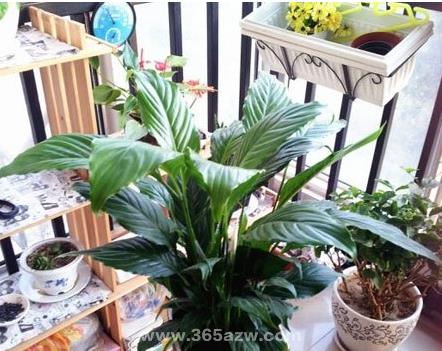
Why doesn't a peace lily bloom?
Many flower lovers don't know why a peace lily (Spathiphyllum) doesn't bloom, because the peace lily is originally a foliage plant, but some flower lovers are very eager to make their peace lily bloom. This article briefly discusses the problem of a peace lily not blooming.
If you want a peace lily to bloom, the first thing to consider is the lighting. Although the peace lily is very shade-tolerant, if it stays in a very dark place for a long time, it is very difficult for it to bloom. However, it should not be placed in the blazing sun either; bright indirect light is the most suitable. In addition, a certain amount of fertilizer must be ensured; if the potting soil is too poor, it is also not conducive to blooming. In winter, it is best to provide sufficient light conditions, which not only helps the leaves stay dark green but also helps the plant overwinter.
There is an induction method circulating online to make a peace lily bloom. The method is to spray gibberellic acid to artificially induce the plant to bloom, and different varieties bloom at different times. Small varieties respond faster to gibberellic acid and can bloom 7-9 weeks after spraying, medium varieties need 10-11 weeks, and large varieties need 12-13 weeks. It should be noted that too high a concentration of gibberellic acid will cause the plant's flowers to become deformed, so generally a dilution of between 1000 and 1500 times is sufficient. This method has not been tested, but this method makes me think of a problem: if the peace lily a flower lover buys has been induced to bloom, then after the first flowering period, must it be induced again in order to bloom? Therefore, it cannot be ruled out that the peace lily in some flower lovers' homes does not bloom because it was induced with gibberellic acid by the seller, so it is very difficult to bloom later.