How to care for the umbrella tree? A gardening expert teaches you the growing methods
The umbrella tree is an indoor plant, and many people buy it to place in the living room or bedroom as decoration, but many people do not know much about growing the umbrella tree, so what are the growing methods for the umbrella tree? Below, the editor introduces them to you, let's take a look together.
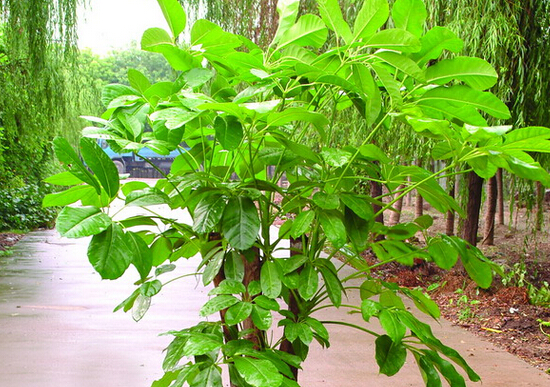
What are the growing methods for the umbrella tree?
The umbrella tree has upright stems and few branches; young branches are green, later turning brown and smooth. Green. Glossy, with the leaf undersides pale green. The leaf stalks are reddish-brown, 5-10 cm long. The growing methods for the umbrella tree are very simple. The umbrella tree can be propagated by sowing and by cuttings. When sowing, it is best to sow the seeds immediately after collecting them, as this gives a high germination rate. Cuttings can be taken in spring, summer and autumn; generally, cutting is combined with shaping: cut the branches of a plant with an irregular shape at 10-15 cm from the soil surface of the pot, so that the mother stem sprouts several branches and a good tree shape is developed. Insert the semi-lignified branches that were cut off into a cutting bed of river sand or perlite, keep a certain substrate humidity and air humidity, and pay attention to shading.
For potted umbrella trees, a mixture of garden soil and leaf mold can be used as the substrate. In summer, avoid direct sunlight and pay attention to proper shading, so that the leaves do not lose their gloss or get scorched and turn yellow from the burning sun. Indoor displays should be placed in a spot with some diffused light, and attention should be paid to ventilation. In late autumn and winter, reduce the amount of watering and control the amount of fertilizer; under conditions of high temperature and high humidity in greenhouses and indoors with poor ventilation, anthracnose or damage from scale insects and red spider mites can occur, so observe carefully and control them promptly.
Temperature: the most suitable temperature for growth is 20-30°C, and high summer temperatures are beneficial to plant growth. It is not cold-tolerant, and low temperatures easily cause leaf drop, or even leave only bare stems. In winter it is best to maintain 18-20°C, and the overwintering temperature should not be lower than 5°C.
Light: avoid exposure to the burning sun; from May to September, when sunlight is strong, shade appropriately and block out 30%-40% of the light, otherwise the leaves will lose their proper gloss and even be scorched and turn yellow. In particular, do not suddenly move a plant placed in a shady spot to a place with strong light, so as to avoid the leaves being scorched and their edges burning. At other times, give plenty of sunlight.
Watering: during the growth period, water generously and keep the potting soil moist, especially in summer when growth is vigorous and water must be replenished in time to promote plant growth. But also avoid over-wetness, otherwise the leaves droop and lose their gloss, the leaves fall off, and the whole plant may even die from root rot. Watering during the growing season should follow the rule of "do not water until dry, and when you water, water thoroughly". In winter, control watering and keep the potting soil on the dry side.
Fertilizing: during the growth period, apply a nitrogen-based fertilizer 1-2 times a month to promote the growth of branches and leaves and make the leaves large and glossy. After the beginning of autumn, stop applying nitrogen fertilizer and apply only phosphorus and potassium fertilizer to improve the plant's cold resistance. Stop fertilizing in winter.
Pruning: when the seedlings are 15-20 cm tall, pinch out the growing tips to encourage branching. Because it rarely branches naturally, and as the lower old leaves gradually fall off, the lower part of the plant will become bare once it grows to a certain height, so every spring, in conjunction with repotting, pinch off the tops to encourage branching, control the height, and form a good plant shape.
Potting and repotting: when propagated seedlings have grown to a suitable size, they can be potted up in spring. For planting, pots with a diameter of 25-30 cm can be chosen, with 3-4 plants per pot. After that, repot once every 2-3 years. It likes loose, fertile, well-drained slightly acidic soil, and dislikes alkaline soil and heavy clay soil. The substrate can be prepared from materials such as leaf mold, peat soil, garden soil, wood shavings or plain sand.
The editor reminds you that if problems arise when growing the umbrella tree, you must not panic; first check online to see how to solve them, and be sure to treat them promptly. Also, it is best to do some preventive work.