Anthurium growing methods and precautions
Anthurium, also called flamingo flower, is a very common choice for home potted plants. It is small and easy to move, and its fiery red color gives people an auspicious feeling. Especially during Chinese New Year, many people choose potted anthuriums. So, how do you grow anthurium? What precautions should you take?
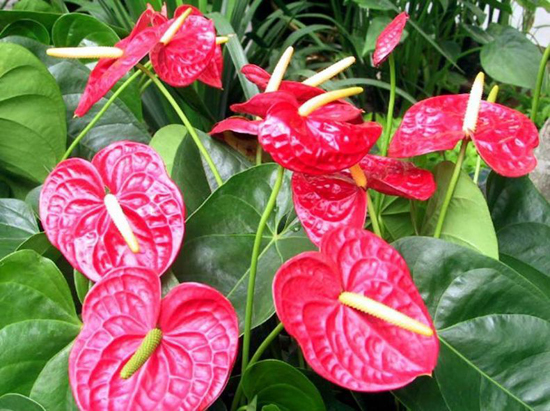
When we generally introduce how to grow a plant, we explain it according to its habits, that is, what kind of environment it is suitable for growing in. Below is a detailed introduction.
Anthurium is a flower variety that is relatively sensitive to salt, so the pH value of the substrate should be kept between 5.2-6.1 as much as possible, which is most suitable for anthurium growth. If the pH value is too low, the flower stems become shorter, which reduces its ornamental value. Tap water is suitable for planting anthurium, but it is expensive; natural rainwater is the best water source for anthurium cultivation.
Root fertilization of anthurium is much more effective than foliar topdressing. This is because the surface of anthurium leaves has a waxy layer that cannot absorb fertilizer well. Liquid fertilizer application should follow the principle of regular and quantitative application. In autumn, the cycle is generally 3-4 days. If the temperature is high, depending on the dryness and wetness of the substrate in the pot, fertilizer water can be applied once every 2-3 days; in summer, fertilizer water can be applied once every 2 days, and when the temperature is high, water can be applied one more time; in autumn, fertilizer water is generally applied once every 5-7 days. The fertilization time varies with the climate and environment. Under normal circumstances, apply it between 8 a.m. and before 5 p.m.; in winter or early spring, do it between 9 a.m. and before 4 p.m.
Anthurium grows in a cycle of "leaf to flower to leaf to flower." The inflorescence is formed in the axil of each leaf. This results in the same yield of flowers and leaves, and the most important factor in the difference in yield is light. If there is too little light, under the influence of photosynthesis, the plant also produces very few assimilates; when the light is too strong, some leaves of the plant will warm up, which may cause leaf discoloration, sunburn, or scorching.
Potted anthuriums sometimes show phenomena such as premature flower senescence, deformity, adhesion, fissures, vitrification, and blue spots. These are mostly physiological disorders caused by improper management of fertilization, potting soil, and air humidity, or by variety-related reasons. The way to prevent them is to improve cultivation management, fertilize reasonably, and provide appropriate ventilation.
In the introduction above, the editor specifically explained how to create an environment suitable for anthurium growth. It also mentioned some points we should pay attention to. Plants, unlike animals, grow in a fixed place, so we need to pay even more attention to helping it change its environment.