How to propagate a rubber plant? A brief introduction to propagation methods
The rubber plant has high ornamental value, is easy to grow and care for, and grows vigorously. So many friends may wonder whether they can propagate the rubber plant themselves through simple methods. So, what propagation methods does the rubber plant have? This article intends to briefly introduce rubber plant propagation methods.
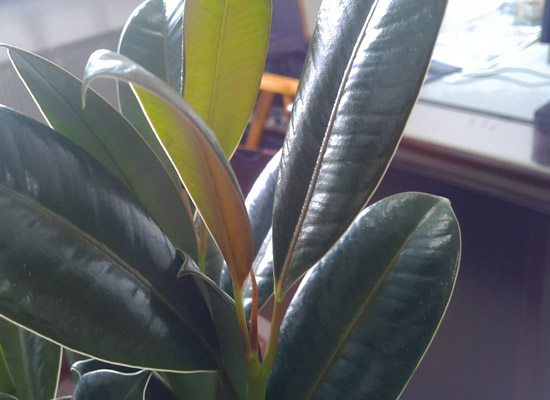
The rubber plant likes a hot and humid environment, so it grows faster in summer, and can grow one leaf in a week. Therefore, the best time to propagate the rubber plant is after mid-May, when the temperature is 25-30 degrees.
Combined with shaping the rubber plant, the following methods can be used for propagation.
1. Air layering method
Choose a robust one- or two-year-old branch, and at a smooth spot between nodes, girdle a ring of bark 1cm wide, then put a prepared cylindrical plastic bag over the area 1cm below the wound, tie it tightly, add potting soil, preferably a handful of soil, then tie the bag opening tightly, and keep the soil ball moist often. If the soil ball dries out, use a syringe to inject water from the top of the soil ball to replenish moisture. After 20 days, new roots can be seen. When the new roots have grown to a certain extent, cut the new plant off from the connection below the soil ball, remove the plastic bag, pot it up with the soil ball, and place it in a cool place for a week. If after girdling you use cotton dipped in clean water to wash away the flowing latex, then use medicated cotton dipped in 10% indoleacetic acid to smear the wound before wrapping it with soil, rooting can be 10-15 days earlier, and it can be cut from the tree and potted 20 days earlier, with a survival rate of 100%. This method is suitable for home propagation, is simple to operate, and forms quickly. The soil used for wrapping can be made by mixing 1 part sun-dried garden topsoil with 1 part fine sand and leaf mold.
2. Seedbed stem cutting method
In spring, when the temperature reaches a suitable level, first prepare the seedbed, then spread sifted potting soil over it, then choose one- or two-year-old branches, with three leaf nodes as one section, cut off the lower two leaves, tie them into small bundles, place them upright in 800-1000mg/L naphthaleneacetic acid or indoleacetic acid, soak for 0.5 hour, then insert them straight into the prepared seedbed. The insertion depth is half the length of the cutting. When inserting, first use a steel rod with a diameter of 6 to make holes in the seedbed, so as to avoid scraping the cut end of the cutting and separating the xylem from the phloem, which would cause the cutting to rot and die. This is also the key to the success of the stem cutting method. In addition, the row spacing of the plants in the seedbed should be appropriate and the seedbed soil should often be kept moist. If conditions permit, a small plastic arch tunnel can also be built over the seedbed to raise the ground temperature. With this method, large-scale propagation is possible, and seedlings can be produced and potted in 45 days.
3. Green stem water cutting method
When the temperature reaches 23-35 degrees, cut off a 10cm-long tip cutting of the rubber plant, remove the lower two or three leaves, and keep the upper ones (then place the branch in a bottle of 200-400mg/L indoleacetic acid solution to fix it, with the soaking depth half of the branch, changing the solution once every 3 days, and roots will form in 20-30 days. When the new roots have grown to a certain extent, pull it out and pot it up, then place it under a shade shed to recover. This method is both convenient and ornamental.
Among the above rubber plant propagation methods, the simplest can be said to be the green stem water cutting method, and this propagation method is also highly ornamental. Friends who are interested may as well give it a try in early summer next year.