How to Grow Spider Plant in Water: A Guide to Caring for Hydroponic Spider Plants
You are surely already familiar with the spider plant (Chlorophytum comosum). But how much do you know about growing it in water? A hydroponic spider plant purifies the air; placing one in your home is like installing an air purifier. With environmental pollution growing worse by the day, growing one or two hydroponic spider plants is very important. Do you know how to grow a hydroponic spider plant? Read on and take a look.
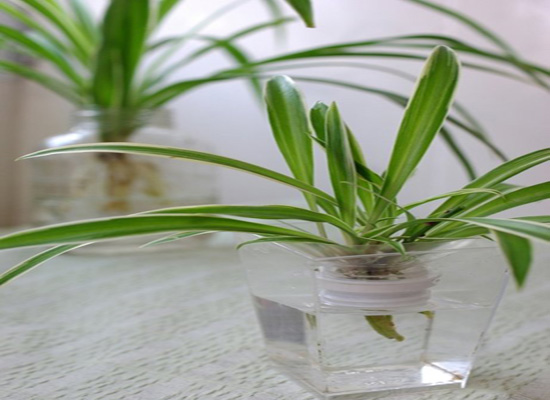
Steps for Growing a Hydroponic Spider Plant
1. For hydroponic spider plants, it is best to choose plantlets with aerial roots that grow on the stolons (runners), because the aerial roots on the stolons are very well suited to a hydroponic environment and are easy to manage; roots will sprout after about 5 days in water. When growing spider plants in water, it is best to choose green-leaved varieties; the variegated 'Silver Line' spider plant is relatively difficult to handle.
2. The container bottle can be single-layered or double-layered. For a single-layer bottle, take a plastic or ceramic bottle with no hole in the bottom and plant the spider plant in it. For a double-layer bottle, use a plastic sieve as the upper layer and a bottomless bottle as the lower layer, plant the spider plant in the upper plastic sieve, and let the roots hang down into the bottle.
3. Take a potted or ground-planted spider plant out of its pot or dig it up from the ground, remove the soil from the roots, wash the roots with clean water, cut off old roots and rotten roots, keep the fibrous roots, cut off some leaves, and keep the healthy, vigorous leaves, generally leaving 6 to 10 leaves.
4. For the single-layer bottle planting method, insert the prepared spider plant into the bottle, tie the bottle mouth tightly with sponge and insert a plastic straw, which is used to supply water. Keep the spider plant upright, fill the bottle with clean water and flower nutrient solution, and let the spider plant roots grow submerged in the water.
5. For the double-layer bottle cultivation method, plant the spider plant on the plastic sieve, with the roots passing through the small holes of the plastic sieve into the lower bottle; put ceramic granules or gravel into the sieve so the spider plant stands upright, and fill the lower bottle with clean water and flower nutrient solution. After potting, place the spider plant indoors or in a shady spot for care.
Caring for a Hydroponic Spider Plant
1. Spider plants like a warm, humid and semi-shady environment. The optimum temperature for growth is 15-25 degrees, and the wintering temperature is 5 degrees. Air that is too dry and poor ventilation can cause the leaf tips to dry out, while too strong sunlight can easily scorch the leaves. Spider plants cannot tolerate dry air, so the leaves must be sprayed with water frequently. Avoid direct sunlight in summer; when the light is too strong, the leaves turn pale yellow, so it is best to place the plant in a semi-shady spot.
2. Do not spray water in the afternoon or evening, as this will make the leaves rot more severely. There is no need for a strict watering interval; water flexibly, following the rule of "do not water until dry, and when you water, water thoroughly." This not only prevents the spider plant from getting sick, but also keeps it growing short and sturdy, enhancing its ornamental value.
3. For cultivation in a single-layer container bottle, add water and flower nutrient solution once every 4 days, feeding the water in through the straw until it is full. For a double-layer bottle, change the water once a week; when changing the water, pour out the water in the bottle, wash the container clean, fill it with clean water and flower nutrient solution, and then place the plastic sieve on top of the water bottle.
4. The water level should be such that 1/3 of the roots are submerged, or the water level should be about 0.2 cm above the bottom layer of the planting basket. Change the water once every 5-7 days in summer, once every 7-10 days in spring and autumn, and once every 10-15 days in winter. It is best to use tap water that has been left to stand for 2-3 days, and the temperature difference when changing the water should preferably not be greater than 2 degrees.
5. When growing a spider plant in water using the root-washing method or the division method, the original thick fleshy roots will rot, so the water must be changed every day, the roots washed, and rotten roots removed. After about 25-30 days, new roots can grow from the root crown area, and the old roots gradually adapt to the hydroponic environment and no longer rot; at this point you can use nutrient solution for cultivation.
6. Add the nutrient solution during the water-changing process. The nutrient solution should be stored in a dry, dark environment, in a place that children cannot easily reach, and the temperature should preferably not exceed 35 degrees.
7. For pest and disease control, if pests or diseases are found, spray the leaves with all-purpose powder mixed with water.
8. A spider plant blooms half a year after potting. When it is blooming, do not spray water on the flowers, to prevent the flowers from dropping early. After the flowers fade, cut them off from the branch tips to encourage more blooms.
After reading the above introduction, do you feel that "Mom no longer has to worry that I can't grow a hydroponic spider plant"? So hurry up and buy a hydroponic spider plant to take home and purify the air!