How to Make a Reishi Mushroom Bonsai: A Guide to Making Reishi Mushroom Bonsai
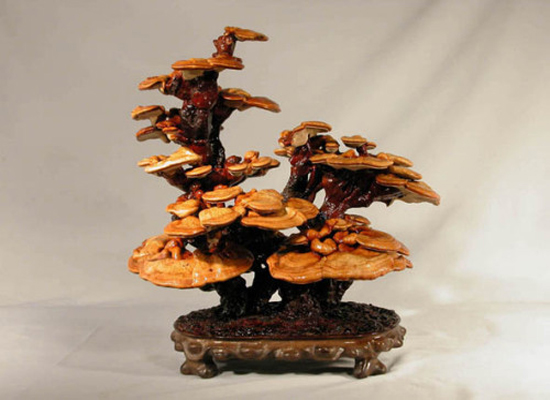
Do you, sitting in front of your computer, know what a reishi mushroom bonsai is? It is a unique handicraft cultivated using natural and artificial conditions. Turning reishi mushrooms into bonsai can increase their value dozens of times over, and placing such a bonsai in your home instantly lends it an air of nobility. So, do you know how to make a reishi mushroom bonsai? Let me now walk you through the method for making this kind of reishi mushroom bonsai.
[Principles of Making Reishi Mushroom Bonsai]
Reishi mushrooms for making bonsai can be cultivated in glass bottles or plastic bags. During the mycelium culture stage, manage them according to the requirements for bottles (bags); after the primordium appears, treat them according to different needs. You can also cultivate them directly in flower pots. When the mycelium covers the surface of the pot medium, lay a piece of plastic film over it, punch several round holes 1-2 cm in diameter in the film as needed, and surround the holes with iron pieces to force the fruiting bodies to grow out through the holes, then treat them as needed.
[Methods for Making Reishi Mushroom Bonsai]
1. Drug stimulation method: Apply a drug (such as alcohol) to the upper end of a growing stipe, and stipes that are thick, branched to one side, as well as offset and scarred caps, will appear.
2. Forced shaping method: Wrap a growing reishi mushroom with plastic film into bends, scars, off-center forms or various simple letter shapes, forcing it to grow according to the shape, then through manual trimming and pruning, you can create many shapes.
3. Approach grafting and branch cutting method: According to the shaping requirements, fix the growing upper ends of 2 or several stipes together with fine thread, or use a sterilized small knife to pare away part of the tender outer shell, cut off the aged stipe of another specimen and then fix them together; after they heal, remove the fine thread, and they join into a single whole.
4. Light-induced culture method: The fruiting bodies of reishi mushrooms have obvious phototropism; the upper end of the stipe and the growth points along the edge of the cap all grow toward the side with light. When cultivating antler-shaped branches, fix the light source and change the direction of the bottle from time to time; or fix the bottle and change the direction from which the light source shines in, and the fruiting body will take on a shape like gnarled, tangled dead branches. After the cap forms, give light stimulation in the same way, and various types of caps will form.
[Color and Craft Processing of Shaped Reishi Mushrooms]
1. Color of shaped reishi mushrooms: After the fruiting bodies of reishi mushrooms form, under conditions of ample scattered light, pigments deposit in the cells, deepening the color of the outer shell on the surface of the fruiting bodies and giving them a certain luster. During cultivation, using the intensity of light can change the color.
2. Shaping craft processing: After shaped reishi mushrooms have grown well, they must be frequently polished, embellished, processed, or treated by soaking in preservative or coating with a protective film, then use foam, plastic, marble and treated moss as filler, place them into a ceramic pot, and name them according to the form of the reishi mushroom; they then become exquisite biological handicrafts.
The above is the process for making reishi mushroom bonsai. After reading through the whole process, do you want to make a pot yourself? Rather than just thinking about it, take action and go make one yourself.