How to care for bromeliads? Detailed guide to growing methods and key points
Bromeliads are one of the most popular indoor ornamental plants, with richly colored leaves and flowers in a thousand different forms, making them very pleasing to look at. For this reason, many households use them to decorate their homes. So, what are the growing methods for bromeliads? What are the key points?
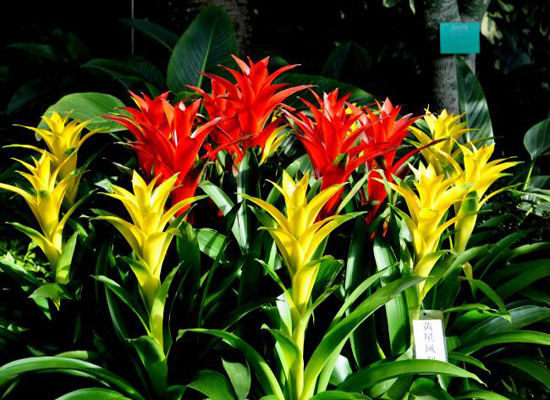
Bromeliads belong to the genus Billbergia in the family Bromeliaceae, native to the forests from Mexico to southern Brazil and northern Argentina, with about 50 species, mostly terrestrial. The leaves are sickle-shaped, with the upper part sloping downward, arranged in 5 to 8 leaves forming a tubular rosette. At present, this flower has become a highly ornamental foliage and flowering plant, and can especially be grown indoors, holding high appeal as a home gardening ornamental.
1. Light
Bromeliads are accustomed to partial shade, should be protected from scorching sun, and placed in partial shade or near a bright window, indoors. The native state of bromeliads is as an epiphyte under trees in tropical rainforests, so their demand for sunlight is not particularly great. When exposed to sunlight for too long, some of the leaves will turn yellow, and then the tips of the flowers will dry out a bit. If cultivated outdoors, appropriate shading should be provided in spring, summer and autumn, especially in summer when 70% shading is needed.
2. Temperature
The optimum growing temperature for bromeliads is 20°C to 30°C, the maximum temperature should not exceed 35°C, the minimum temperature is 14°C, and below 10°C there is a risk of frost damage at any time. In winter, it is best not to place them under a radiator.
3. Water
When watering the potting soil, wait until the surface of the potting soil is slightly dry, that is, when the top 1 to 2 cm of soil has dried, then water a second time; excessive moisture easily rots the roots. Plants in the Bromeliaceae family all have a leaf cup at the base of the leaves, and the leaf cup has a water reservoir; make sure there is always water in the reservoir and that it does not run dry. The water in the leaf cup should be replaced after a period of time, say about ten days, to prevent the water from becoming foul. Ordinarily, you can also spray a fine mist of water on the surface, leaves and flowers. The optimum relative air humidity is 70% to 80%, and it should not be lower than 50%.
4. Soil
For potting, choose a well-draining substrate, such as a mixed substrate of peat, perlite and sand, in the ratio: 1 cubic meter peat : 4 to 5 kg perlite : 0.15 cubic meters sand. Keep the pH between 5.5 and 6.5. If a small amount of decomposed chicken manure, cake fertilizer powder or bone meal and other base fertilizer can be placed at the bottom of the pot, the growth will be even better.
5. Fertilizing
During the growing season from April to September each year, apply liquid fertilizer once every two weeks. Fermented organic fertilizer can be used, or a solution of 0.1% urea plus 0.2% potassium dihydrogen phosphate can be sprayed on both sides of the leaves, and some extremely dilute liquid fertilizer can also be poured into the leaf cup, to be absorbed by the scale hairs at its base. The ratio of nitrogen, phosphorus and potassium is 10 to 15 to 20.
6. Propagation
Usually propagated by division, though at present tissue culture is mostly used for mass propagation, and seed propagation is used in breeding. For division, in spring the suckers at the rhizome of a mature mother plant can be separated and planted separately; for tissue culture, young leaves are mostly used as explants, through callus induction to differentiate clustered buds, then inducing rooting to form plantlets. From inoculation to seedling transplanting takes about 4 months, and after planting they bloom in 2-3 years.
It seems that growing bromeliads is still not easy and requires careful tending. Perhaps it is precisely for this reason that this flower can present itself with such a brilliant and eye-catching appearance; perhaps it is precisely for this reason that its ornamental value is higher.