What are the cultivation methods and precautions for the maidenhair fern?
The maidenhair fern is a commonly kept green shade-loving plant in the home, but some friends know little about how to grow it: either the leaves turn black, or the leaves wither... In any case, they just cannot keep it alive. So, how do you grow a maidenhair fern? What precautions should you take?
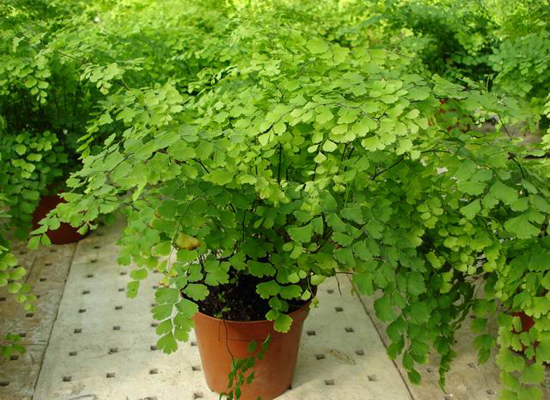
Maidenhair fern, scientific name: Adiantum capillus-veneris L., family Adiantaceae, perennial herb, 0.1-0.6 m tall. Because its stems are slender and look like iron wire in color, it is called maidenhair fern (tiexianjue, "iron-wire fern").
To grow maidenhair fern well, you might as well follow the requirements below:
1. Soil
Maidenhair fern likes loose, permeable, fertile calcareous sandy loam. For pot cultivation, the growing medium can be made by mixing equal parts of loam, leaf mold and river sand.
2. Watering
Maidenhair fern likes a moist environment. During the peak growing season, water it thoroughly. Besides keeping the potting soil moist, also pay attention to maintaining high air humidity; when the air is dry, sprinkle water around the plant. Especially in summer, water 1-2 times a day; if it lacks water, the leaves will shrivel. Avoid letting the potting soil alternate between dry and wet when watering, as this easily turns the leaves yellow.
3. Sunlight
It likes bright indirect light and is afraid of direct sun. If the light is too strong, the leaves turn withered and yellow or even die. In summer, shade it appropriately; long periods of strong direct light will cause most of the leaves to turn withered and yellow. Indoors, it should be placed in a dark spot; even if kept there for 1 year, it can still grow normally.
4. Temperature
It likes warmth and is also cold-tolerant. The suitable growing temperature is 21-25°C during the day and 12-15°C at night. In winter it should be moved into a greenhouse; at temperatures above 5°C the leaves can still stay fresh green, but below 5°C the leaves will suffer cold damage.
5. Fertilizing
Apply dilute liquid fertilizer 2-3 times a month. When fertilizing, do not splash it on the leaf surface, to avoid causing leaf rot. Because of the maidenhair fern's calcium-loving habit, it is advisable to add an appropriate amount of lime and crushed eggshells to the potting soil; frequently applying calcium fertilizer will give better results. In winter, reduce watering and stop fertilizing.
6. Pests and diseases
Potted maidenhair fern often suffers from leaf blight. In the early stage, Bordeaux mixture can be used for control; in severe cases, 70% thiophanate-methyl at 1000-1500 times dilution can be used for control. If scale insects harm the plant, 40% omethoate at 1000 times dilution can be used for control.
7. Pruning
After autumn begins, as the temperature drops, the maidenhair fern enters a stage of slow growth and the old leaves gradually turn yellow; at this time they should be cut off.
Many people think the maidenhair fern is a shade plant, so they keep it out of the sun all year round. In fact, this is a mistaken idea. Therefore, note the following:
1. Maidenhair fern fears summer heat and cannot be exposed to the sun, but it also cannot be completely shaded. In summer, it is best to place it under a shade shed or a large tree, or move it outdoors at night and back indoors during the day.
2. In winter, it should get plenty of light.
Sunlight is a necessary condition for plants to carry out photosynthesis, so shade-loving plants cannot refuse sunlight either. Friends who are eager to care for their fern and fear the sun will damage the maidenhair fern may instead cause its leaves to turn black.