Flowering Anthurium Facts: Get to Know This Flower as Passionate as Fire
What is an anthurium? Most people may feel unfamiliar when they first hear this name, but in fact this flower is quite common. Don't believe it? Take a look at the picture - well? Doesn't it look familiar? The editor can only say that I recognize what this flower looks like, yet I never knew it was actually called anthurium. For this reason, the editor specifically gathered relevant information before daring to confidently share anthurium knowledge with everyone here.
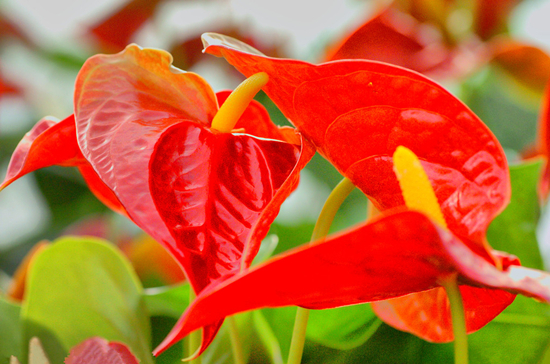
What is an anthurium? The anthurium belongs to the Araceae family and is also called flamingo flower (Anthurium andraeanum). Its unique blooms and vivid colors have won it the affection of many people, so quite a few grow it at home. Many friends then wonder: is the anthurium toxic? How do you grow an anthurium? Below, the editor will explain the relevant knowledge about the anthurium.
How to grow an anthurium:
1. Choosing a pot: The anthurium has fleshy roots and is fairly sensitive to light, so generally choose a pot with low light transmittance and plenty of drainage holes at the bottom. Peat pots, black plastic pots and the like are therefore better choices.
2. Growing medium: The anthurium prefers a moist, humid environment, so the growing medium must have strong water- and fertilizer-holding capacity and good permeability, with a pH between 5.5 and 6.5 being ideal. If the pH is too high, the anthurium's uptake of iron, manganese, zinc and others decreases and the leaves turn yellow; if the pH is too low, the supply of calcium and magnesium drops, which increases the solubility of some trace elements, causing their concentration to rise and triggering mold diseases.
3. Humidity control: The anthurium grows at temperatures of 18°C to 30°C. During flower bud differentiation, the average temperature needs to be lowered and the day-night temperature difference reduced to ensure normal bud differentiation. In winter, the temperature should not drop below 15°C.
4. Light regulation: The anthurium is a shade-loving plant, but it cannot go without light either, so when placing a potted anthurium, be sure to put it somewhere without direct sunlight. Once it enters the flowering stage, shade is needed to prevent the spathe from discoloring or scorching; in the evening or on cloudy and rainy days, no shading is needed.
5. Fertilizer management: Normal growth of the anthurium requires many nutrient elements, including the major elements nitrogen, phosphorus and potassium, as well as the trace elements iron, copper, manganese, zinc and others. Because the surface of anthurium leaves is waxy and does not absorb nutrients, fertilize at the roots, following the principle of "light fertilizer, frequent application." During the vigorous growth period in spring and summer, increase the amount of nitrogen fertilizer; in autumn, increase the amounts of phosphorus and potassium fertilizer. The fertilizer solution must not touch the leaves. In winter, control fertilizer and water so the plant overwinters safely.
6. Pest and disease management: Common pests of the anthurium include red spiders (spider mites) and aphids. Prevention is mainly achieved by regulating temperature and moisture, applying pesticide preventively when appropriate, and paying close attention to observation in daily care to achieve the goal of pest prevention.
Is the anthurium toxic?
The anthurium, also called flamingo flower, has flowers with mild toxicity; as long as you do not eat it by mistake, there will be no problem. Wash your hands each time you prune the branches and leaves. Its toxicity mainly comes from its sap, so with a bit of care there is nothing to worry about. The flamingo flower belongs to the Araceae family, and most plants in this family are toxic, but as long as you do not come into overly close contact with it, there is no problem. The flamingo flower can be grown at home; it has mild toxicity, but it is best placed outdoors.
The above is the relevant introduction to the anthurium. You probably have a rough idea of how to grow this flower now. Because it is mildly toxic, everyone should still be cautious. For the health of your family, do not grow it indoors!