What is the white magnolia? A detailed explanation of cultivation precautions
When it comes to the white magnolia, the editor immediately pictures those pristine white flowers, so pure and clean, giving people a feeling of innocence like the girl next door, and the floral fragrance is even more captivating. Pick one, wash it, and brew it as tea, and that scent is beyond words. After saying all this, many people may be confused by the editor. Is this flower really that good??? Hehe, actually this is just the editor's subjective feeling, after all, I really do like white magnolia. Below, the editor will introduce this flower to everyone. What is the white magnolia? What should be noted when cultivating it?
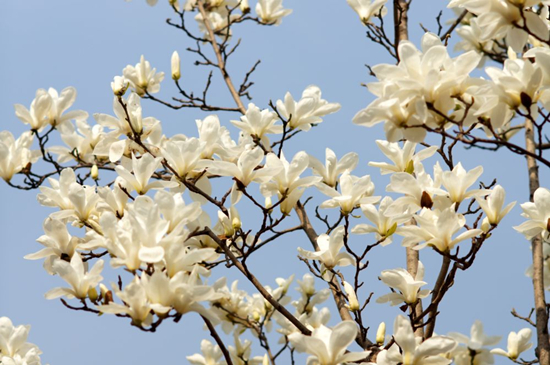
What is the white magnolia, and what should be noted when cultivating it? Everyone, follow the editor into the world of the white magnolia and feel that floral fragrance!
The white magnolia is a deciduous tree, up to 25 m tall, with a diameter that can reach 200 cm. The crown is narrowly ovate when young, and when the tree is mature it becomes broadly ovate or loosely broad-ovate. Large trees of seedling origin often have an obvious trunk, a sturdy body, a majestic and towering appearance, strong growth vigor, long internodes and sparse branches, though the number of flowers is somewhat sparse. Grafted plants often show multiple trunks or a low-branching trunk, with short internodes and dense branches; the tree is relatively compact, but the flowers are abundant and clustered, and from a distance they are pure white and exceedingly charming. Therefore, white magnolias of different origins create different moods in garden applications. In small or enclosed gardens, solitary planting or small clump planting should use grafted plants to show a quaint charm; whereas in scenic tourist areas, seedling plants should be chosen to express a rough and simple style.
The white magnolia is fresh and elegant, and is an important plant for courtyard beautification. In cultivating the white magnolia, note that it is a flowering tree with both color and fragrance in early spring. When planting, the timing must be well controlled, neither too early nor too late. Planting 10 days before budding in early spring or after the flowers fade and before leaves unfold is most suitable. When transplanting, regardless of the size of the seedling, the roots must be kept with a ball of soil, and care should be taken to avoid damaging the root system as much as possible, so as to ensure survival. Before planting, fully decomposed organic fertilizer should be applied abundantly in the hole as a base fertilizer. After planting, seal the soil and press it firm, and water thoroughly in time.
The white magnolia relatively prefers fertilizer, but dislikes heavy fertilization; during the growing season, applying fertilizer twice is generally enough to benefit flower bud differentiation and promote growth. One application is in early spring, and the other is carried out in May to June. The fertilizer is mostly fully decomposed organic fertilizer. Newly planted saplings do not need fertilization; apply fertilizer after leaf fall or in the following spring. The root system of the white magnolia is fleshy and not tolerant of waterlogging. During flowering and growth, the soil should be kept slightly moist. After autumn begins, watering should be reduced to delay rooting in the white magnolia, promote branch maturity, and help it overwinter. In winter, generally do not water; water only once if the soil is too dry. The branches and trunk of the white magnolia have poor wound-healing ability, so pruning is generally not carried out. However, for the sake of a reasonable tree shape, water sprouts, dead branches, diseased and pest-damaged branches, and branches that hinder the beauty of the tree shape should still be cut off in the early leaf-unfolding stage. In addition, after the flowers fade, if seeds are not to be kept, the remaining flowers and follicle clusters should also be cut off to avoid consuming nutrients and affecting flowering the next year.
The white magnolia is mostly planted in the ground; when grown in pots, it is suitable to cultivate as a stump bonsai.
The white magnolia can be propagated by grafting, layering, cuttings, sowing, and other methods, but the two most commonly used are grafting and layering.
The above is an introduction to the white magnolia and some relatively basic cultivation precautions. Has everyone also been captivated by the white magnolia? It is suggested that those who do not know this flower can go take a look; you really will be attracted!