How do you care for anthuriums to keep them vivid and luscious? Master these eight elements and that is enough
Anthuriums, with their vivid colors and unique flower shapes, are very popular with the public, and therefore have become the top choice for household potted flowering plants. However, anthuriums also have their own cultivation requirements, and friends who have grown anthuriums probably know that with improper care, anthuriums either fail to bloom or fail to survive.
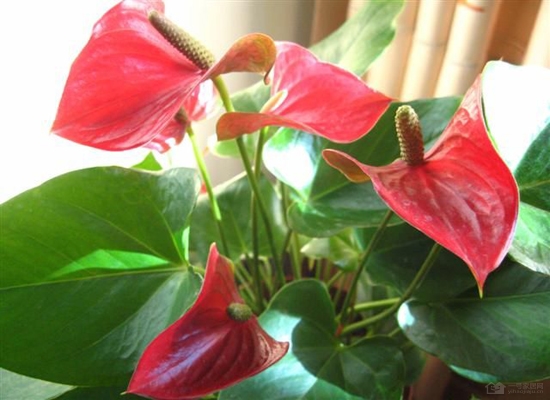
Anthuriums belong to the genus Anthurium in the family Araceae, and are perennial evergreen herbaceous plants. They have a typical semi-succulent fibrous root system and also produce aerial roots. The stem is extremely short, nearly stemless. They can bloom year-round; generally, once the plant has grown to a certain stage, every leaf axil can send out a flower bud and bloom. To keep anthuriums growing normally and blooming year-round, you need to master the 8 elements related to anthurium growth.
1. Nutrients
1. Carbohydrates are the most important nutrient for anthurium growth, and they come from photosynthesis.
2. During anthurium growth, relatively large amounts of elements are needed, including the 6 elements nitrogen, phosphorus, potassium, sulfur, magnesium, and calcium, which are mainly obtained from the growing medium or added artificially.
3. Trace elements, such as iron, manganese, copper, zinc, molybdenum, boron and other elements, come from the growing medium or are added artificially.
2. Light
Too strong light will inhibit plant growth and cause the leaves and the spathes of the flowers to discolor or burn, greatly affecting flower yield and quality. Conversely, when light intensity is too low, due to insufficient assimilates in the plant, the flowers tend to become smaller, the flower stems become soft, and yield decreases. The suitable light intensity for anthurium growth is 10000 to 22000 lux.
3. Temperature
Anthuriums are relatively sensitive to temperature during growth. The suitable growth temperature is 14°C to 35°C, the optimum temperature is 19°C to 25°C, and a day-night temperature difference of 3°C to 6°C is appropriate, that is, a daytime temperature of 21°C to 25°C and a nighttime temperature of about 19°C are most suitable for anthurium growth. Under such temperature conditions, the absorption and accumulation of nutrients by anthuriums are favored, which is extremely beneficial to anthurium growth and flowering.
4. Humidity
Anthuriums have relatively high requirements for air humidity. If humidity is too low, the plant will grow aged, and the leaves and flowers will be smaller; if humidity is too high, the plant will grow very fragile, and fungi can easily invade. When the temperature is 20°C to 28°C, humidity should be 60% to 70%; when the temperature reaches above 28°C, humidity should be between 70% and 80%. However, in winter, even if the greenhouse temperature is relatively high, it is not advisable to keep too much moisture, because if the plant leaves are too wet, their cold resistance will instead be reduced, making them prone to frost injury and unfavorable for safe overwintering.
5. Watering
Potted anthuriums have different water requirements at different growth and development stages. The seedling stage is not tolerant of drought, so water should be applied thoroughly at one time, and the growing medium should often be kept moist to promote early rooting and more new roots; plants at the medium and large seedling stages need more water, so the water supply must be sufficient; during the flowering stage, watering should be appropriately reduced, and phosphorus and potassium fertilizers should be added to promote flowering. During watering, be sure to alternate wet and dry conditions, and never water when the plant is suffering from severe water deficiency.
6. Growing medium
Because anthuriums grow epiphytically or semi-epiphytically under natural conditions, their aerial roots can absorb water from moist air, so the cultivation medium must be similar to the medium they attach to in natural growth, that is, it must have good water retention, drainage, and aeration performance, otherwise root rot is likely to occur. The commonly used medium is imported peat. In addition, sifted coconut coir can be used to replace peat.
7. Fertilization
For fertilization, apply different compound liquid fertilizers according to the different growth stages of anthuriums. Apply fertilizer A during the growth period, and use a combination of fertilizer B and fertilizer A during the flowering period. Generally, depending on the dryness and wetness of the medium in the pot, apply fertilizer water once every 2 to 3 days; in summer, apply fertilizer water once every 2 days, and when the temperature is high, water once more; in autumn, generally apply fertilizer water once every 5 to 7 days. Each fertilization must be carried out by a dedicated person, and the dilution concentration and application amount of the liquid fertilizer (stock solution) must be strictly controlled. In addition, 2 hours after applying the liquid fertilizer, use a sprinkler system to spray water on the plant leaves to wash off fertilizer remaining on the leaves, so as to keep the leaf surface clean.
8. Repotting
When repotting, first place a layer of medium at the bottom of the pot, with the thickness determined by the height of the medium and the depth of the flower pot. Take the anthurium seedling out of the small pot together with the medium, place it in the center of the flower pot, cover with soil up to the junction of roots and stem, and then gently pat firm.
Anthuriums are not as rough-growing as plants such as pothos. They have certain requirements for growing medium, humidity, and temperature. Therefore, they need more careful tending when planted.