How to grow lucky bamboo? Soil culture and water culture each have their own requirements
Lucky bamboo is not only graceful in form but also auspicious by name, so many households keep it as a houseplant. So how do you grow lucky bamboo? Lucky bamboo likes shade, warmth and humidity, and can be grown either in water or in soil, but the two methods have different requirements.
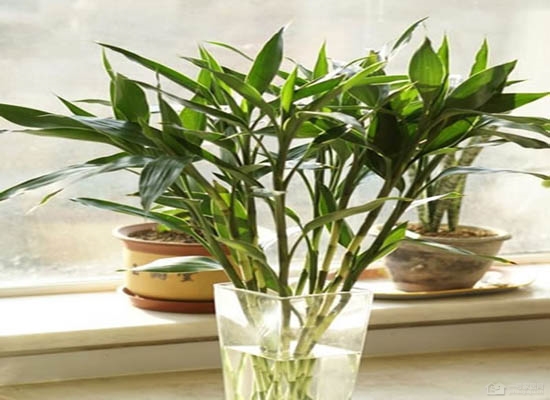
Lucky bamboo, also known as green-leaf immortal, myriad-longevity bamboo and green-leaf bamboo banana, is a perennial evergreen shrub. Its habits are as follows.
I. Temperature
Lucky bamboo likes shady, humid and hot conditions, tolerates waterlogging, has strong tolerance to fertilizer and strong cold resistance; it likes a semi-shaded environment. The suitable growing temperature is 20-28°C, and it can tolerate low temperatures of 2-3°C, but in winter it must be protected from frost. In summer and autumn, the hot and humid season is very favorable for the growth of lucky bamboo and is its best growing period.
II. Light
Lucky bamboo is not strict about light and grows well in bright, diffused light. Too strong light or direct sun exposure can cause the leaves to turn yellow, lose their green color and grow slowly. So when planting in the open field, a shade net shed 1.7-1.8 m high should be built, preferably with a 75% shading rate, to create a semi-shaded, diffused-light environment. Especially from April to September, avoid direct strong light, sun exposure or excessive drought, otherwise the leaf surface easily becomes rough, scorched and weak-growing, and the leaves lose their luster, reducing their ornamental value.
III. Water
During the growing season, the soil should be kept moist at all times, and water should often be sprayed or sprinkled on the leaf surface. After heavy rain, standing water in the field should be drained to prevent lodging. In winter, the soil should preferably be alternately dry and moist, but it should not be too dry or too wet; reduce watering and stop fertilizing.
IV. Notes on water culture and soil culture
1. Water culture
Remove the leaves from the base and cut a slanted opening
Before placing in the bottle, remove the leaves from the base of the cutting and cut the base into a slanted opening with a sharp knife; the cut should be smooth to increase the area for absorbing water and nutrients. Change the clean water once every 3-4 days, and a few small pieces of charcoal can be added to prevent rot. Do not move the position or change the direction within 10 days, and in about 15 days silvery-white fibrous roots will grow.
Change water to adding water
After rooting, it is not suitable to change the water; after the water evaporates, only add water in time. Frequent water changes easily cause yellow leaves and withered branches. The added water is best well water; if using tap water, first store it in a container for one day. The water should remain clean and fresh; do not use dirty water, hard water or water mixed with oil, otherwise the roots easily rot.
Fertilize in time
To prevent leggy growth in water-cultured lucky bamboo, do not apply chemical fertilizer. It is best to inject a few drops of brandy into the bottle about every 3 weeks, with a small amount of nutrient solution; alternatively, dissolve half a tablet of aspirin crushed into powder or one tablet of VC in 500 g of water, and drip a few drops in when adding water, which can keep the leaves emerald green.
Avoid wind
Do not place lucky bamboo beside a TV or where an air conditioner or electric fan often blows, to prevent the leaf tips and leaf edges from drying up.
2. Soil culture
Soil quality
Lucky bamboo is suitable for growing in well-drained sandy soil, semi-muddy sand or alluvial clay. Therefore, the growing medium can be made by mixing peat soil with 50% garden soil. First place a 2 cm to 3 cm thick layer of expanded clay pellets or coarse gravel at the bottom of the pot as a drainage layer, then add the growing medium.
Propagation
In spring, cut the removed stems into 5 cm to 10 cm leafless stem nodes, or cut offshoots with stem tips that branch from the base, insert them in clean coarse river sand, water thoroughly, cover with a plastic bag, keep the medium moist, and place in a bright indoor spot; roots can form in about 25 days.
Care
The potting soil should be kept moist, and a humic acid liquid fertilizer should be applied once every half month. In summer, plants cared for outdoors should be shaded; too strong light will turn the leaves yellow, and it is better to place them on a north-facing balcony or in light shade. When the climate is dry, pour water over the ground and leaves once to twice a day. From November to the following March, they should be cared for indoors, placed in a sunny spot in front of a south-facing window, and kept above 10°C so they can grow slowly. In spring, from March to April, repot and change the soil; after planting, keep the potting soil slightly moist, and once new shoots appear, normal water and fertilizer management can be carried out. After about two years of cultivation, the stems should be cut back and replanted; the plant can be cut back leaving 5 to 6 nodes, and the cut-off parts can be used for cuttings or water culture.
Lucky bamboo is a relatively rough-and-ready plant, so it does not need excessive pampering. Simply follow its growth patterns and manage humidity, water quality or soil quality, and moisture well, and it can be kept evergreen all year round.