How to grow Anthurium in the North? Master these cultivation tips
The climate in the North is changeable, which can affect plant cultivation. Some friends in the North say they have encountered many difficulties when growing Anthurium. So how exactly should Anthurium be grown in the North? Next, the editor will introduce tips for growing Anthurium in the North.
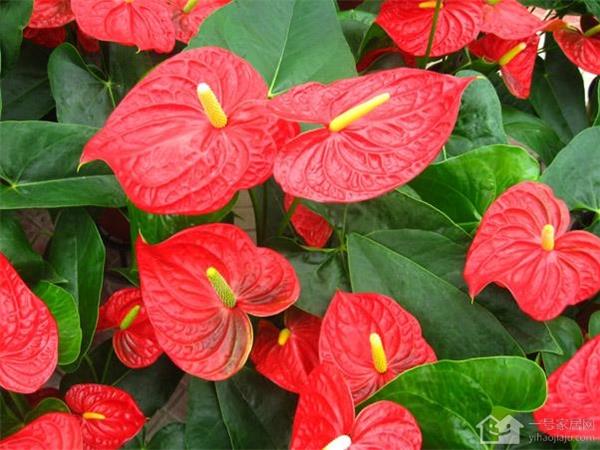
Tips for growing Anthurium in the North
Temperature The suitable temperature for Anthurium growth is 25°C to 28°C during the day and 18°C to 22°C at night, but in early autumn the outdoor temperature is relatively high; the greenhouse temperature rises quickly, so at this time temperature control mainly focuses on cooling during the day and keeping warmth at night. For daytime cooling, fans are basically no longer used; roof windows, outward-opening windows, shade nets, etc. are mainly used for control. Usually, when the morning temperature exceeds 25°C, first open the roof windows and outward-opening windows to cool down; when the temperature exceeds 30°C, fans and wet pads can be used for cooling; to prevent too drastic cooling, the fans should not all be turned on at this time, and only one or two groups of fans should be turned on according to the temperature.
In autumn, the temperature difference between morning and evening is relatively large, so at night all insulation facilities in the greenhouse should be activated to maintain the nighttime temperature in the greenhouse. For this reason, heat should be retained as early as possible in the afternoon. When the temperature is below 25°C, close the roof windows and outward-opening windows, gather in the outer shade net, and unfold the inner insulation screen. In late autumn, the daytime greenhouse temperature will not be very high either, but at noon on sunny days the roof windows and outward-opening windows should still be opened for ventilation. When the outdoor minimum temperature is below 15°C, heating should begin at night. On cloudy and rainy days, when the daytime temperature is below 20°C, appropriate heating should be applied to increase temperature and reduce humidity. During temperature control, note that temperature increases and decreases must not be too drastic.
Light During the growth process, the light intensity required by Anthurium is 10,000 lux to 18,000 lux. Insufficient light easily causes flower bud abortion, blackening of the spathes, and affects the growth rate. If the light is too strong, it will cause the leaves and spathes to fade, or even cause sunburn; therefore, whether light management succeeds or not is directly related to the quality of the potted flowers and the number of flowers. In early autumn, the light duration is longer and the intensity is greater. A slight mistake can scorch Anthurium leaves, especially those of small seedlings, and also affect flower color. Light control is basically the same as in summer, using double-layer shade nets for shading.
After mid-autumn, the light duration gradually shortens, and the intensity gradually weakens. Generally, in the morning the inner shade net with lower shading degree is used first. When the light gradually strengthens, the outer shade net can be activated, gradually increasing the unfolded width of the outer shade net, which helps the temperature rise gradually. In the afternoon, when the light gradually weakens, keep the inner net unchanged and gradually close the outer shade net, so that the light will not be too strong and the temperature will drop relatively slowly, which helps maintain the nighttime temperature in the greenhouse. At other times, appropriate shading should be provided. On cloudy and rainy days, all shade nets should be closed to make the light as sufficient as possible. Special attention should be paid to the fact that after a long period of continuous cloudy and rainy weather, when the weather suddenly clears, the greenhouse temperature rises sharply and light increases sharply, making plants more prone to scorching. At this time, shading should be provided as early as possible so that the plants have a process of adaptation.
Humidity In early autumn, the temperature is relatively high, and humidity should also be relatively high. Generally, when the temperature is 25°C to 28°C, humidity should be controlled between 70% and 80%; when the temperature is above 28°C, humidity should be greater than 80%. Air humidity can be increased through misting systems and watering the ground. When increasing air humidity, never spray too much water on the leaf surface at high temperatures. Mist spraying is best done between 10 a.m. and 3 p.m., and follows the principle of small amounts and multiple times, with each application preferably not forming small water droplets on the leaves. To ensure that nighttime humidity is not too high (not exceeding 90%), humidity can be appropriately reduced after 3 p.m., keeping it between 60% and 70%.
The main pests and diseases of Anthurium include bacterial wilt, leaf spot disease, root rot, anthracnose, red spider mites, aphids, thrips, lepidopteran pests, etc., which can be controlled by spraying agricultural streptomycin, new plantamycin, Ruining, and Aimeile. Generally, spray once every 7 to 10 days, and change the pesticide after spraying 2 to 3 times. Pesticide application should also be done between 9 a.m. and 4 p.m. to ensure the plants are dry at night.
The above are the tips introduced by the editor for growing Anthurium in the North. I believe friends have also gained some understanding. Plant cultivation is indeed not easy, and only by caring for them attentively can they grow healthily. I hope this article can help you.