How to grow a Chinese fringeflower (Loropetalum chinense var. rubrum) bonsai? Suitable for accenting garden green spaces
The Chinese fringeflower has dense branches and leaves and a graceful form; it tolerates pruning and wiring well, can be used for hedges, and can also be used to make stump bonsai. When it blooms, the whole tree is covered in red flowers, which is extremely spectacular. However, many people who grow Chinese fringeflower bonsai find that after growing it for a period of time, the flowering period easily becomes irregular and branches drop. So next, let me teach you how to care for it.
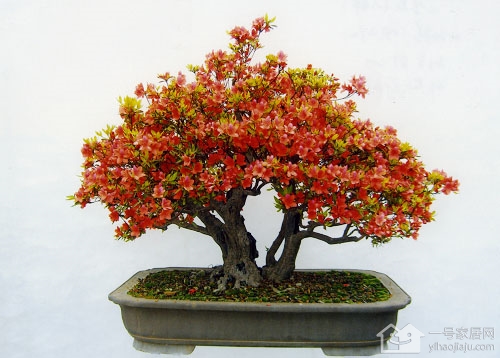
I. Care methods for Chinese fringeflower bonsai
1. Soil selection
The Chinese fringeflower prefers slightly acidic soil. If the soil is too alkaline, the Chinese fringeflower bonsai will grow poorly and even die. For growing Chinese fringeflower in pots, river sand, coal ash, and yellow loam in a ratio of 3:2:5 is relatively ideal; river sand and yellow loam in a ratio of 3:7 or sandy yellow loam can also be used, with a layer of well-draining coarse sand or ceramsite placed at the bottom for drainage.
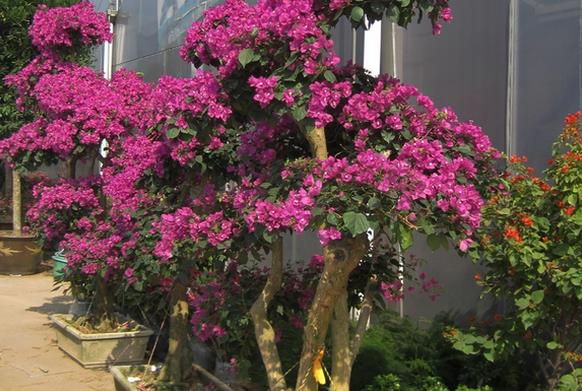
2. Pruning and repotting
Pruning and shaping are especially important for growing a good Chinese fringeflower bonsai. To ensure the ornamental form of the Chinese fringeflower bonsai, during its growth period you should cut off dominant branches, leggy branches, clustered branches, weak inner branches, and pest- or disease-damaged branches, and pruning the growth points and removing leaves can regulate the flowering period or the red-leaf period. Heavy pruning should preferably be done around the peak flowering period or in early autumn, and the effect is better when combined with repotting. After flowering, the spent flowers and developing fruit should be cut off as early as possible to avoid consuming nutrients.
Repotting is beneficial to the growth of the Chinese fringeflower. When repotting, pay attention to pruning old roots, leggy roots, overlapping roots, and coiled roots, thinning out overly dense rootlets, removing rotten and dead roots, clearing away the old soil, and replacing it with new soil. The interval between repotting depends first on the growth of the stump bonsai and second on the size of the pot. Generally, for a large pot it is 3-4 years, for a medium pot 2-3 years, and for a small pot 1-2 years; under special circumstances it can be done at any time.
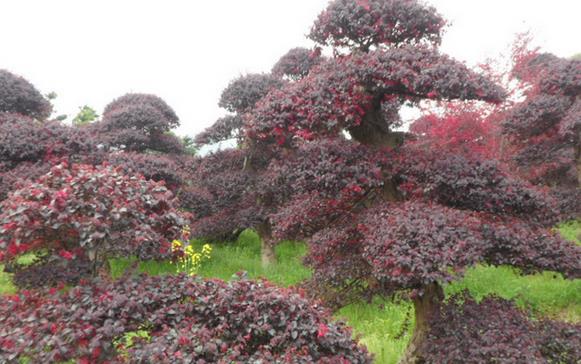
3. Watering and fertilizing
When growing the Chinese fringeflower, it is best to use heavy fertilizer and heavy watering. Fertilization should follow the principle of applying thin fertilizer frequently. During the growth period, diluted thoroughly fermented cake fertilizer water can be applied twice a month, with 1% urea added in between. Before the flowering period, spraying an 800-1000 times solution of monopotassium phosphate can promote flower bud differentiation and enhance flower color. Do not fertilize during the flowering period or the dormant period. A 0.5% ferrous sulfate solution should also be sprayed once each season to maintain soil acidity. Fertilization should be carried out on cloudy days or in the evening on sunny days.
Watering a Chinese fringeflower bonsai should be flexibly controlled according to the season, climate, pot size, and plant growth conditions. In principle, each watering must soak through thoroughly, keeping the soil moist but not waterlogged. During the high temperatures of midsummer, in addition to watering thoroughly in the morning and evening and spraying water on the leaves, if conditions permit, appropriate shading should be provided to avoid direct sun exposure that burns the roots near the pot wall or burns the leaves and causes localized withering at the leaf edges. High temperatures can also turn the leaves green, affecting the ornamental value.
4. Pest and disease control
The Chinese fringeflower has very strong resistance to pests and diseases, but if management is poor, pests and diseases such as black spot, sooty mold, and scale insects may occur. Therefore, when growing the Chinese fringeflower, pay attention to monitoring its pests and diseases, and achieve early detection and early treatment.
5. Propagation of Chinese fringeflower bonsai
Wild resources of the Chinese fringeflower are relatively scarce, so bonsai Chinese fringeflower generally uses grafting as the propagation method. The Chinese fringeflower can be grafted throughout the growth period, with the highest survival rate in April-May. For grafting, relatively strong current-year branches are generally used, and tender buds (branch tips) can also be used for side grafting or bud grafting.
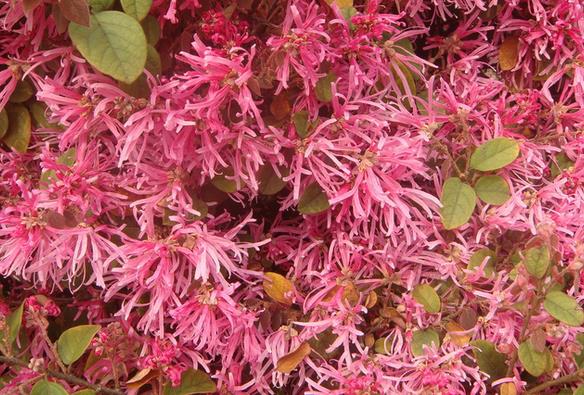
II. Flowering period of the Chinese fringeflower
The leaves of the Chinese fringeflower are alternate. New leaves are light red, and old leaves are dark red. The flowers are mainly red, with distinctions of light red, peach red, deep red, and purple red. They are borne 4-8 per cluster, in head-like or spike-like inflorescences.
The flowering period of the Chinese fringeflower is not particularly fixed. In Lingnan, the peak flowering period is March-April, and it can continue to bloom sporadically in summer and autumn. After flowering, it produces fruit. The fruit is sauce-colored and has no ornamental value. Remember not to delay.
The above are some organized methods regarding the flowering period of the Chinese fringeflower and the care of Chinese fringeflower bonsai. I hope they are helpful to friends who are growing or are about to grow Chinese fringeflower bonsai. After all, placing a Chinese fringeflower at home is also a very nice scenic feature. If you want to learn more about care knowledge, please continue to follow No. 1 Home Network.