Morphological Characteristics and Effects of Astragalus dahuricus
Astragalus dahuricus is fairly common in northern China, especially in areas with developed animal husbandry. Astragalus dahuricus has an overall spreading posture, the plant is relatively short, and the flowers are purple, giving it a rather good ornamental effect. Next, Xiao Qi will share the morphological characteristics and effects of Astragalus dahuricus.
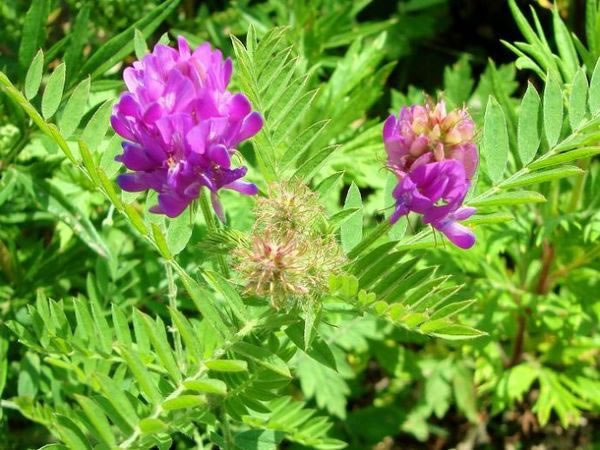
I. Morphological Characteristics of Astragalus dahuricus
Astragalus dahuricus is an annual or biennial herb, covered with spreading, white soft hairs. The stem is erect, up to 80 cm tall, branched, with fine ridges. The odd-pinnate compound leaves have 11-19 (23) leaflets and are 4-8 cm long; the petiole is less than 1 cm long; the stipules are free, narrowly lanceolate or subulate, 4-8 mm long; the leaflets are oblong, obovate-oblong or oblong-elliptic, 5-20 mm long and 2-6 mm wide, with a rounded or slightly pointed tip and a blunt or nearly cuneate base, and the petiolules are less than 1 mm long. The raceme is rather dense, bearing 10-20 flowers, and is 3.5-10 cm long; the peduncle is 2-5 cm long; the bracts are linear or bristle-like, 3-4.5 mm long. The pedicels are 1-1.5 mm long; the calyx is obliquely campanulate, 5-5.5 mm long, the calyx tube is 1.5-2 mm long, and the calyx teeth are linear or bristle-like, with the upper 2 teeth rather short and the lower 3 teeth longer (up to 4 mm); the corolla is purple, the standard petal is nearly obovate, 12-14 mm long and 6-8 mm wide, with a slightly emarginate tip and a broadly cuneate base, the wings are about 10 mm long, the blade is curved-oblong, about 7 mm long and 1-1.4 mm wide, with a blunt tip and an auricle at the base extending outward, and the claw is about 4.5 mm long; the ovary is stalked, hairy, and the stalk is about 1.5 mm long. The legume is linear, 1.5-2.5 cm long and 2-2.5 mm wide,
with a protruding pointed beak at the tip, upright. It is curved inward, with transverse veins, falsely 2-locular, containing 20-30 seeds, and the fruit stipe is short, 1.5-2 mm long. The seeds are light brown or brown, kidney-shaped, 1 mm long and about 1.5 mm wide, spotted and smooth. The flowering period is July-September, and the fruiting period is August-October.
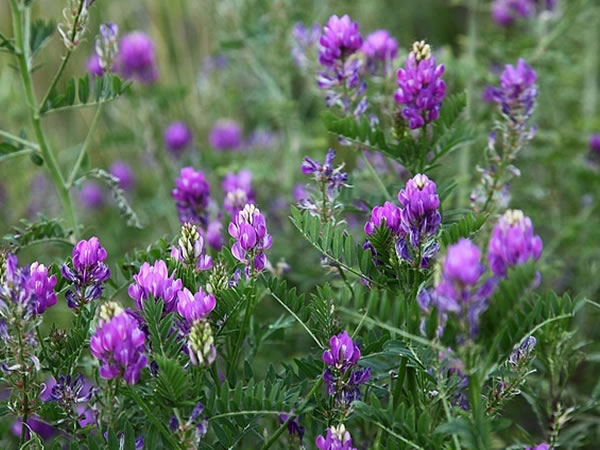
II. Effects and Functions of Astragalus dahuricus
1. Astragalus dahuricus is food for many large livestock, especially donkeys, for which it is their favorite food. Therefore, Astragalus dahuricus often appears in our daily lives as a feed for livestock, and because it has strong vitality, there is no need to worry about it being eaten bare, as it can quickly continue to grow.
2. If Astragalus dahuricus were used entirely as a feed, that would seem a bit of a pity. Astragalus dahuricus can not only serve as a main feed for livestock, but can also be consumed by us as a Chinese medicinal herb. Because Astragalus dahuricus is a plant with a slight bitter taste, its taste when eaten is not very good, but it can clear heat and detoxify, and is very beneficial to heat syndromes that appear in the human body.
3. Astragalus dahuricus can also improve the environment, because as a plant, its wild vitality is extremely strong, so it is very suitable for planting in the wild, for use in improving sandy soil. Moreover, Astragalus dahuricus itself is also relatively suitable for planting on hillsides and other places, and can effectively prevent land desertification, which is of great significance to our protection of the environment and ecological civilization.
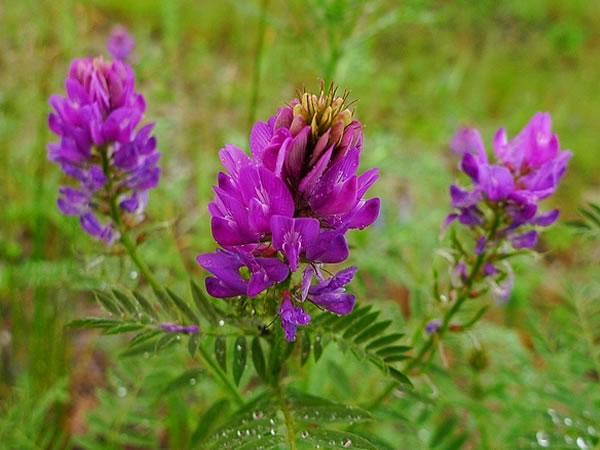
The above is an introduction to the morphological characteristics and effects of Astragalus dahuricus. I hope the above content is helpful to everyone and provides a better understanding of Astragalus dahuricus.
Recommended reading:
① Morphological Characteristics of Aeginetia indica and Its Effects and Functions
② Complete Collection of Androsace Flower Language and the Characteristics of Androsace
③ Key Points for Cultivating Hamamelis mollis and Propagation Methods for Hamamelis mollis
④ What Is Juncus effusus and the Planting Methods for Juncus effusus
⑤ Morphological Characteristics of Clerodendrum bungei and Cultivation Methods for Clerodendrum bungei