How to grow common soapwort? Detailed guide to cultivation methods and morphological characteristics
Common soapwort, also called soapweed, has a beautiful plant form and flower shape, a rich fragrance, and high ornamental value. It is suitable for planting in flower beds and flower borders. So how do you grow common soapwort? What morphological characteristics does it have? Let's learn about it together below.
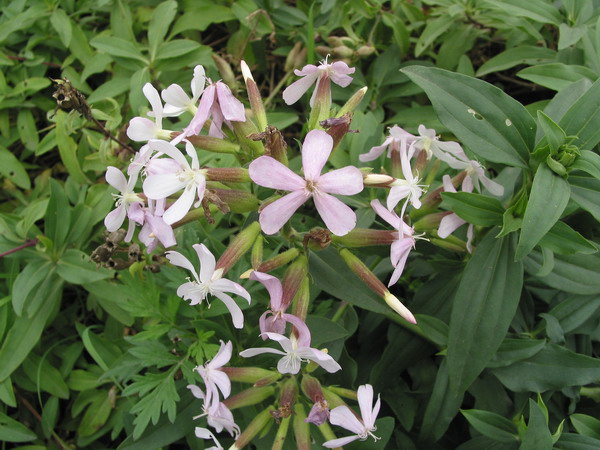
I. Cultivation methods of common soapwort
Common soapwort is naturally robust, tolerant of extensive management, and not demanding about soil. It can generally be grown in loam, and is slightly resistant to alkaline soil (pH 6.5-7.5).
1. Common soapwort likes light and a warm, humid climate, and dislikes waterlogging. When planting, choose neutral plots with good drainage and a low groundwater table, preferably sandy soil and sloped areas.
2. Common soapwort has strong drought tolerance and generally does not need frequent watering. If there is little rain and the temperature is high, water thoroughly about once every 20 days to ensure a good ornamental effect. Within a year, watering once in spring to promote regrowth and once in early winter to prevent freezing is enough.
3. Common soapwort is tolerant of poor soil and does not need much fertilizer, nor is it demanding about fertilizer. Apply about 7500 kg per hectare. During the vegetative growth period, mainly use nitrogen fertilizer, with a small amount of phosphorus fertilizer applied appropriately. Before the flowering period, spray 1-2 times with inorganic fertilizers such as nitrogen fertilizer, superphosphate, and potassium dihydrogen phosphate to achieve the ornamental effect of strong leaves and beautiful flowers.
4. Common soapwort generally does not need pruning, but after pruning during the growing season, it grows very quickly and can form a landscape again in about half a month.
5. Common soapwort has strong adaptability, a high transplant survival rate, is easy to cultivate, simple to maintain, has strong colony-forming ability, and quickly creates a landscape effect. Common soapwort has a well-developed underground root system, dense green branches and leaves, and dense small flowers. It has strong resistance and resists weed growth, and after planting it can grow for many years.
6. In the high-temperature season from July to August, common soapwort is prone to leaf spot disease. Pests are mostly white grubs and cutworms, which often damage the roots and rhizome area, causing plants to wither and die, resulting in missing plants and broken rows.
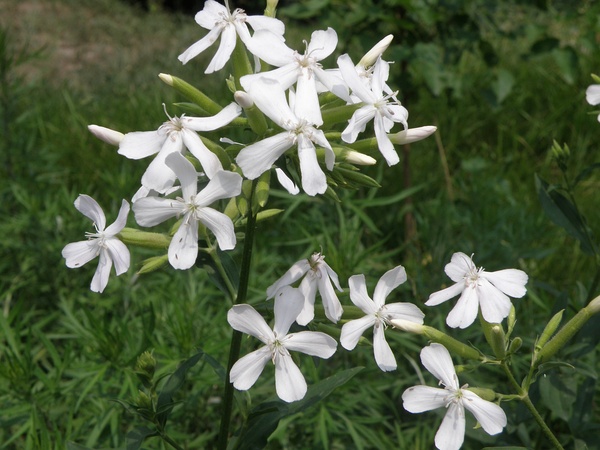
II. Morphological characteristics of common soapwort
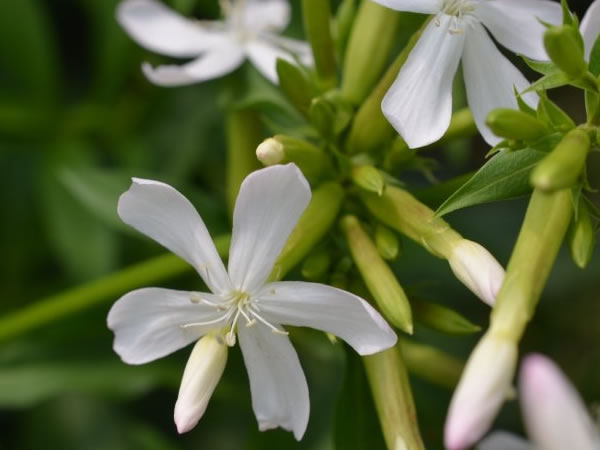
Common soapwort is a perennial herb, 30-70 cm tall. The main root is thick and fleshy; the rhizome is slender and much branched. The stem is erect, unbranched or branched in the upper part, usually hairless. The leaves are elliptic or elliptic-lanceolate, 5-10 cm long and 2-4 cm wide, gradually narrowed at the base into a short petiole-like form, slightly connate, half-clasping the stem, acute at the apex, rough at the margin, hairless on both surfaces, with 3 or 5 basal veins. The inflorescence is a cymose panicle, with small cymes bearing 3-7 flowers; the bracts are lanceolate, long-acuminate, with sparse short coarse hairs on the margin and midvein; the pedicels are 3-8 mm long, sparsely short-hairy; the calyx is tubular, 18-20 mm long and 2.5-3.5 mm in diameter, green, sometimes dark purple, initially hairy, with 20 longitudinal veins, inconspicuous, and the calyx teeth are broadly ovate with a protruding tip; the gynophore is about 1 mm long; the petals are white or pale red, the claw is narrow and long, hairless, and the limb is cuneate-obovate, 10-15 mm long, slightly notched at the apex; the corona scales are linear; the stamens and style are exserted. The capsule is oblong-ovate, about 15 mm long; the seeds are round-reniform, 1.8-2 mm long, blackish brown, with small tubercles.
The above is an introduction to the cultivation methods and morphological characteristics of common soapwort. We hope it helps everyone grow common soapwort. If you want to learn more about common soapwort, keep following us.
Recommended reading:
① How to plant datura and datura planting methods
② Cultivation methods of China pink and care experience for potted China pink
③ Cultivation methods of butterfly bush and planting management experience for butterfly bush
④ What is soft rush and how to grow soft rush
⑤ Can nerve plant be hydroponically grown? Hydroponic methods and propagation techniques for nerve plant