How to propagate a money tree? A detailed guide to two major propagation methods
Because of its auspicious name, many people buy a money tree (Zamioculcas zamiifolia) to keep at home to bring in wealth. After growing a money tree for a long time, it will certainly need to be propagated. To ensure that money tree propagation goes smoothly, most people know that good methods matter. This article introduces the propagation methods for the money tree.
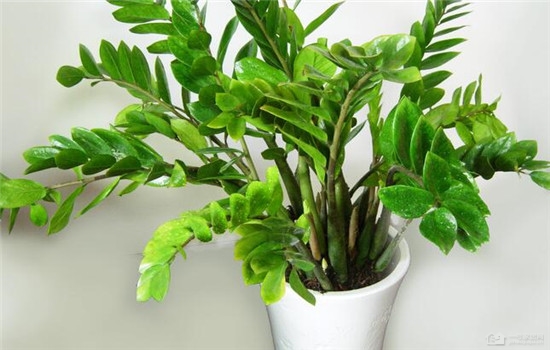
Division propagation
In April, when the outdoor temperature reaches above 18°C, take the large money tree plant out of its pot, shake off most of the old soil, pull it apart at the weak points where the tubers join, apply sulfur powder or plant ash to the wounds, and pot them up separately. Be careful not to bury them too deep when planting; burying the top of the tuber 1.5-2 cm below the soil surface is sufficient.
In addition, because money tree tubers have dormant buds, a single large tuber can be cut into small pieces each with 2-3 dormant buds. After the wounds have dried and healed, bury them first in slightly moist fine sand, and once the cut tuber pieces have grown into independent plants, pot them up.
Cutting propagation
Cuttings can be a single small leaf, a section of leaf rachis with 2 leaves attached, or a section of leaf rachis alone. In terms of rooting results, cuttings made from a leaf rachis with leaves attached root faster, have a higher sprouting rate, and more easily form larger tubers. Insert a single leaf into a mixed substrate of river sand and vermiculite; after 10-14 days, a small rooted bulbous stem forms at the base of the leaf, and after 2-3 months of cultivation it can grow into a small plant, but under normal conditions the seedling formation rate is not high.
If a leaf rachis or a leaf rachis with leaves is used as the cutting, the substrate can be ordinary fine sand, or a substrate mixed from peat soil, perlite and river sand in a 3:1:1 ratio. Insert the cutting to a depth of 1/3-1/2 of its length, leaving only the leaves above the substrate. After spraying thoroughly with water, place it in a shaded spot, maintain an ambient temperature of 25°C-27°C, and depending on how dry or moist the substrate is, mist the leaf surface 1-2 times a day, keeping the substrate slightly moist; it must never be overly wet, otherwise the cuttings will rot and the propagation will fail.
When the cutting has formed a certain root system, the middle of the root gradually swells to form a small bulbous tuber, and the tuber gradually enlarges. Some of the more tender cutting leaves, after being potted, will turn yellow and die due to high temperatures or poor water management, but the tuber can survive; mature leaves and cuttings with a whole leaf stalk can also stay green and vigorous. A small number of tubers can sprout and grow new leaves in the same year, but their growth vigor is weak and growth is slow; the following year the tuber will grow thick new shoots and grow normally.
That is all for the knowledge about money tree propagation methods. If you are growing a money tree, you also need to know its daily care methods; only after understanding fertilizing, watering and so on can you be sure to grow the money tree better, so that it will not wither away as you keep it.