What to do when Clivia leaves turn yellow? Different situations call for different treatments
In traditional culture, orchids represent elegance, and being named after the junzi (gentleman), they are even more a symbol of refined taste. As a result, Clivia has become an important choice for home plants; especially in Chinese-style home decor, Clivia better brings out the elegant atmosphere of traditional culture. However, problems often arise when growing Clivia, such as: what to do when Clivia leaves turn yellow?
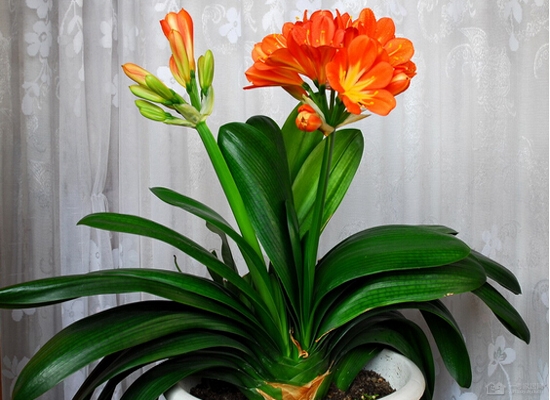
Clivia is a perennial herbaceous plant of the genus Clivia in the Amaryllidaceae family. It is a semi-shade plant that prefers cool conditions and dislikes high temperatures. The optimum growing temperature is 15-25°C; below 5°C it stops growing. It has high ornamental value. But if the leaves of Clivia turn yellow, its ornamental value is greatly reduced. In such cases, we need to treat the root cause to see results.
I. Common causes of yellow leaves in Clivia
① Sunburn yellowing: when the sun is strong, the leaves get sunburned and turn yellow, so it should be kept in a semi-shaded place.
② Dampness yellowing: Clivia has fleshy roots, so the soil in the pot only needs to be kept slightly moist. Overwatering damages the roots and the leaves turn yellow.
③ Starvation yellowing: yellowing of leaves due to lack of fertilizer. Clivia only needs a dilute nitrogen fertilizer once every half a month; in the hot summer season, do not fertilize to avoid damaging the roots. If the cause is one of the above, careful cultivation alone is enough, and at this point you just need to prune the yellowed leaves of the Clivia. Note: hold the scissors over a flame to sterilize them, then cut off the yellow leaves; do not tear them off.
II. Clivia leaves turn yellow, and the small leaves in the middle turn black and rot
If the small leaves in the middle turn black and rot, further judgment is needed. Pry apart two leaves to check; if the gap between the leaves is black and oozing decayed sap, it can be judged that a formed Clivia flower scape failed to grow out from between the leaves in time and rotted directly in the middle of the leaves.
There are many reasons for flower scape rot: one is that too much water was sprayed when the plant was in the owner's hands, causing dirty water to flow into the gap and bacterial infection to cause rot; another situation is that careless watering caused dirty water to splash into the gap and cause rot.
Consequences: generally it will not affect the life of the Clivia, but in high-temperature and high-humidity weather, it can very easily cause the head to rot off and the whole plant to rot.
Treatment: use toilet paper or facial tissue to absorb the decayed sap, remove the dirt that can be cleaned by appropriate means, keep the environment relatively dry at ordinary times, and it is recommended to use the bottom-watering method.
III. All leaves of Clivia turn yellow
If all leaves turn yellow, it is often a symptom of sunscald. Solution: shade it immediately and cut off the yellow leaves.
IV. Clivia leaves wither, yellow and droop
Withered, yellow or drooping leaves are a symptom of water deficiency. For watering, follow the principle of not watering until dry, and no water accumulation in the pot.
V. Localized yellowing of Clivia leaves
Localized yellowing is very likely caused by fire scorching, cold wind, hot water, or acid or alkali erosion. Just eliminate the external cause in time. Sometimes, insufficient nitrogen fertilizer can cause the plant to suffer from chlorosis. The reduction of chlorophyll causes the leaves to turn yellow. In this case, apply more fermented cake fertilizer water.
VI. Clivia leaves wrinkle and develop yellow spots
Excessive fertilization causes root burn. Change the soil immediately, and use a 0.1% potassium permanganate aqueous solution to soak the roots for 20-30 minutes, then rinse with clean water, let dry, cut off the rotten roots, apply plant ash to the wounds, and replant.
VII. The two outer leaves of Clivia turn yellow
This is normal metabolism of old and new layers; you only need to prune off the 2 outer leaves.
VIII. Clivia leaves appear grayish-yellow
The main cause of grayish-yellow Clivia leaves is excessively strong direct sunlight, so the Clivia needs to be shaded.
IX. Clivia leaves show chlorosis symptoms
Due to insufficient light, Clivia will become chlorotic. Indoors, fluorescent lamps can be used to supplement lighting.
X. Clivia leaves are yellow and weak
Yellow and weak leaves mean lack of fertilizer. Apply thin fertilizer frequently; if the leaves turn yellow, the soil is poor and not breathable. Replace with leaf mold or pine needle soil.
XI. Yellowing of lower leaves causes root rot
① Pull the Clivia up together with its roots.
② Use a utility knife to cut away old leaves and rotten leaves.
③ Use scissors to cut off the already rotten roots and old roots.
④ In a spray bottle, mix water and chlorothalonil in a 3:5 ratio.
⑤ Move the Clivia back into the pot.
⑥ Water with rooting solution and nutrient solution.
⑦ At first, water about 2 times a month for 5 months.
⑧ After 5 months, water about 4 times a month for 2 months.
⑨ Return to the normal watering frequency.
It can be seen that there are quite a few reasons why Clivia leaves turn yellow. Therefore, we need to figure out the cause of the yellowing and then treat the root cause; otherwise, the result may be the opposite of what we want.