Saffron crocus
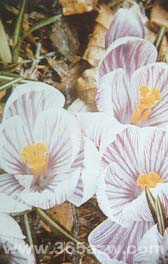
Family and genus: Iridaceae, Crocus
Habits: It is an autumn-planted bulbous flower, and the saffron crocus is native to southern Europe. It prefers cool, moist and semi-shaded environments, is relatively cold-tolerant, and does best in well-drained, humus-rich sandy loam. The corms lie dormant in summer and develop roots and sprout leaves in autumn. It blooms in late October, with the flowers opening by day and closing at night.
Propagation: Corms are the main method of propagation. A mature corm has several main and lateral buds, and after flowering new corms swell and form at the base of the leaf cluster. Each year in August-September the new corms are dug up and planted, and they can bloom that same year. Seed propagation requires 3-4 years of cultivation before the plants bloom.
Cultivation: The soil should be turned over, tilled and broken up finely, with plenty of base fertilizer applied. Plant the corms in autumn, covering them with 5-8 cm of soil; weed promptly during the growing period, pay attention to drainage after rain, and during autumn drought loosen the soil and water to keep it moist so as to encourage rooting. It blooms in October, and after flowering apply topdressing once to help the corms develop. After one planting, the corms can be dug up and divided when they become crowded after several years. Store the corms in a dry room at 17-23°C.
Pests and diseases: Sclerotinia disease harms the corms and seedlings. When storing corms, any injured or diseased corms must be removed to prevent the corms from deteriorating and to prevent infection and spread of the pathogen. It can be controlled by spraying with a 500-fold dilution of 50% thiophanate-methyl wettable powder.
Uses: The saffron crocus has slender, delicate leaves, and its flowers are tender and elegant, with colors including white, purple and orange, and a distinctive fragrance. It is an excellent material for edging flower beds and for planting in rock gardens, and can also be grown in pots or in water for indoor viewing.