Watering should also be scientific and reasonable: how to water a ZZ plant in winter
How should a ZZ plant be watered in winter? Many friends who grow ZZ plants are quite torn about this: water too much, and they worry about root rot; water too little, and they worry the plant will dry up from drought. This article takes this as its topic, briefly introducing the growth habits of the ZZ plant, and from there explaining how to water a ZZ plant in winter.
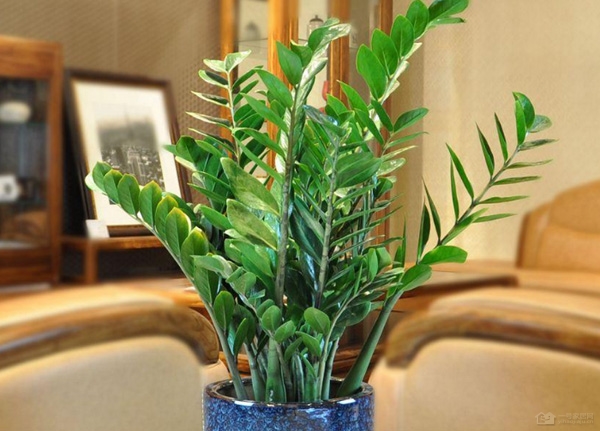
The ZZ plant, also known as the coin tree, Zamioculcas, Zamioculcas zamiifolia, and dragon-phoenix tree, is a rare foliage plant of the genus Zamioculcas in the family Araceae, and is an evergreen herbaceous plant grown mainly for its foliage. It is named a "tree" mainly because its upright, thick and sturdy leaf rachises give it the outward texture of a woody plant, and so it is called a "tree" type.
The ZZ plant originates from the tropical (savanna) climate zone of eastern Africa, where rainfall is relatively low. It likes warm, hot and slightly dry conditions, semi-shade, and an environment with little variation in average annual temperature. It is relatively drought-tolerant, but fears cold, and is averse to strong direct sunlight. Its optimum growth temperature is 20-32°C. Whether potted or planted in the ground, it requires little variation in average annual temperature. It is afraid of heavy, sticky soil and of water accumulating in the pot. If the pot soil is poorly aerated, it easily leads to rot of its tubers. It requires loose, fertile soil that drains well, is rich in organic matter, and is acidic to slightly acidic. Its sprouting ability is strong: after the thick, large compound leaves are cut off, new leaves quickly emerge from the top of its tuber.
From this it can be seen that the ZZ plant likes warmth, but can adapt to a relatively dry environment. In winter, temperatures are lower and water does not evaporate easily, so watering too much easily leads to water accumulation and thus root rot. Therefore, watering a ZZ plant must be scientific and reasonable.
1. For a ZZ plant kept in a greenhouse, when the room temperature reaches above 33°C, the plant should be sprayed with water once a day. Because this plant has strong drought tolerance, it is best to keep the pot soil slightly moist and on the dry side; occasionally applying too much water or fertilizer will not cause root rot.
2. After mid-Autumn, reduce watering, or replace watering with spraying, to help the newly sprouted tender leaves survive the winter safely.
3. In winter, pay attention to spraying water on the leaf surfaces and the surrounding environment, so that the relative air humidity reaches above 50%. In addition, in winter special attention should be paid to the pot soil not being overly moist; it is best to keep it on the dry side, otherwise under low-temperature conditions, overly moist pot soil more easily leads to rot of the plant's roots, and even the death of the whole plant.
4. How often should a ZZ plant be watered? Under normal circumstances, a ZZ plant is watered once every 5 days.
5. The ZZ plant is not tolerant of waterlogging. When cultivating a ZZ plant, you should first choose a good substrate; the substrate should be loose and breathable, and in such a substrate it is very easy to control moisture. In addition, the environment should be well ventilated; in a well-ventilated environment, you can water as soon as the pot soil looks dry, and of course water thoroughly. If it is not ventilated, you must wait until the pot soil is dry before watering; in an unventilated environment it is very difficult to control moisture.
When watering a ZZ plant in winter, one point is crucial: not only should the pot soil of the ZZ plant have appropriate moisture, but at the same time the environment in which the ZZ plant is placed, mainly the air humidity, should be kept at a certain level.