Phlox Propagation Methods and a Complete Guide to Varieties
Phlox is relatively low-maintenance, which makes it a mainstay cultivar for basic flower beds. Phlox plants are short, and their flower colors are extremely rich, giving a great ornamental effect. So how is phlox propagated? What varieties are there? Let's find out together below.
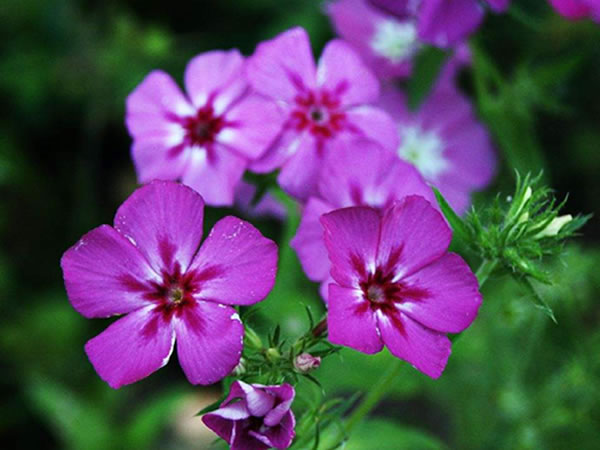
I. Phlox Propagation Methods
1. Division propagation: This method is simple to perform and plants establish quickly, but it is not suitable for mass propagation.
Carry it out in early spring or autumn. Taking advantage of the strong root-sucker branching ability of perennial phlox, which readily sprouts root suckers during growth, dig out the sucker shoots around the mother plant and plant them. The sucker shoots should carry as complete a root system as possible to increase the survival rate.
2. Layering propagation: Layering can be done in spring, summer, and autumn.
Mound layering: Mound soil over the base into a steamed-bun shape, let it root, then separate and plant it.
Ordinary layering: Take one- or two-year-old branches close to the ground, bend the lower part and bury it in the soil, with the upper end of the branch exposed above the ground. When layering, first score the bark of the branch portion that will be buried in the soil (this can release nutrients and help rooting). After rooting in about 30 days, it can be separated from the mother plant and planted.
3. Cutting propagation: Phlox cuttings can be done by root cuttings, stem cuttings, and leaf cuttings.
Root cuttings: Carry out in spring and autumn. Along with division planting, cut some roots into small sections about 30 cm long, bury them flat in plain sand, and at 15 to 20 degrees, keep the soil moist; new shoots can grow in about 30 days.
Stem cuttings: Carry out in spring, summer, and autumn, generally after flowering. Stem cuttings are suitable for large-scale production. Along with pruning and pinching, take well-developed branches, cut 3 to 5 cm long cuttings, insert them into clean, sterile plain sand at a plant-to-row spacing of 2 to 3 cm, and just keep the soil moist; they can root in about 30 days. In summer, be careful to spray 1 to 2 times with an 800- to 1000-fold 50% carbendazim solution to prevent the cuttings from rotting.
Leaf cuttings: In summer, take leaves with axillary buds (keep about 1/2 of the leaf), with 2 cm of stem attached, and insert them into clean, sterile plain sand. Be careful to provide shade and keep the soil moist; they can root in about 30 days.
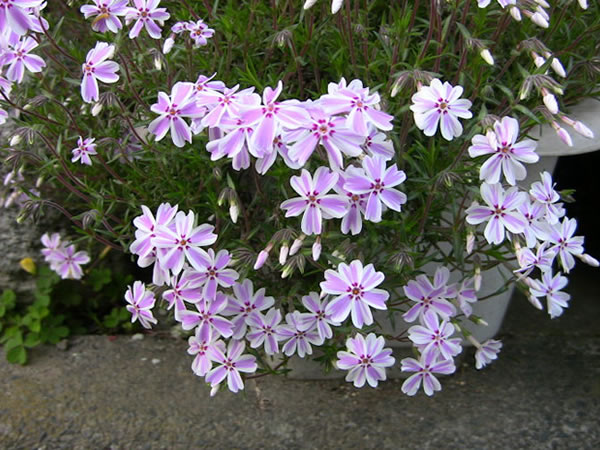
II. Phlox Variety Classification
1. Classification by flower color
(1) Solid colors: white, goose yellow, and various shades of red-purple, including star phlox and light purple and deep purple.
(2) Bicolors: including inner and outer bicolors, bicolors on the corolla tube and corolla edge, spots in the throat, stripes on the corolla edge, and a white five-pointed-star-shaped patch in the middle of the corolla edge, etc.
(3) Tricolors: such as rose red with a yellow center in the white base, or purplish red with a white center and blue dots, etc.
2. Classification by petal type
(1) Round-petaled type: the corolla lobes are large and broad, making the overall shape round;
(2) Star-petaled type: the edge of the corolla lobes again has three-toothed clefts, with the middle tooth 5 times the length of the teeth on either side;
(3) Fringed-petaled type: the edge of the corolla lobes again has fine-toothed clefts;
(4) Radiate type: the corolla lobes are lanceolate-oblong with pointed tips.

The above are the phlox propagation methods and an introduction to phlox variety classification. There are quite a few ways to propagate phlox, so everyone can choose a relatively suitable propagation method.
Recommended reading:
①How to grow phlox: Phlox cultivation methods
②What is the flower language of phlox? When is the phlox flowering period?
③Soft-stemmed golden trumpet propagation methods and precautions
④Milkweed propagation methods: Milkweed growth habits
⑤Propagation methods of Crossostephium chinense: Morphological characteristics of Crossostephium chinense