Which Clivia Variety Is Best? Teach You to Tell Superior from Inferior Varieties
Clivia has a name rich in meaning, and so it has long been an object chanted and praised by men of letters, and has also become a top choice for home greenery: it adds cultural flavor and elegance to the home. So, which Clivia variety is best? How can you tell whether a Clivia is a good variety?
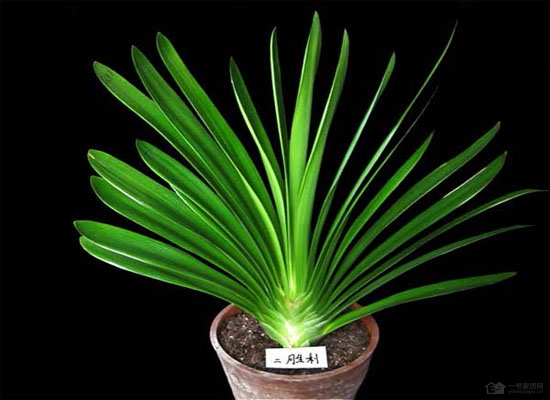
The leaves of the Clivia plant grow opposite each other and can absorb dust and pollutants from the air. There are many Clivia varieties, and some are rare and precious varieties that cost a great deal. For the ordinary crowd who know little about plants and about Clivia, how do you choose a Clivia, especially one of a good variety?
1. Look at leaf width
A mature Clivia whose leaves are more than 9-10 cm wide and whose leaf length does not exceed 3 times the leaf width is a superior grade; one with leaf width of 6-18 cm and a length-to-width ratio of 4-6 times is a relatively good grade; one with a leaf length-to-width ratio above 7 times is an ordinary variety.
2. Look at leaf veins
Three vertical veins, with veins clearly raised, up to 1.5 mm high, wide spacing between veins, straight vertical veins and flat horizontal veins, makes a fine grade; five vertical veins, smooth and inconspicuous, with irregular veins, makes a medium grade; more than five vertical veins makes a low grade.
3. Look at leaf brightness
A leaf surface with a glossy, oily wax sheen, bright and bright on both sides, is a superior grade; bright and bright on half the surface is a medium grade; not bright and grayish is a low grade.
4. Look at the head shape of the leaf tip
Generally, a leaf whose tip is round and blunt is a fine grade; if it is round-square, or has a slightly pointed tip, it is a medium grade; a sharply pointed shape like a sword tip is a low grade. But a few superior-grade plants have sharply pointed leaf tips.
5. Look at leaf thickness
Thick, plump leaves indicate an excellent variety, while thin leaves indicate an ordinary variety. For large Clivia, a leaf thickness between 2-2.5 mm, and for small Clivia between 1.15-1.5 mm, is a fine grade. But whether large or small Clivia, the leaves must not be too thick or too thin; too thick or too thin both count as low grade. As for the difference in thickness between the leaf edge and the middle, the smaller the difference, the better.
6. Look at leaf color
A light yellow base with dark green vertical and horizontal leaf veins is a fine grade; yellow, pale yellow, or light green is a medium grade; dark green, old green, light gray, dark gray, and gray are all low grade.
7. Look at the evenness of leaf thickness
Leaves whose edges and centers are uniform in thickness are a fine grade; leaves thicker in the middle than at the edges are a medium grade; leaves even thicker in the middle or forming a groove shape are a low grade.
8. Look at the leaves' light exposure (light preference)
Leaves arranged neatly and not disorderly, not losing their shape no matter which direction the pot faces relative to the sun, and with extremely low light preference, make a fine grade; needing the light direction adjusted every 3-5 days, otherwise the central leaves show an uneven in-and-out appearance, makes a medium grade; needing the light direction adjusted every day, otherwise the central leaves show a very obvious uneven in-and-out appearance, and even after manual shaping the upper leaves still lean east and the lower leaves west, makes a low grade.
9. Look at flower color
Deep orange-red with a milky white backing, edged with a green central line and veining, is a fine grade; orange-red, rose red or light tea red is a medium grade; deep yellow, light yellow, cream yellow, bright red, light red, red with mixed-color yellow or mixed-color pink, and petals with pointed tips, mixed pink, mixed color or mixed grayish white, yellow with red, yellow with white are all low grade.
10. Look at flower form
A superior form with large petals that are round yet not scattered, with 28-45 flowers or more, the interval between flowers opening not exceeding 7 days, and the flowers on one scape opening into a neat circle, is a fine grade. Opening unevenly, blooming in 3-5 batches, and dropping as they open, is a medium grade. Flowers on one scape opening one by one, or 2-3 opening separately, with a flowering period of one month or two months, is a low grade.
11. Look at the fruit
Fruit that is relatively large, glossy in color, and convex at the closed end is a superior grade; fruit that is relatively small and duller in color is a medium grade.
At present, there are many Clivia varieties on the market and their names are complicated, and a variety that truly meets all eleven of the above requirements would probably be hard to find. Therefore, to grow Clivia, you might as well follow the guide: Huamian and Heshang - traditional rare and precious varieties.