The Language of Balloon Flowers and What Sending Balloon Flowers Means
Balloon flower - just hearing this name, many people think of Kikyo from the once-popular anime series Inuyasha. The balloon flower is a very beautiful plant, and not only is its name beautiful, it also carries a deeply memorable floral language. Next, let us take a look at the language of the balloon flower.
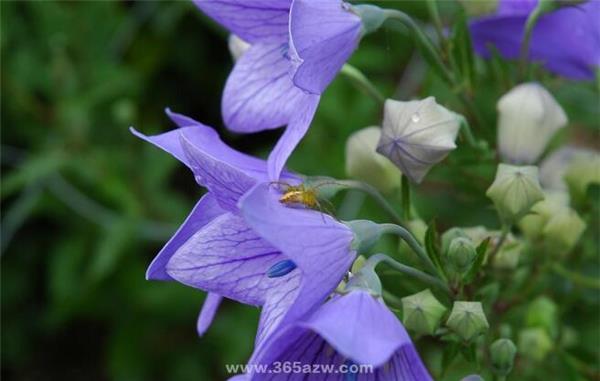
Lisianthus (Eustoma) is a plant native to the limestone areas between the southern United States and Mexico, also known as prairie gentian, and belongs to the genus Eustoma in the family Gentianaceae. The balloon flower is the bloom of the plant Platycodon grandiflorus, alias: bellflower, monk's hat, bitter-root vegetable, stem grass, bundle flower, hexagonal lotus, white medicine. Latin name: Platycodon gradiflorus, a perennial herbaceous plant of the genus Platycodon in the family Campanulaceae. The stem is 20-120 cm tall, usually hairless, occasionally densely covered with short hairs, unbranched, very rarely branched in the upper part.
The language of the balloon flower is: eternal love, unchanging love, honesty, gentleness, sincere and unchanging love, love never to be forgotten, love never forgotten through all ages, hopeless love, no regrets, and so on.
The legend behind the language of the balloon flower:
Legend has it that long ago, in a certain village, there lived a young girl named Kikyo. She had no parents and had always lived alone at home. In the village, there was a boy who had grown up with her as childhood sweethearts. When they were young, they always played together and even made a lifelong vow to each other.
A few years later, Kikyo grew into a beautiful young woman, and the boy grew into a handsome young man, and they became a couple. However, in order to fish, the young man had to take a boat to a faraway place. Before leaving, the young man repeatedly urged Kikyo to wait for him and promised he would definitely return, and Kikyo agreed. Though reluctant in her heart, Kikyo had no choice but to send her beloved off on his journey.
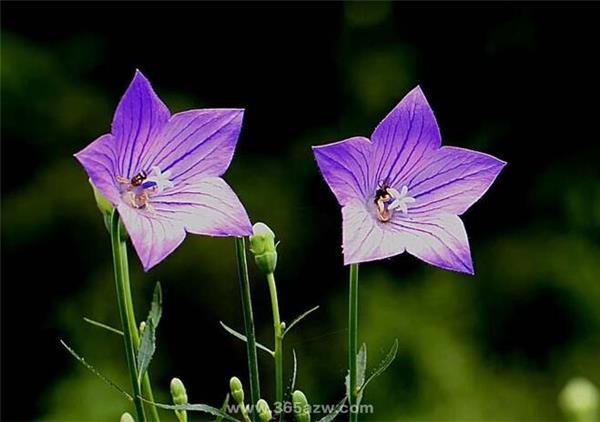
Day after day, year after year, Kikyo's heart was torn to pieces in the torment of waiting. She constantly prayed to heaven for her beloved to come back soon, but the young man who loved Kikyo left no news behind and never returned. Kikyo could not let go of the longing in her heart, and always ran to the seaside, praying for a miracle to appear, that the sea would bring her beloved back to her side.
Decades passed, and Kikyo had become an old woman in the twilight of her years, yet she still went to the seaside every day to wait for her beloved's return. While waiting, Kikyo thought of her beloved young man at every moment. Finally one day, as Kikyo recalled the sweet times the two had shared in their youth, she slowly closed her eyes, and her body turned into a beautiful balloon flower.
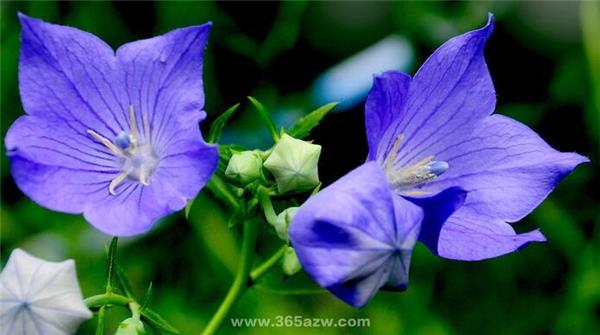
The Effects and Functions of Balloon Flower
[Nature and Flavor] Bitter, pungent, neutral.
[Meridian Entry] Lung meridian.
[Effects] Diffuses the lung, removes phlegm, benefits the throat, discharges pus, regulates qi, invigorates blood, aids digestion, calms the spirit.
[Functions] Commonly used for cough with abundant phlegm, chest tightness and poor breathing, sore throat and hoarseness, lung abscess with pus expectoration, and sores with pus formed but not yet bursting.
1. To treat lung abscess with cough and chest fullness, chills and rapid pulse, dry throat without thirst, and frequent discharge of turbid, foul-smelling saliva, with pus like rice porridge after a long time: one liang of Platycodon root, two liang of licorice. Take the above two ingredients, add three sheng of water, boil down to one sheng, and take warm in two divided doses; this will cause the pus and blood to be vomited out.
2. To treat phlegm cough with uncontrolled panting: one and a half liang of Platycodon root. Grind and sift into a powder, use half a sheng of a boy's urine, decoct down to four ge, remove the dregs and take warm.
3. To treat throat obstruction and toxic qi: two liang of Platycodon root. Add three sheng of water, boil down to one sheng, and take all at once.
4. To treat cold-type excess binding in the chest with no heat signs: three fen of Platycodon root, one fen of croton (peeled, cored, roasted until black, ground into a paste), three fen of fritillary. Grind the above three ingredients into a powder and take mixed with white rice water; half a qian-bi for the strong, reduced for the frail. If the illness is above the diaphragm, vomiting will surely occur; if below the diaphragm, purging will surely occur. If there is no purging, take a cup of hot congee; if the purging does not stop, take a cup of cold congee.
5. To treat typhoid with stuffiness of qi and chest fullness that feels near death: one liang each of Platycodon root and bitter orange (roasted, pith removed). Cut the above into pieces the size of rice beans, add one and a half sheng of water, boil down by half, remove the dregs, and take in two divided doses.
6. To treat foul, rotting gum disease: equal parts Platycodon root and fennel. Burn and grind into powder and apply.
The above is the related introduction to the language of the balloon flower. We hope it is helpful to you.