How to care for Phalaenopsis orchids? Master these key points
The Phalaenopsis orchid (Phalaenopsis spp.) is a flower whose form resembles a butterfly dancing gracefully, with rich and vivid colors. It has the reputation of being the queen of orchids, is loved by people, and has been brought indoors for cultivation for ornament and to beautify the home environment. Native to Asia, since it was first discovered in 1750, more than seventy native species have been recorded to date. The Phalaenopsis orchid is a genus of orchid with short stems and large leaves, an arched flower stem, and relatively large petals like a pair of butterfly wings, with a graceful posture and gorgeous colors. Below, learn about caring for Phalaenopsis orchids.
I. About the Phalaenopsis orchid
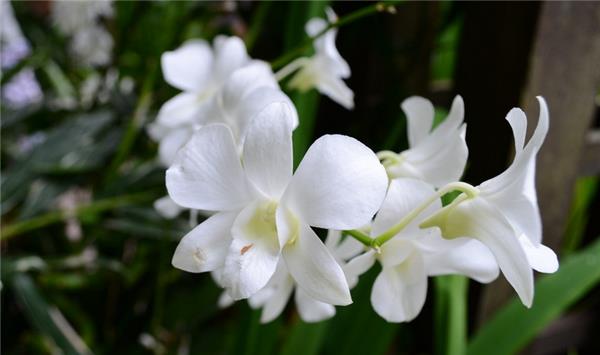
The Phalaenopsis orchid belongs to the plant kingdom, angiosperms, monocotyledons, Asparagales, Orchidaceae, genus Phalaenopsis, with about 100 species. Native to Europe and Asia, North Africa, North America and Central America. Two very well-known species: Platanthera bifolia bears white flowers and is a smaller plant. Platanthera chlorantha has large, greenish-white flowers and a larger plant form. Both bear 5 to 15 flowers, fragrant, clustered into a spike-like inflorescence.
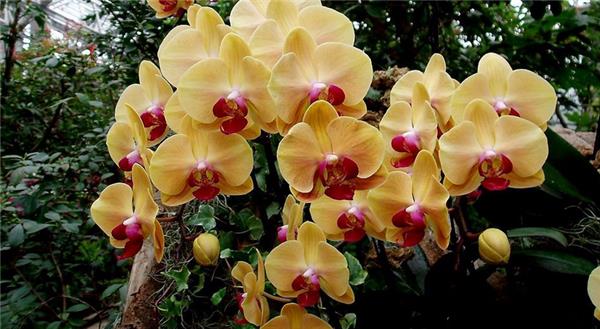
The Phalaenopsis orchid has a graceful flower posture, elegant and varied colors, and is named for its butterfly-like flower shape. It is widely cultivated around the world. Although it is an epiphytic orchid, it has no pseudobulb, only a very short stem at the base. The leaves are wide and thick, long-elliptical, and can reach more than 50 cm. Some varieties have beautiful pale silver mottling on the leaves, with purple beneath. The flower stalk emerges from the leaf axil, slightly curved, of varying lengths, bearing from a few flowers to several hundred flowers, shaped like butterflies, with long-elliptical sepals, a lip with a three-lobed tip, and a wide range of flower colors. It can bloom for more than one month. Abroad it is mostly used as a cut flower, and it is a high-end item among tropical orchids. The vast majority of Phalaenopsis orchids have no scent; some do have a scent, and we call it a scented Phalaenopsis orchid. This kind of Phalaenopsis orchid is very rare, but many people say after smelling it that it is a foul smell, and some people who work near the flowers are made to have headaches by the fumes.
II. The role of the Phalaenopsis orchid
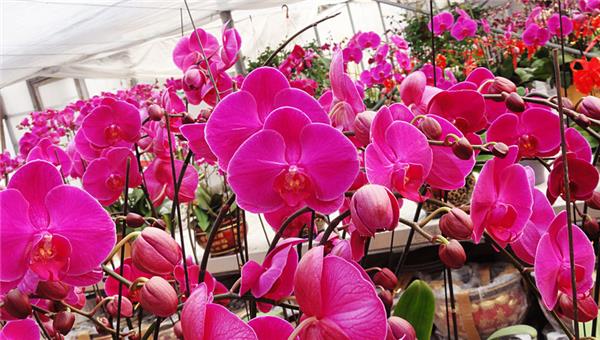
1. The Phalaenopsis orchid has a powerful effect in beautifying the home environment. Its plant is very peculiar: it has neither stolons nor pseudobulbs. Each plant grows only a few broad leaves that are as thick and plump as spoons, alternately stacked above the base. Thick white aerial roots are exposed around the leaves, and some climb on the outer wall of the flower pot, full of natural wild charm. When the Chinese New Year season arrives, a flower stalk up to a full chi long emerges from the leaf axil, and then opens one flower after another. Each flower has 5 parts, with a lip set in the middle. The flower colors are vivid and dazzling, including pure white, goose yellow, and crimson, as well as light purple, orange-red and azure blue. Quite a few varieties combine two or three colors; some look as if a pattern of stripes has been embroidered on them, and some look as if they have been sprayed with evenly distributed colored dots. Each stalk bears seven or eight flowers, and at most twelve or thirteen, and can be enjoyed continuously for sixty or seventy days. With such a beautiful appearance, could you still resist it?
2. The Phalaenopsis orchid, from the outside in, can make a home full of life. The name "butterfly flower" carries a meaning that many people do not know. The scientific name of the Phalaenopsis orchid, according to its original Greek meaning, is "an orchid that looks like a butterfly." It can absorb nutrients from the air to survive, which proves its dynamic role in the home, flying about in the air like a butterfly; vitality and liveliness are generated right here. As for its appearance, although it does not move, it is so beautiful and eye-catching that it can add a lot of atmosphere to a home, cheerful like a holiday.
3. The Phalaenopsis orchid has many very interesting flower meanings, making home style even more poetic. The flower meaning of the Phalaenopsis orchid is "I love you" and "happiness flies to you." Therefore, many people give Phalaenopsis orchids to the bride when they marry. Also, the Phalaenopsis orchid corresponds to the zodiac signs Aquarius and Sagittarius, representing loyalty, wisdom, rationality and virtue. With such a romantic flower placed at home, it is sure to add a lot of good atmosphere to the home.
III. How to care for the Phalaenopsis orchid
Caring for the Phalaenopsis orchid needs to be divided into two stages: early-stage management and late-stage management. At each different period, the care temperature and water must be adjusted well, and attention must be paid to pest removal. For example, in late-stage care during the flowering period, water and fertilizer management is especially important. During care, focus on the following issues.
1. Watering too frequently will cause root rot. Friends who cultivate Phalaenopsis orchids always worry that the orchid lacks water, and regardless of whether the growing medium is dry, they water every day, causing severe root rot.
2. Maintain an appropriate temperature and do not let the temperature get too low. Usually the time when flowering Phalaenopsis orchids come on the market is mostly in early spring, and after buying them home they are generally placed in the living room and other places for enjoyment. Although the daytime temperature in these places is sufficient, the nighttime temperature is somewhat on the low side. On the other hand, professionally cultivated orchids are mostly in well-equipped greenhouses. By comparison, the temperature and humidity at home are both somewhat insufficient, so the plant's growth tends to weaken day by day. Therefore, sometimes no matter how well it is cared for, the orchid still has times when it does not bloom.
3. Prevention of diseases. The Phalaenopsis orchid mainly has the following diseases, which we should pay special attention to. Bacterial brown spot disease is the most serious disease of the Phalaenopsis orchid. The symptom is the appearance of brown spots on the leaves. They are oily or heart-shaped, surrounded by yellow-shaped material. Handling methods include adjusting the nitrogen amount in the fertilizer solution, removing diseased plants, and maintaining stable relative humidity. Chemical agents have no effect on this disease. Only by using plants in good growing condition and healthy can this bacterial problem be avoided.
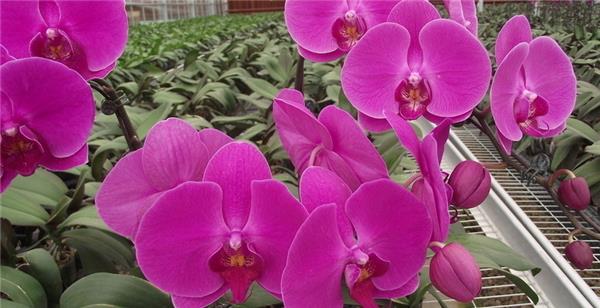
Finally, the flower meaning of the Phalaenopsis orchid is "I love you" and "happiness flies to you," representing loyalty, wisdom, rationality and virtue. When you use your own carefully cultivated Phalaenopsis orchids to form a bouquet and give it to him or her, the other person will surely feel your beautiful intentions.
The symptom is the appearance of brown spots on the leaves. They are oily or heart-shaped, surrounded by yellow-shaped material. Handling methods include adjusting the nitrogen amount in the fertilizer solution, removing diseased plants, and maintaining stable relative humidity. Chemical agents have no effect on this disease. Only by using plants in good growing condition and healthy can this bacterial problem be avoided. Finally, the flower meaning of the Phalaenopsis orchid is "I love you" and "happiness flies to you," representing loyalty, wisdom, rationality and virtue. When you use your own carefully cultivated Phalaenopsis orchids to form a bouquet and give it to him or her, the other person will surely feel your beautiful intentions.