What varieties of spider plant are there? A guide to the common spider plant types
Growing spider plants can make the indoor environment cleaner. There are many kinds of spider plants. Today let's take a look at what kinds of spider plants there are.
How to grow spider plants so they are more resilient and long-lasting.
1. Substrate: Spider plants adapt well to all kinds of soil and are easy to cultivate. A small amount of base fertilizer can be added to prepare fertile sandy loam, humus soil, peat soil or fine sandy soil.
2. Propagation: Spider plants are highly adaptable and have a high survival rate. They are usually propagated by division, cuttings, sowing and other methods. Cutting and division propagation can be done at any time from spring to autumn.
3. Watering: Spider plants like a humid environment, and the potting soil should be kept moist often. Because its fleshy roots can store a large amount of water, it has strong drought resistance and does not need frequent watering. In winter, when the temperature is below 5 degrees, water less, and the potting soil should not be too wet, otherwise the leaves tend to turn yellow.
4. Fertilizing: During the growing season, apply liquid fertilizer once every 2-3 weeks. Apply less nitrogen fertilizer, and stop fertilizing when the ambient temperature is below 10 degrees.
5. Light: Spider plants like a semi-shaded environment and can be grown indoors in bright light all year round. Direct strong sunlight should be avoided; it is best to find a place with scattered sunlight, or use a gauze curtain to block 50%-70% of the sunlight, so that it can grow luxuriantly and the leaves look beautiful.
6. Temperature: Spider plants tolerate high temperatures. The suitable growing temperature is between 15-30°C, and in winter a temperature above 10°C is best.
7. Humidity: Spider plants like a humid environment. To keep them fresh and green, you can often spray water on the leaves to wash them.
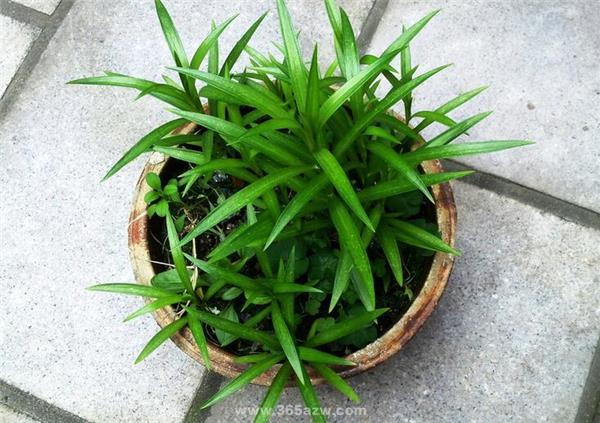
8. Pruning: As the plant grows, to maintain a good plant shape, yellow leaves at the base and leaf tips should be cut frequently, and pay attention to pruning some old roots and rotten roots.
9. Pest control: Spider plants grow in dense clumps with poor ventilation and are easily harmed by scale insects, so prevention should be the priority.
Spider plants mainly include the following 8 major varieties:
1. Broadleaf spider plant: The leaves are broadly linear, with entire margins or slightly wavy. The flower scape emerges from the leaf cluster, and after flowering it forms creeping stolons that can take root and sprout into new silver-striped spider plants. It has a raceme, white flowers, 2 flowers per bract axil, and a perianth in two whorls of 6 segments. The flowering period is in spring and summer, and the capsule is three-angled and spherical.
2. Silver-striped spider plant, also called middle-striped spider plant: The leaves are narrow and long, lanceolate, creamy white with green stripes and edges.
3. Milky white spider plant: The main vein of the leaf has white longitudinal stripes.
4. Purple spider plant, also called painted-leaf spider plant: The main vein of the leaf is purple.
5. Golden-edged spider plant: The leaf edges are golden yellow, the leaves are slender and soft, and the leaves hang down like flowers. It is evergreen all year round and was called the crane orchid in ancient times. Its special appearance forms a unique hanging landscape and three-dimensional beauty, and it can create a distinctive decorative effect.
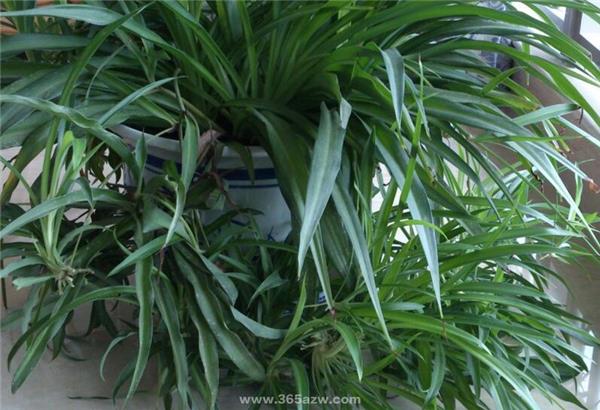
6. Golden-centered spider plant: An evergreen perennial herb with slender, linear-lanceolate leaves, yellow-white longitudinal stripes in the center, and bright green color. It is a common potted plant for offices and homes.
7. Silver-edged spider plant: The leaf edges of the silver-edged spider plant are white.
8. Silver-striped spider plant: There are silvery white longitudinal stripes around the main vein of the leaf.
The best choices for purifying air are spider plants and green pothos.
1. A perennial evergreen herb in the class Monocotyledoneae, family Liliaceae, genus Chlorophytum, with horizontal or oblique rhizomes and many thick fleshy roots. The leaves grow in clusters, are linear, slender, and orchid-like. Sometimes there are green or yellow stripes in the middle. The flower stem emerges from the leaf cluster and grows into a stolon that produces leaf clusters at the tip. The flowers are white, usually 2-4 in clusters, arranged in a loose raceme or panicle, and purple petals occasionally appear inside; the capsule is three-angled and flattened-spherical, about 5 mm long and about 8 mm wide, with 3-5 seeds per locule. The flowering period is May, and the fruiting period is August. The plant has the effect of purifying air, and the whole plant can be used as medicine.
2. Green pothos can absorb benzene, trichloroethylene, formaldehyde and so on from the air. According to environmental scientists, a newly renovated home should be ventilated well, and then placing a few pots of green pothos can basically meet the standard for moving in. Newly laid flooring very easily produces harmful substances. Because green pothos can simultaneously purify benzene, trichloroethylene and formaldehyde in the air, it is very suitable for placement in newly renovated rooms. Green pothos also has an extremely strong air-purifying function and has the reputation of being a green purifier. Green pothos can convert formaldehyde into substances such as sugar or amino acids during metabolism, and can also break down and absorb the benzene emitted by photocopiers and printers.
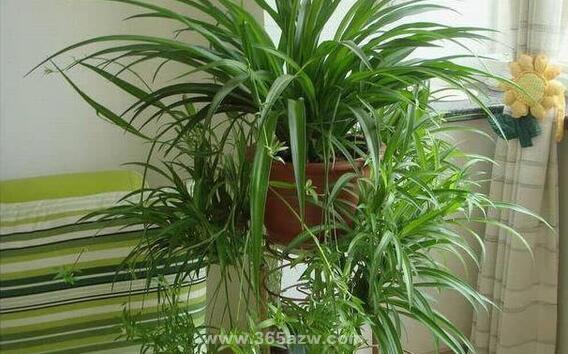
The above is an introduction to the types of spider plants. I hope you enjoy today's article.