How to Grow Mimosa Pudica? Detailed Guide to Cultivation Methods and Precautions
Mimosa pudica is a peculiar plant, and many people want to grow one but do not know how to start. Next, let us look at the cultivation methods and precautions for Mimosa pudica.
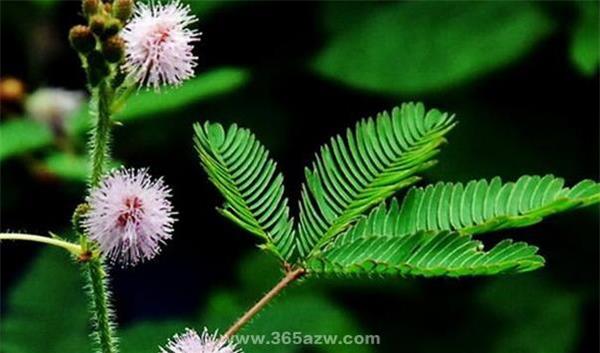
Mimosa pudica (scientific name: Mimosa pudica Linn.): a perennial herb or subshrub of the Fabaceae family. Because its leaves respond to heat and light and close immediately when touched by external force, it is named Mimosa pudica. Its shape resembles a pom-pom. After flowering, it produces pods, and the fruit is oblate. The leaves are pinnately compound, alternate, and arranged in a palmate pattern. It generally blooms after midsummer, with oblong capitula, 2-3 borne in the leaf axils. The flowers are white or pink, the calyx is bell-shaped with 8 tiny calyx teeth, the corolla is four-lobed, there are four stamens, and the ovary is hairless. The pods are flat, each pod segment contains 1 seed, and the segments fall off when mature. The flowering period is September. The flowers, leaves and pods of Mimosa pudica all have good ornamental value, and it is relatively easy to keep alive, suitable as a potted flower on balconies and indoors (eating it or excessive contact with Mimosa pudica can also cause hair loss). It can also be planted in courtyards and other places. Mimosa pudica differs from ordinary plants: when touched by people, its petioles droop and its leaflets close, so people interpret this as shyness, and thus it is called Sensitive Plant, Hehu Grass, Mimosa pudica, Zhixiu Grass and Pachou Grass (Cantonese). It is native to the tropical regions of South America, likes warmth and humidity, and has ordinary requirements for soil.
Precautions for growing Mimosa pudica:
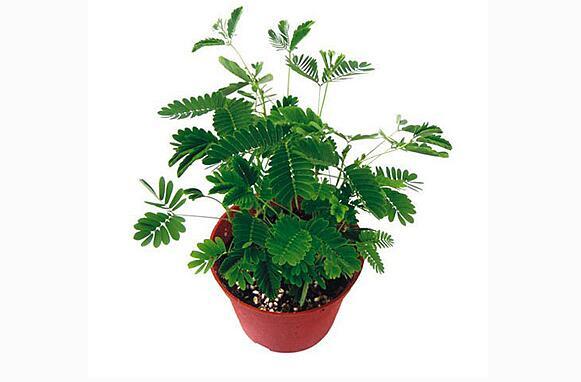
Fertilizer application: Mimosa pudica only needs to be fertilized once a month.
Watering points: Mimosa pudica is originally a tropical plant and likes a humid environment, so the pot soil should be kept moist frequently. In summer, water according to the condition of the pot soil, about once a day; do not let the soil dry out. You can often spray water on the plant. In winter, reduce the amount of watering to prevent frost damage.
Pruning essentials: Besides the function of shaping, pruning can also encourage the plant to grow more branches and bloom more. For the cutting position, the easiest way is to start above the strongest new bud. That is, keep the new bud and cut off the rest. If the plant itself is growing robustly, you can prune as you please. (Keep at least two leaves.) The plant itself will produce new buds at the junction between the leaf stalk and the main branch.
Pot soil replacement: Generally, Mimosa pudica grown in the current year does not need repotting; simply apply some fertilizer water during maintenance. For perennial Mimosa pudica kept for more than two years, the soil can be changed in spring, but there is no need to replace all the soil; generally half to one third is enough!
Feng shui applications of Mimosa pudica
Among plants, there are no eternal advantages and no eternal disadvantages, only eternal adaptation. Mimosa pudica has ornamental, medicinal and other convenient values, but in terms of feng shui, it must be viewed from two sides, or it can be said that its feng shui disadvantages are far fewer than its advantages.

1. Starting with the advantages, Mimosa pudica can bring joy to family members. When the feather-like slender leaves of Mimosa pudica are touched by external force, the leaves close immediately, so it is named Mimosa pudica. Their leaves also respond to heat and light, so every evening their leaves also fold up. Mimosa pudica is also known as Zhixiu Grass, Huhe Grass and Pachou Grass. It grows in clusters, the base of the stem becomes woody, and it can reach 1 m in height; its cold tolerance is relatively poor. If you lightly touch the feather-like slender leaves, the leaves close immediately, hence the name Mimosa pudica. The flowers are pink, and the inflorescence is spherical and light and airy. The gentle and sweet flower shape creates a romantic atmosphere.
Here, we see that Mimosa pudica is very lovely and can indeed bring happiness to family members. A plant that can make family members happy is a feng shui plant, and a house that lets family members live happily is a feng shui house. It can be seen that a residence planted with Mimosa pudica is a residence with good feng shui.

The above is the relevant introduction to the cultivation methods of Mimosa pudica. I hope everyone will like today's article.