What are the characteristics of the sensitive plant (Mimosa pudica)? A detailed guide in one article
The sensitive plant is a very unusual plant that folds its leaves when touched. What are its characteristics? Let's take a look together below.
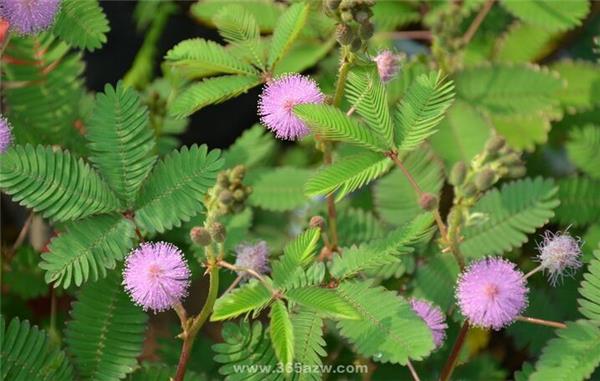
Mimosa pudica, also known as the shy plant or touch-me-not. Family and genus: Fabaceae, Mimosa genus. Characteristics: perennial herbaceous plant. Potted plants reach 20-40 cm in height, and the whole plant bears bristles and prickles. The inflorescence is a head, axillary, with pale pink flowers. The leaflets are extremely sensitive to external stimuli, closing and drooping when touched, then recovering after a while. In winter in the north, it can overwinter indoors at above 10°C. It is a novelty ornamental plant. Native to tropical America, it is not particular about soil, prefers a warm climate, requires ample sunlight and is not cold-tolerant.
The sowing details for Mimosa pudica are as follows: Sowing season: January to December. Flowering season: January to December. From sowing to flowering: about 60 days. Germination temperature: 15-25°C. Germination time: 7-12 days. Optimum growing temperature: 10-35°C. Mimosa pudica not only folds its leaflets and droops its leaf stalks at night; during the day, when some leaflets are disturbed, they also fold in pairs. If the stimulus is stronger, this stimulus is quickly transmitted in turn to neighbouring leaflets, and even to the leaflets of the entire compound leaf, at which point the compound leaf stalk droops. If the stimulus is strong enough, it can even cause the leaflets of the whole plant to close and the compound leaves to droop. But after some time, it can recover to its original state. Mimosa pudica reacts very quickly to vibration, beginning to respond 0.1 s after being stimulated and completing the response within a few seconds. The stimulus travels very quickly through the plant, reaching 40-50 cm/s. The drooping of the compound leaf in Mimosa pudica is caused by changes in the tension of the cells in the pulvinus at the base of the compound leaf stalk.
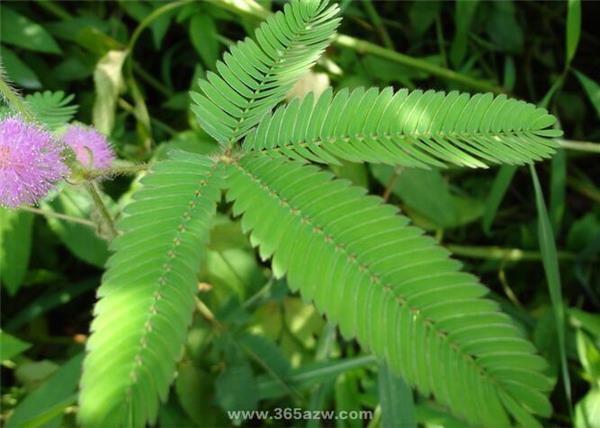
Mimosa pudica is native to tropical America and is a perennial herbaceous plant of the Mimosa genus in the Fabaceae family. Because of its unique physiological habits, it has many alternative names and nicknames, such as laughing grass, sensing grass, shouting grass, shy grass, bashful grass, shy plant and husband-and-wife grass. But why does Mimosa pudica have so many alternative names? It is because of its characteristics.
1. The biggest characteristic of Mimosa pudica is that when it is stimulated (for example, by touch), its leaf surface contracts and folds together. If the stimulus is stronger, this stimulus is quickly transmitted in turn to neighbouring leaflets, and even to the leaflets of the entire compound leaf, causing the leaf stalk to droop. If the stimulus is strong enough, it can even cause the leaflets of the whole plant to close and the compound leaves to droop. But after some time, it can recover to its original state. Mimosa pudica also reacts very quickly to vibration, beginning to respond 0.1 s after being stimulated and completing the response within a few seconds.
2. At night, Mimosa pudica also folds its leaflets and droops its leaf stalks; during the day, when some leaflets are disturbed, they also fold in pairs. It is more sensitive in weak light. Normally, the water in the pulvinus supports the leaf blade; but when it is stimulated by an external force, the water in the pulvinus immediately flows elsewhere, causing the leaves of Mimosa pudica to close. In addition, it automatically folds up at night (that is, sleep movement). This unique trait is precisely the source of the name and nicknames of Mimosa pudica.
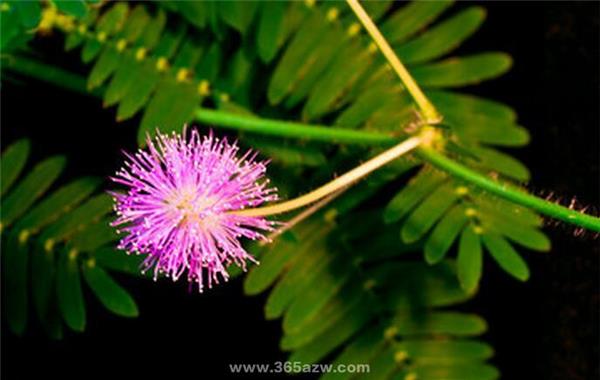
3. Because Mimosa pudica has strong vitality and grows in a rather unruly way, many places classify it as a grass, but in fact it also flowers. Its flowering period is from July to October each year, but the flowering period is very short; the flowers fade less than two days after blooming. The flowers are pink, and the head inflorescence is spherical, shaped like a pom-pom. After flowering, it also produces pods, and the fruit is flat and round.
4. The flower language of Mimosa pudica is sensitivity, shyness and courtesy. Gently touching the leaves of this plant makes them immediately close and droop; even a gust of wind can cause this, just like a shy young girl, hence its flower language is shyness. People born under the blessing of this flower have a very shy and timid personality and are very afraid of strangers. They are especially keen in perception and also have strong self-esteem. These special abilities of Mimosa pudica make people involuntarily fall in love with it. If you grow such a Mimosa pudica at home, when you are feeling troubled you can touch it and it will close its leaves. Isn't that fun?
The above is an introduction to the characteristics of Mimosa pudica. I hope today's article is helpful to you.