How to Propagate Carnations? Detailed Explanation of the Cutting Propagation Method
How to propagate carnations? This is a question that friends who love growing carnations always like to ask. After all, successfully growing a pot of your favorite plant yourself brings the greatest sense of satisfaction and accomplishment. There are many propagation methods for carnations, among which the cutting method is the most commonly used. Therefore, this article briefly introduces the carnation cutting method.
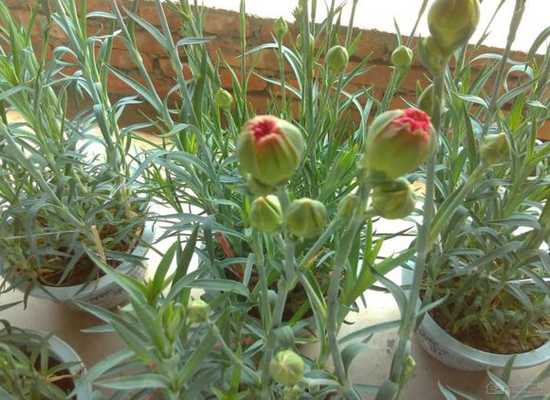
Generally speaking, carnation cuttings can be taken anytime from December to April of the following year, with January to February being the most suitable. At this time, the lateral buds used as cuttings grow robustly and are of the best quality; at the same time, taking cuttings during this period can control the plants to bloom at New Year's Day and Spring Festival of the following year. The survival rate of cuttings taken in March is also relatively high, but subsequent growth is not as good as that of cuttings taken from January to February. If taking cuttings after March, the selected cuttings can be slightly longer. Since the temperature gradually rises at this time, with large day-night temperature differences and high humidity, it is necessary to set up frames for shade for about 3 weeks, and pay attention to ventilation to prevent seedlings from being affected by pests and diseases.
1. First, prepare the growing medium. Generally, use garden soil mixed with 30% to 40% rice hull ash or sandy soil. After mixing evenly, place it in a cutting pot or wooden box.
2. Selection of cuttings. Choose plants that are free from pests and diseases, growing robustly, with compact internodes, and that have 3-4 pairs of expanded leaves, 1 pair of unexpanded leaves, with a flower bud rate of less than 10% among the group of cuttings.
3. When collecting cuttings, use the "snap-off method," using both hands simultaneously: one hand holds the main branch, and the other holds the bud selected as a cutting. Peel off the old leaves and the bud outward together, keeping the base intact with a node scar. Immerse the cutting in water or spray water on the peeled area to allow it to absorb enough water, and set aside for cutting.
4. The depth of insertion should be 1/3 to 1/2 of the cutting's length. After inserting, water thoroughly and maintain a temperature of 10°C to 15°C. The seedling bed requires meticulous care. Water again the next day after insertion. If the leaves show signs of wilting, spray the leaf surface several times. The soil should be slightly moist, but not overly wet.
5. At the initial stage of insertion, shade is generally required during clear daytime to avoid strong light; about 2 weeks of shading is usually sufficient. Cuttings will root in about 30 to 45 days. Generally, transplanting can be done about 1 month after the seedlings have survived.
6. Cutting propagation needs to be carried out in a greenhouse. Select cuttings from mother plants that are growing robustly, bloom uniformly, and have thick, short-jointed branches. From the middle section of robust branches, select short and thick lateral buds, each 3 to 4 cm long.
For carnation cutting propagation to succeed, the first step is to choose the right time for cutting, and then to select strong plants. These are the most basic conditions. Of course, the growing medium is also quite important.