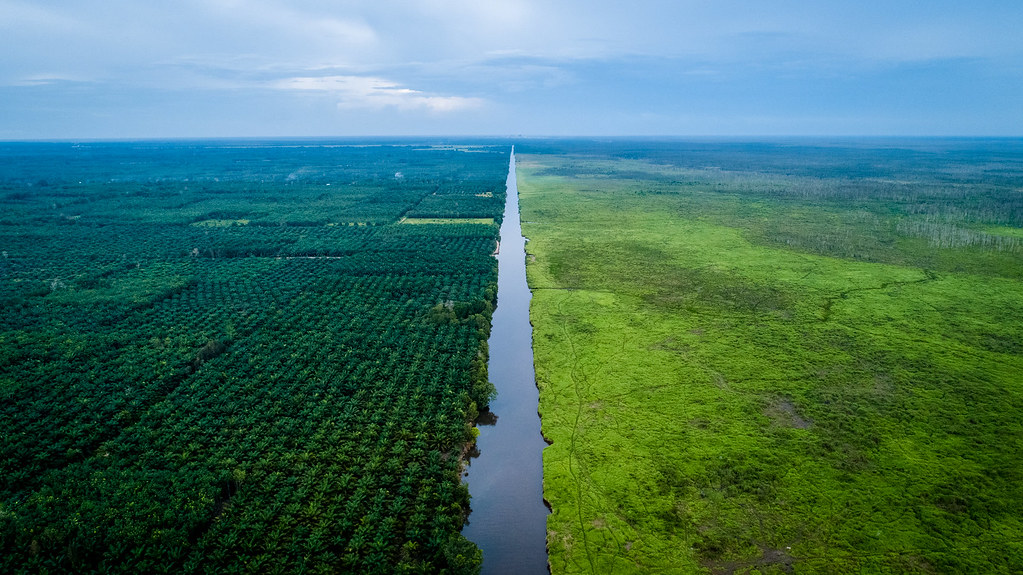
In 2018, 3.6 million hectares of primary forest were lost to commodities such as beef and palm oil
The Guardian reports that according to satellite analysis by the World Resources Institute, part of Global Forest Watch (GFW), a total of millions of hectares of primary tropical rainforest were destroyed in 2018, mainly because of beef, chocolate and palm oil.
For the sake of beef, chocolate and palm oil, a total of millions of hectares of primary tropical rainforest were destroyed in 2018. Image credit: Faizal Abdul Aziz/CIFOR (CC BY-NC-ND 2.0)
Scientists: Deforestation trend continues to rise
Forests store vast amounts of carbon and are home to wildlife; protecting forests is a key task in stopping climate change and the sixth mass extinction. But scientists say the deforestation trend is still rising. Although forest loss in 2018 was lower than in 2016 and 2017, dry weather caused the second-worst wildfires since 2002.
In Brazil, logging companies and ranchers are clearing primary forest, damaging and encroaching on the lands of uncontacted indigenous tribes; the Democratic Republic of the Congo and Indonesia also had high forest loss, but Indonesia was the only country where government protection policies effectively reduced forest loss; Ghana and Ivory Coast saw the largest increases in rainforest destruction, mainly due to gold mining and cocoa cultivation.
Frances Seymour, a member of the World Resources Institute, said: "Since tree cover loss peaked in 2016, this is the second year in a row that the decline has narrowed, which is very encouraging, but looking back over the past 18 years, the trend of forest loss is still increasing."
Hard to recover for decades: 3.6 million hectares of primary forest destroyed
The analysis examined all tree loss in the tropics, with the focus on primary forest. Primary forest is characterized by being untouched by humans, storing the most carbon, and having the greatest abundance and diversity of wildlife. Once primary forest is destroyed, it is difficult to restore for decades.
The data show that more than 3.6 million hectares of primary rainforest were cleared in 2018. GFW manager Mikaela Weisse pointed out, "Most of the loss in 2018 (1.3 million hectares) occurred in the Amazon region. What is shocking is that we saw some lands that had been unaffected by deforestation for many years being encroached upon."
For example, in Brazil's Ituna Itata reserve, more than 4,000 hectares were illegally cleared in the first half of 2018, more than double the total loss since 2002. The reserve is home to one of the world's few remaining uncontacted tribes, which have protected the forest for centuries.
Brazilian President Bolsonaro took office in January, and forest protection efforts are weakening, but Bolsonaro's impact will only appear in the 2019 data.
Main causes of destruction: palm oil, agricultural and livestock expansion, cocoa cultivation
In the Democratic Republic of the Congo, primary forest loss in 2018 was 38% higher than the average level from 2011 to 2017. Small-scale deforestation such as agricultural expansion and firewood collection accounted for about 3/4 of the loss.
In Indonesia, the main cause of primary forest destruction is palm oil plantations, but forest loss has begun to decline and is the lowest since 2003. Government policies appear to be working, but the country's climate in 2019 is drier than in the previous two years, and parched land may cause the frequency of forest fires to soar again.
Forest destruction in Ghana increased by 60%, and in Ivory Coast by 26%. "The good news is that the cocoa industry has already taken countermeasures," said GFW analyst Caroline Winchester. "The Cocoa and Forests Initiative began implementation in 2017, but 70% of deforestation in Ghana and Ivory Coast occurred in protected areas."
Seymour stressed that forest loss often directly causes human tragedy. "Every year, hundreds of people are killed for trying to stop mining, logging and ranchers. For moral reasons, we undoubtedly must immediately find ways to stop this from happening again."