How to care for Haworthia fasciata? Detailed care tips and precautions
Haworthia fasciata is a small plant similar to aloe, and many people like to keep a potted Haworthia fasciata at home. What are the care tips for Haworthia fasciata? Let's take a look together today.
Introduction to Haworthia fasciata
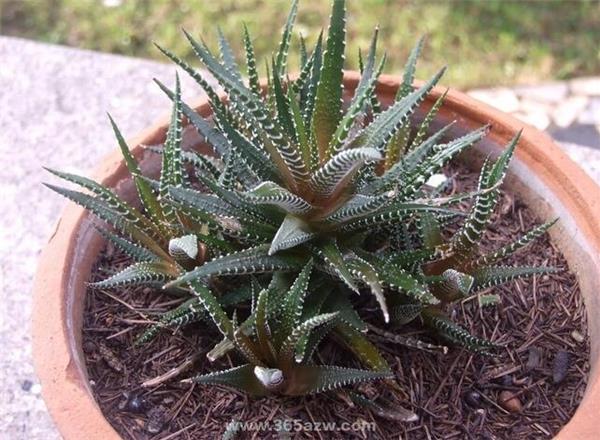
Haworthia fasciata, also known as pheasant's tail, gets its name because its thick, triangular, lance-shaped leaves are inlaid with banded white star-like patterns, resembling the feathers on a pheasant's tail. Its thick leaves are arranged compactly and closely, fresh and elegant, with a delicate, beautiful and petite form. The white stripes on the dark green leaves create a strong contrast. It is very shade-tolerant and is an ideal small indoor potted flowering plant.
Morphological characteristics of Haworthia fasciata
It is a perennial evergreen succulent plant of the Liliaceae family. The plant is small and petite, with greenish-white flowers in a raceme. The fleshy leaves are arranged in a rosette, with a plant spread of 5-7 cm. The leaves are 3-4 cm long and 1.3 cm wide, triangular-lanceolate, gradually pointed, slightly upright, with the upper part curved inward; the leaf surface is flat, and the leaf back is raised and keel-shaped, green, with relatively large white wart-like protrusions arranged in horizontal stripes.
The leaves are densely whorled on the stem axis, forming a rosette; the leaves are triangular-lanceolate, with sharp tips, dark green, and a smooth surface; the leaf back is green, with relatively large white wart-like protrusions arranged in horizontal stripes, forming a strong contrast with the dark green leaf surface, and at a glance looking just like a petite pheasant's tail.
How to make Haworthia fasciata variegate
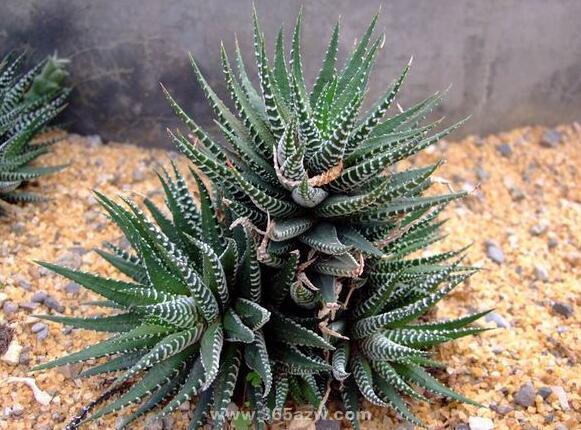
The ways Haworthia fasciata variegates are, on one hand, artificial intervention, and on the other hand, natural variegation. Ordinary households cannot reach such a high level of technique, so they can only let it variegate naturally. As long as you pay a little attention during care, variegation is no problem.
Haworthia fasciata variegation
If you want Haworthia fasciata to variegate, you must strictly control the environment during care:
Haworthia prefers a warm and dry environment, is drought-tolerant, and fears waterlogging. Strong light exposure will make the leaf tips turn red, or even scorch and dry up. Conversely, insufficient light will make the plant shape loose and messy, affecting its ornamental value.
Therefore, it should be placed in a bright place without direct sunlight for care. Usually keep the potting soil on the drier side to control growth and maintain the perfection of the potted plant;
In spring and autumn, apply a thin fertilizer once a month; in summer, pay attention to ventilation; in winter, restrict watering, and it can overwinter safely above 5°C.
In winter, sufficient light conditions are needed; insufficient light easily causes leaf degeneration and shrinking, seriously affecting normal growth.
Is variegation in Haworthia fasciata good?
Generally speaking, when Haworthia fasciata variegates, yellow stripes appear on the leaves, and this is called variegation, like the variegated leaf art of orchids, and it is very beautiful.
Variegation in Haworthia fasciata does not affect its growth; it merely grows in a different form. If you like variety, you might as well try raising two kinds of Haworthia fasciata among several.
The flower language of Haworthia fasciata: cheerful, lively
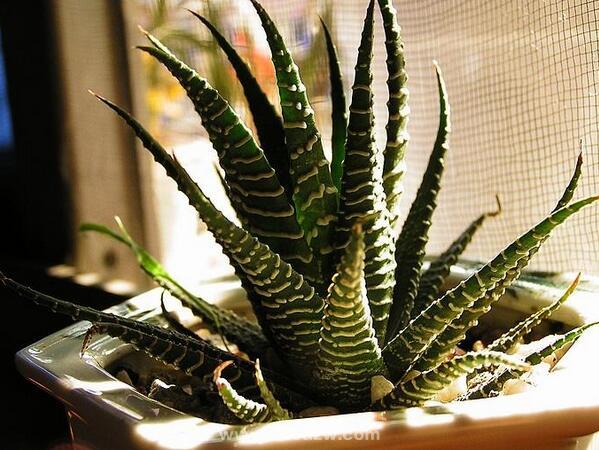
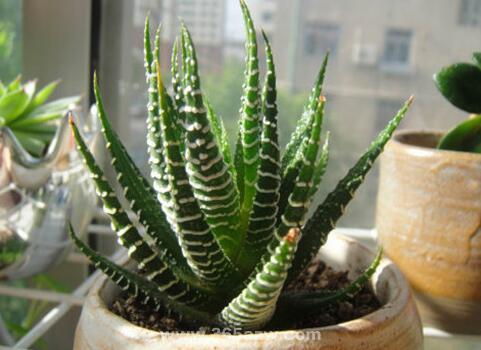
Haworthia fasciata is a perennial succulent herbaceous plant of the Haworthia genus in the Liliaceae family, native to the tropical arid regions of southern Africa. The leaves are densely whorled on the stem axis, forming a rosette; the leaves are triangular-lanceolate with sharp tips; the leaf surface is smooth and dark green; the leaf back is green, with relatively large white wart-like protrusions arranged in horizontal stripes, forming a striking contrast with the dark green leaf surface. It has good ornamental value.
Haworthia fasciata prefers a warm, dry and sunny environment. It fears low temperatures and humidity. The suitable temperature during the growing period is 6-18°C, and 10-13°C in March of the following year; the minimum winter temperature should not be lower than 5°C. It has no strict requirements for soil, and fertile, loose sandy loam is suitable.
The above is an introduction to Haworthia fasciata care tips. I hope it is helpful to you.