How to Grow Alpinia katsumadai (Grass Cardamom)? Benefits and Uses Explained in Detail
You are probably familiar with the traditional Chinese medicinal herb Alpinia katsumadai. As a commonly used plant in traditional Chinese medicine, Alpinia katsumadai has high medicinal value. Today let us take a look at what functions and effects Alpinia katsumadai has.
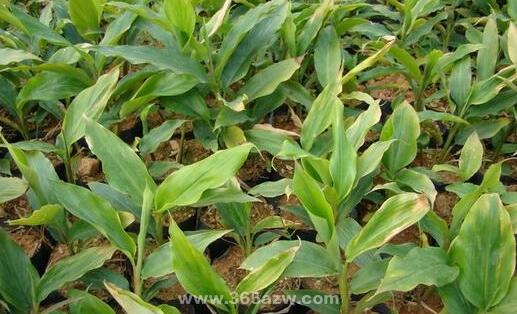
Alpinia katsumadai is a perennial evergreen herbaceous plant. There are four traditional Chinese medicines named after cardamom, namely nutmeg (Myristica fragrans), Alpinia katsumadai, Alpinia galanga (red cardamom), and Amomum kravanh (white cardamom). All four varieties are rich in volatile oils and have an aromatic, invigorating quality.
Benefits and Uses of Alpinia katsumadai
Alpinia katsumadai has the effects of drying dampness and dispelling cold, resolving phlegm and stopping malaria, and promoting digestion and dissolving food. However, those with qi deficiency or blood deficiency, and those without cold-dampness excess patterns, should not take Alpinia katsumadai. Alpinia katsumadai treats malaria, and cold phlegm congealed in the stomach that is difficult to disperse: Alpinia katsumadai, Dichroa febrifuga (Changshan), Anemarrhena asphodeloides (Zhimu), dark plum (Wumei), areca nut (Binglang), licorice (Gancao), and pangolin scales (Chuanshanjia). Decoct in water and take. (Ciyou Xinshu, Alpinia katsumadai Drink)
1. Alpinia katsumadai treats spleen pain and distension: two Alpinia katsumadai kernels. Decoct with wine and take. (Renzhai Zhizhi Fang)
2. Alpinia katsumadai treats dan malaria, with a wiry and rapid pulse, heat only without chills, or more heat and less chills, chest oppression with ability to eat, bitter taste in the mouth and dry tongue, restlessness, thirst for water, dark yellow urine, and difficult bowel movements: green tangerine peel (with the white removed), Magnolia officinalis bark (prepared with ginger and stir-fried), Atractylodes macrocephala (Baizhu), Alpinia katsumadai kernels, Bupleurum chinense (with the root removed), Poria cocos (with the skin removed), Pinellia ternata (soaked in water seven times), Scutellaria baicalensis, and honey-fried licorice, in equal parts. Cut into fine pieces. Take 20 grams per dose, with one and a half cups of water and five slices of ginger, decoct down to seven parts, remove the dregs, and take warm, without restriction as to time. (Jisheng Fang, Qingpi Decoction)
3. Alpinia katsumadai treats the early stage of pestilence, with aversion to cold first and then fever, later fever only without aversion to cold; in the first two or three days, the pulse is neither floating nor deep but rapid, with fever day and night, worse in the afternoon, and headache and body pain: areca nut 10 grams, Magnolia officinalis bark 5 grams, Alpinia katsumadai kernels 2.5 grams, Anemarrhena asphodeloides 5 grams, peony root 5 grams, Scutellaria baicalensis 5 grams, licorice 2.5 grams. Use one cup of water, decoct down to eight parts, and take warm in the afternoon. (Wenyi Lun, Dayuan Drink)
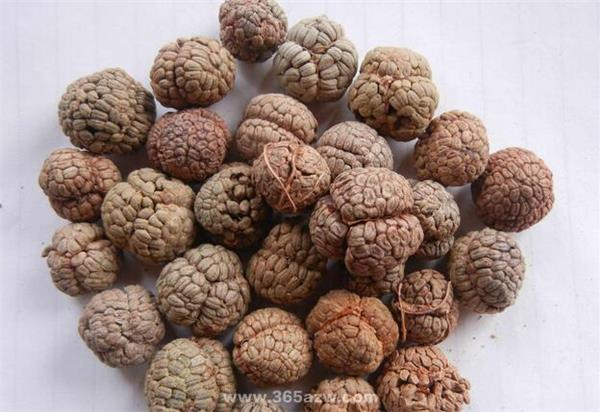
4. Alpinia katsumadai treats disharmony of cold and heat in the stomach and intestines, dysentery with red and white discharge, and latent-heat diarrhea, as well as toxic bowel disease with blood in the stool: Alpinia katsumadai seeds, licorice, Sanguisorba officinalis (Di Yu), and bitter orange (with the pulp removed, stir-fried with bran). Grind the above in equal parts into a coarse powder. Take 10 grams per dose, with one and a half cups of water and one piece of roasted ginger, crushed, decoct together down to seven parts, remove the dregs, and take, without restriction as to time. (Chuanxin Shiyong Fang, Alpinia katsumadai Drink)
5. Alpinia katsumadai treats malaria, and cold phlegm congealed in the stomach that is difficult to disperse: Alpinia katsumadai, Dichroa febrifuga (Changshan), Anemarrhena asphodeloides (Zhimu), dark plum (Wumei), areca nut (Binglang), licorice (Gancao), and pangolin scales (Chuanshanjia). Decoct in water and take. (Ciyou Xinshu, Alpinia katsumadai Drink)
6. Alpinia katsumadai treats swelling and cold malaria that does not resolve, with shivering and little fever, a blue complexion and inability to eat, or loose watery stools with unusually copious urine: Alpinia katsumadai kernels and prepared Aconitum carmichaelii (blast-fried, with skin and navel removed). Grind the above in equal parts into fine pieces. Take 25 grams per dose, with two cups of water, seven slices of ginger, and one jujube, decoct down to seven parts, remove the dregs, and take warm, without restriction as to time. (Jisheng Fang, Guofu Decoction)
Alpinia katsumadai is the fruit of the ginger-family plant Alpinia katsumadai. Alpinia katsumadai has the effects of drying dampness and dispelling cold, resolving phlegm and stopping malaria, and promoting digestion and dissolving food. Alpinia katsumadai mainly treats malaria, phlegm-fluid retention with stuffiness and fullness, cold pain in the stomach and abdomen, regurgitation, vomiting, diarrhea and dysentery, and food stagnation.
Propagation Methods of Alpinia katsumadai
Alpinia katsumadai can be propagated by seeds and by division.
Seed Propagation
Generally, seeds are selected from early August to September and sown as soon as they are harvested. Before sowing, the seeds are sprouted. If the quantity of seeds is small, mix them with 4 times their volume of moist sand and place in a pot, keeping them moist at all times. At a temperature of 30-35°C, sprouting points generally appear in a little over 10 days, at which point they are taken out and sown. Sow in drills with a row spacing of 10-15 cm, cover with 0.5 cm of soil after sowing, and cover the bed surface with grass. Seedlings begin to emerge in 20-30 days, and it takes 40-60 days from sowing to full emergence. When the seedlings have 2-3 leaves, thin them or move them to another bed to promote faster leaf growth. By the time they have 5-7 leaves, the plants begin to tiller, and when the seedlings are about 30 cm tall they can be taken from the nursery for field planting. The planting spacing is 1 m × 1.5-2 m between plants and rows. Plant 2-3 seedling plants per hole, and do not plant too deep, so as not to affect root development and shoot emergence. After planting, press the soil firm and water with settling water.
Division Propagation
In the field, select robust, high-yielding plants and cut off their rhizomes, each rhizome bearing 2-3 aboveground stems. Generally, from a vigorously growing two-year-old clump, 8-10 small clumps can be taken as planting stock, and they are planted as soon as they are dug up.
Morphological Characteristics of Alpinia katsumadai
Leaves
The Alpinia katsumadai plant reaches up to 3 m in height. The leaf blades are linear-lanceolate, 50-65 cm long and 6-9 cm wide, with a gradually pointed apex and a short sharp tip, a gradually narrowed base, asymmetrical sides, and a hairy margin; both surfaces are hairless, or rarely the leaf underside may bear very sparse coarse hairs; the petiole is 1.5-2 cm long; the ligule is 5-8 mm long and covered with coarse hairs on the outside.
Flowers
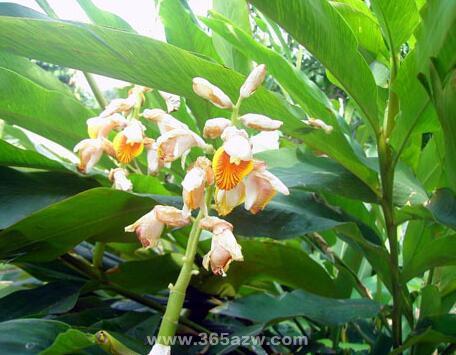
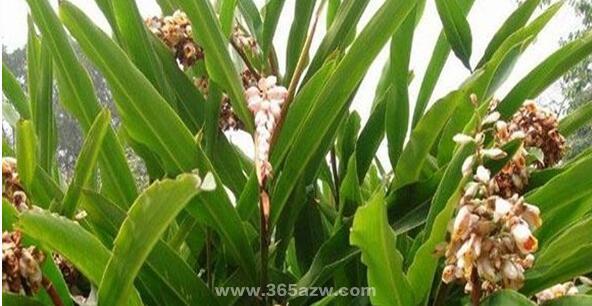
The raceme of Alpinia katsumadai is terminal and upright, up to 20 cm long; the rachis is pale green and covered with coarse hairs; the pedicels are about 3 mm long; the bracteoles are milky white, broadly elliptical, about 3.5 cm long, covered with coarse hairs at the base and gradually becoming hairless upward; the calyx is bell-shaped, 2-2.5 cm long, with irregular toothed lobes at the apex and additionally split on one side, fringed or not, and hairy on the outside; the corolla tube is about 8 mm long, and the corolla lobes are slightly rolled inward at the margins and fringed; there are no lateral staminodes; the labellum is triangular-ovate, 3.5-4 cm long, slightly 2-lobed at the apex, with colored stripes radiating from the center toward the margins; the ovary is hairy, about 5 mm in diameter; the glands are 1.5 mm long; the anther cells are 1.2-1.5 cm long. The fruit is spherical, about 3 cm in diameter, and golden yellow when ripe.
The flowering period of Alpinia katsumadai: April to June; fruiting period: May to August.
The above is a related introduction to Alpinia katsumadai, and we hope it is helpful to you.
The above is a related introduction to Alpinia katsumadai, and we hope it is helpful to you.