What to Do When the Spadix of an Anthurium Turns Black: Find the Cause and Treat It Accordingly
A bright red anthurium, yet its spadix has turned black - what an eyesore. Many friends who grow anthuriums will feel especially worried at such a sight: what exactly causes the spadix of an anthurium to turn black? This article takes that as its starting point and briefly introduces the causes of a blackened spadix in anthuriums.
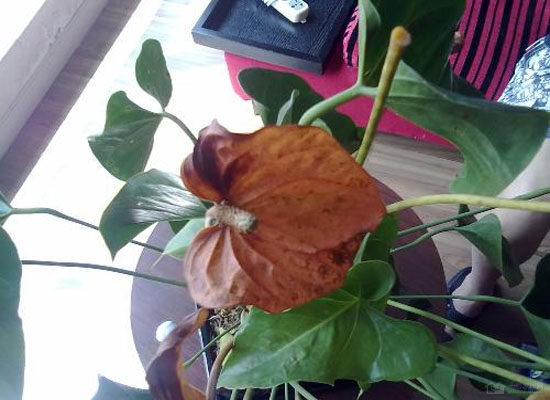
Anthurium, also known as flamingo flower (Anthurium andraeanum Linden), is a perennial evergreen herbaceous plant in the Araceae family. The stem nodes are short; the leaves grow from the base, are green, leathery, entire, and oblong-cordate or ovate-cordate in shape. The petioles are slender, and the spathe is held flat, leathery with a waxy sheen, orange-red or scarlet; the spadix is yellow, and it can bloom continuously all year round.
But when such a beautiful flower develops black spots on the spadix, one cannot help but sigh. So why does this happen?
According to reports, there may be two reasons why the spadix of an anthurium turns black:
The first is the need for metabolism. Generally speaking, only after an anthurium flower has been open for a long time does its spadix turn black. In this case, it is caused by the natural law of flowers blooming and fading, and since it is not a disease, there is generally no need to worry too much about it.
The second is root rot caused by too much watering. The growing medium for anthuriums is generally imported peat, which has a strong ability to retain fertilizer and water, but once it dries out completely it does not readily absorb water, so water should be applied thoroughly while it is still slightly moist; do not water after it has dried out completely or while it is waterlogged. Peat at the surface showing dryness is the signal to water. If the medium contains too much water and watering is not carried out on a wet-dry cycle, it is very easy to cause root rot, leading to poor growth of the whole plant.
At the same time, because anthuriums have difficulty absorbing ordinary chemical fertilizers, it is best to use only fully water-soluble fertilizers such as 'Peters' (Huaduoduo), and the amount applied must not be too large; the principle is to apply dilute fertilizer frequently. If too much is applied, the plant will absorb the excess and suffer fertilizer burn, with leaves turning black and wilting and the plant dying.
It can be seen that, aside from the reason of too long a blooming period, a blackened spadix in anthuriums is mostly caused by too much watering, especially by watering too frequently under low-temperature conditions. Although a hot and humid environment favors the growth of anthuriums, in an indoor environment water often does not evaporate easily for the plant, and if there is too much water it will inevitably lead to root rot; when too much water accumulates, the spadix will turn black.