What to Do About Rotten Leaves on Anthurium? Identify the Condition and Treat It Accordingly
What should you do when an anthurium's leaves rot? So-called anthurium leaf rot generally refers to the leaves turning yellow and withering, causing them to drop. There are many causes of this situation, and to deal with it well, you need to distinguish between the different cases and take corresponding measures. This article aims to give a brief introduction to this.
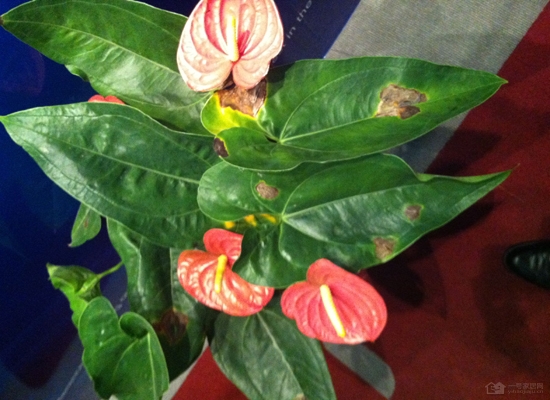
The anthurium has a peculiar flower shape, gorgeous flower colors and beautiful leaves, so it can be enjoyed both for its flowers and its foliage. Therefore, leaves turning yellow and withering directly affects its ornamental value. The yellowing and withering of anthurium leaves may be caused by the following reasons.
1. Bacterial leaf spot disease
In the early stage of infection, water-soaked irregular brown to dark brown spots appear between the leaf veins, surrounded by yellow halos. In severe cases, the spots merge into large patches, and the leaves wilt, curl and hang on the short stems. If you examine the dead and rotting tissue and it gives off an unpleasant fishy odor, accompanied by yellow bacterial ooze, then it can be confirmed as leaf spot disease caused by bacterial infection.
Control method: In the early stage of the disease, spray the plants once every 7 to 10 days with a 4000-fold dilution of 72% agricultural streptomycin sulfate soluble powder, or a 3000-fold dilution of medical-grade streptomycin sulfate.
2. Fungal black spot disease
It often causes symptoms such as necrosis, wilting and rotting of leaf tissue. The pathogen or its modified forms, such as small black dots and black mold, can be observed with the naked eye. It generally develops relatively slowly and mostly appears as wet rot, with no fishy odor.
Control method: In the early stage of the disease, you can spray with a 400-fold dilution of 40% phosethyl-Al or iprodione wettable powder, or spray with an 800-fold dilution of 45% amobam aqueous solution, or spray with a 1000-fold dilution of 75% chlorothalonil wettable powder. The sterilization results are all relatively good.
3. Old leaves and new leaves turn yellow at the same time
The main reason is long-term lack of light.
Solution: Appropriately increase light.
4. Old leaves turn yellow
The main reason is long-term lack of water or watering that does not soak through, which leads to this situation.
Solution: Water thoroughly every time.
5. New leaves turn yellow while old leaves remain normal
This situation is due to too much watering or a lack of fertilizer.
Solution: Control watering, or apply additional fertilizer.
It can be seen that the causes of rotten leaves on anthurium are varied. If you use chemicals to treat it without distinguishing between them, it may be counterproductive, failing to save the anthurium's life and instead speeding up its decline.