What are the cultivation methods and flower meaning of tuberose?
After tuberose blooms, its fragrance drifts everywhere, and the flowers are also very beautiful. What issues should be noted when cultivating tuberose? Next, we will introduce them to you in detail.
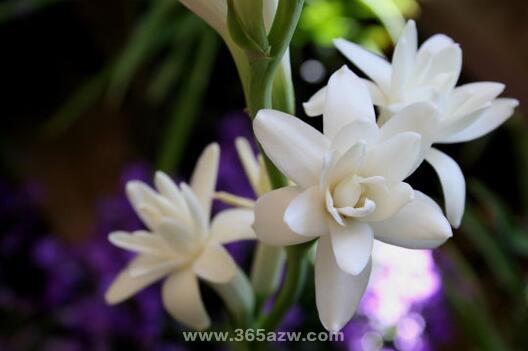
Tuberose belongs to the Amaryllidaceae family and is a perennial bulbous flower. Tuberose has strong stress resistance; its soil requirements are cold tolerance, salt-alkali tolerance, love of sunlight, and fear of waterlogging, and it requires fertile, deep, slightly alkaline clay soil.
After the seedlings emerge, the soil needs to be loosened frequently and sufficient water and fertilizer should be given, with a total of 2-3 topdressings, especially applying 1 round of fertilizer water rich in phosphorus and potassium just before the flower scape is about to emerge. From summer to mid-autumn, water frequently to keep the soil moist but not waterlogged. After flowering, cut the flower stalk from the stem node, then topdress 1-2 more times, still strengthening water and fertilizer management to promote plump growth of the bulb. The following spring, change the soil, apply base fertilizer, and replant separately; moreover, bulbs that have undergone protected cultivation through winter bloom earlier and more abundantly the next year. The flowering period begins in June; after the first batch of flowers fades, flower stalks are produced again in August-September, and flowering capacity is greatly increased.
Methods to enhance the rich fragrance of tuberose: during its flowering period, the room temperature should be kept at 15°C-25°C; after dark, plants that have already bloomed should be shaded; after tuberose blooms, take some measures to prevent overly free air circulation.
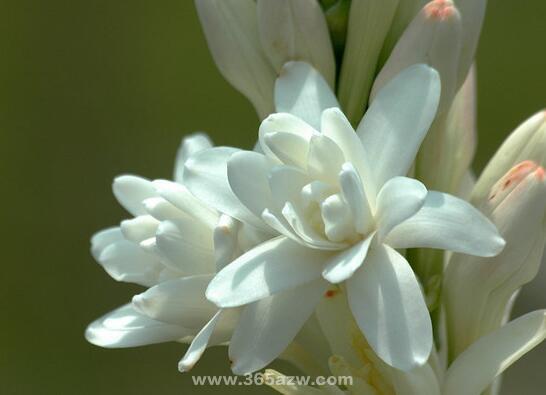
Tuberose is an important bulbous flower for courtyard flowerbeds and flower borders, and is also suitable for mass planting, clump planting among lawns or flowering shrubs, and accenting beside roadside stones. The leaf clusters and flower branches are simple and elegant; at night, the pure white and delicate flowers are even more fragrant, making them indispensable material in night garden arrangements. Tuberose is also an important cut flower, and its vase life can last about 10 days; in cut flower arrangements it is often paired with gladiolus, and in bouquets, flower baskets, and vase flowers it offers both color and fragrance, while dwarf varieties are suitable for potted ornamental display.
Propagation methods
Bulb division propagation is mostly used. In late November, after the aboveground parts wither, dig out the underground stems and remove the shrunken old bulbs. Generally, each clump can be divided into 5-6 mature bulbs and 10-30 bulblets, which are dried and stored in a dry place indoors. Divide the bulbs in spring, and when planting, plant large and small bulblets separately; usually bulblets can bloom after one year of cultivation. Large bulblets for cut flower production should preferably be more than 2.5 cm in diameter. Small bulblets can grow into large flowering bulbs after 1-2 years of cultivation.
Flower meaning
The flower meaning of tuberose is dangerous pleasure, because tuberose only releases its rich fragrance at night, so it is called tuberose. Because this fragrance is too strong, it can make people feel difficulty breathing, so tuberose is generally not placed indoors. Therefore, its flower meaning is: dangerous pleasure.
Legend
According to legend, in ancient times there was a handsome young man surnamed Zhang whose flute playing was very beautiful and famous far and near. On a beautiful moonlit summer night, the young man leaned against a tree and played the flute. Just as he was playing happily, a purple cloud suddenly floated near above him, and a beautiful fairy descended gracefully from the clouds. The fairy said she was an envoy from the moon palace, and that Chang'e had heard his flute playing and specially ordered her to come down to ask for the sheet music. The flute player gladly gave it to her.
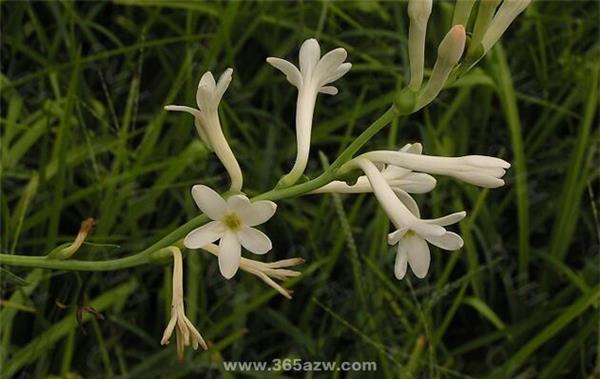
After Chang'e received the sheet music, she ordered the musicians in the moon palace to play it. In her joy, to express her thanks, she again ordered the same fairy to descend to the mortal world and invite the young man to the moon palace. The young man suddenly felt attachment to the mortal world, so he asked the fairy to delay one day before going to the moon palace. The fairy did not agree, and only pulled out the jade hairpin from her hair and gave it to him as a keepsake. When she threw it to him, the young man failed to catch it, and the jade hairpin fell to the ground, but no matter how he searched, he could not find it. As a result, the jade hairpin turned into a flower, while the young man remained in the mortal world. This flower not only gives off fragrance at night, but especially under the bright moonlight its fragrance is most intense, hence tuberose.
The above is the relevant introduction to tuberose cultivation. I hope it is helpful to you.