How to grow alfalfa? A detailed guide to practical care tips
Alfalfa is a type of clover, and its flowering form is very beautiful. Next, let me introduce information related to growing alfalfa.
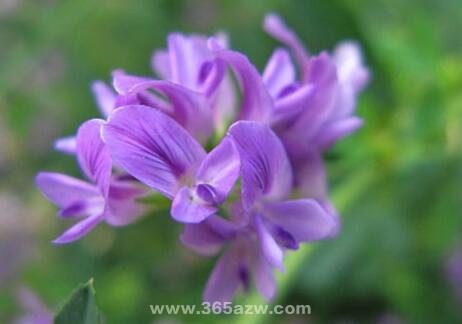
Biological characteristics of alfalfa
Alfalfa is a perennial herbaceous plant, and its hay yield ranks first among many leguminous forage grasses. It is also complete in nutrients, rich in protein, trace elements and more than ten kinds of vitamins. Alfalfa's main root is very long, generally extending 3-5 m or more into the soil, and at its deepest can reach about 10 m. The lateral roots are well developed, the stems are mostly upright and smooth, 60-100 cm tall, and the leaves are composed of three leaflets, obovate, with long and smooth petioles and very large stipules. The flowers are purple, in racemes, and the seeds are kidney-shaped, with a 1000-seed weight of 1.5-2.5 g. After sowing, it reaches its growth peak in two to three years, and its lifespan can last 10-20 years, or even 40 years.
It likes warm, semi-humid climates, is very drought-resistant, not tolerant of waterlogging, and has strong cold resistance. It is not strict about soil requirements, and calcareous loam or sandy loam with a pH of 6.5-8.5 is most suitable. In poor soil, an appropriate amount of barnyard manure and phosphate fertilizer should be applied as a base fertilizer to help root nodules form.
Alfalfa can be sown in all four seasons of the year.
The flower language of alfalfa: luck.
Related legends:
Legends about clover have existed for a long time. Some say it was a gift brought to the human world by Adam and Eve from the Garden of Eden; others say the name lucky clover comes from Napoleon. Once, while marching past a grassland, he found a four-leaf clover, felt it was very unusual, and when he bent down to pick it, he just happened to avoid a bullet shot at him and escaped disaster. From then on, clover became a symbol of good luck. Now the four-leaf clover has been internationally recognized as a symbol of good luck.
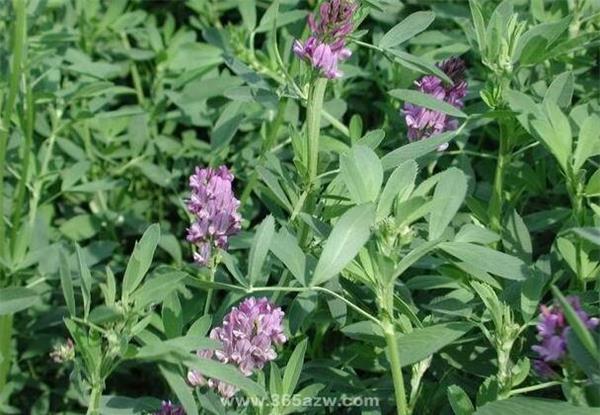
Alfalfa also has another flower language, and that is hope, love, not despair, but hope.
What should be noted when growing alfalfa?
Land selection: choose fertile land with a soil layer of more than 1 m, loose, with good drainage and air permeability. Alfalfa is drought-tolerant, but afraid of flooding. If alfalfa land is flooded for 24 hours, 80% of the alfalfa will die.
Selection of suitable regions and seeds: regions with a growing period of less than 85 days cannot grow alfalfa.
Land preparation and sowing:
1. Before sowing, plow deeply once, rotary till once, then rake level once and compact, so that the soil is firm below and loose on top. Remove stones larger than 2 cm.
2. Selection of seeding machinery: alfalfa should be sown with precision seeding.
3. When soil moisture is poor, irrigate sufficiently by sprinkler before and after sowing.
4. Sowing method: seeding rate: 1.5-2 jin per mu, width 60 cm, row spacing 15-20 cm, sowing depth 1.5-2 cm.
5. Sowing time: sow in May.
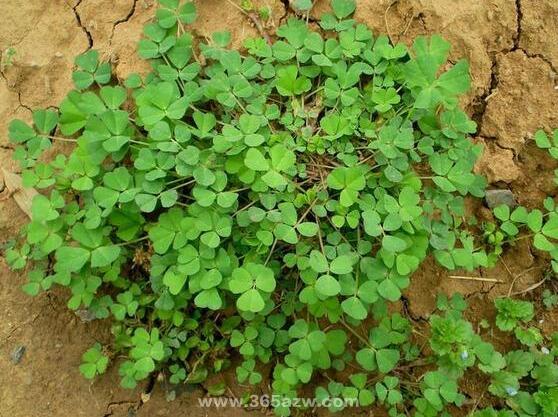
Weed control: from after sowing to the seedling stage, after green-up each year, and after each harvest, pay attention to weed control. Manual pulling or chemical weed control can be used. For chemical weed control, spray alfalfa-specific herbicide, and note that it must not be used within 14 days before harvest.
Drainage and irrigation: alfalfa roots go deep into the soil and have strong drought resistance. However, timely watering during dry seasons and after each cutting can significantly increase yield. Alfalfa roots are not tolerant of flooding, so in the rainy season, low-lying waterlogged land should be drained promptly.
Fertilization: alfalfa has root nodules and can fix nitrogen from the air to provide nitrogen for itself, so phosphate fertilizer should be the main application, with an appropriate additional application of potassium fertilizer; however, in poor wasteland, saline-alkali land, and places with low soil nitrogen content, a certain amount of urea should be applied as seed fertilizer at sowing. During the seedling stage of alfalfa growth or after green-up each year, the root system's nitrogen fixation capacity is relatively weak, and applying a certain amount of nitrogen fertilizer can increase its yield.
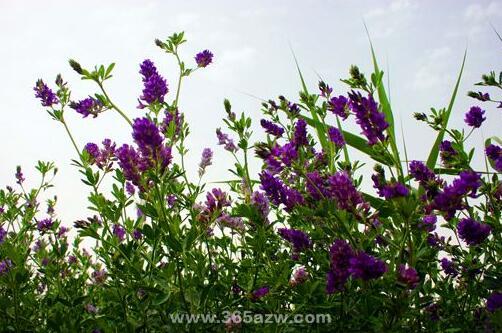
The above is the related introduction to alfalfa. I hope it is helpful to you.