Is it good feng shui to place an anthurium at home? Feng shui theory helps you analyze it
Leaf spot disease is a fairly common one among the diseases of the areca palm (Chrysalidocarpus lutescens). It causes one withered yellow spot after another to appear on the areca palm's glossy green leaves, affecting not only its appearance but also its growth. So what are the symptoms of areca palm leaf spot disease? And how do you prevent and control it?
Areca palm (scientific name: Chrysalidocarpus lutescens H. Wendl.): also known as yellow palm and purple palm. A clumping evergreen shrub or small tree of the palm family, genus Chrysalidocarpus. The stems are smooth, yellow-green, without prickles, covered with a waxy bloom when young, bearing obvious leaf scars arranged in ring-like striations. The leaf surface is smooth and slender, pinnately parted, 40-150 cm long, with slightly curved petioles and soft tips. Like other plants, the areca palm is threatened by various diseases throughout its growth, and leaf spot disease is one of the common ones.
I. Common symptoms
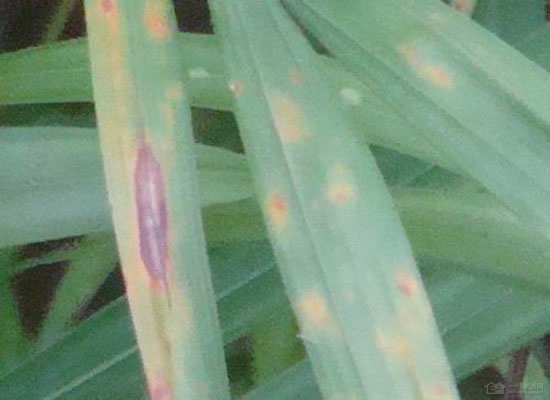
In the early stage of the disease, small yellow-brown spots appear on the leaves, gradually expanding into streaks and merging into irregular necrotic patches. Leaf tips and leaf margins are the most susceptible. When the disease is severe, more than half of most leaves become withered and curled, as if burned by fire; the center of the lesion is dark or grayish white, surrounded by a dark line along the edge, and in the later stage small elliptical black dots are scattered over the diseased area.
II. Pathogen
Pestalotia palmarum Cooke, of the order Melanconiales, class Coelomycetes, subphylum Deuteromycotina, causes areca palm leaf spot disease. The small black dots on the diseased area are the pathogen's acervuli. The acervuli are first embedded and later exposed; the conidia are elliptical to club-shaped, with 4 transverse septa dividing them into 5 cells, the middle 3 cells brown and the cells at both ends colorless, with 2-3 flagella at the apex, about 8-15 micrometers long; the basal cell has a small stalk.
III. Occurrence pattern
The disease generally occurs from May to November. High temperature and frequent rain favor the spread and expansion of the disease.
IV. Prevention and control methods
(1) Strengthen nursery management: during the seedling stage, provide appropriate shade to avoid direct sun exposure.
(2) Rational fertilization: do not apply too much nitrogen fertilizer; it is advisable to apply more potassium fertilizer.
(3) Chemical control: regularly spray Guoguang Yintai (80% zineb wettable powder) at 600-800 times dilution + Guoguang Sitaling (a foliar fertilizer of amino acid-chelated multiple trace elements), for preventive protection before disease onset and to supplement nutrition and improve ornamental value; in the early stage of disease onset, spray 25% prochloraz emulsifiable concentrate (such as Guoguang Bixian) at 500-600 times dilution, or 50% mancozeb wettable powder (such as Guoguang Yingna) at 400-600 times dilution. Use 2-3 times consecutively, with an interval of 7-10 days.
Once you understand the symptoms and occurrence pattern of areca palm leaf spot disease, you can take various preventive measures early to ensure that the areca palm not only grows vigorously but also has greater ornamental value.