What are the precautions for growing Trillium?
Trillium is a herbaceous plant. What issues should be noted when growing Trillium? Let's take a look together next.
Introduction to Trillium
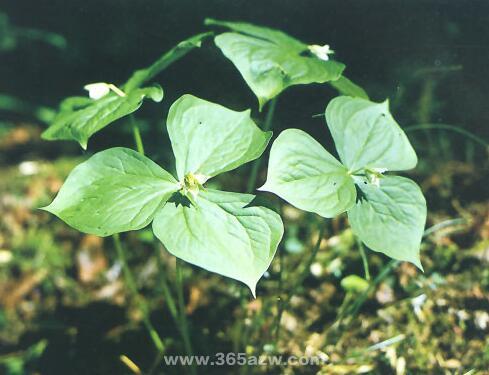
Trillium (Trillium tschonoskii Maxim.), a plant in the Liliaceae family. Trillium is a perennial herb, with stems clustered on a thick, short rhizome, 15-50 cm tall.
Trillium grows under forests at an altitude of 1600-3200 m, in shady and damp valleys, on mountain slopes, or under rocks by roadsides. It has the effects of promoting blood circulation, relieving pain, stopping bleeding, reducing swelling, and dispelling rheumatism.
Morphological characteristics of Trillium
Stem
Trillium is a perennial herb, with stems clustered on a thick, short rhizome, 15-50 cm tall.
Leaves
The leaves of Trillium are rhombic-rounded or rhombic, 6-15 cm long and 5-15 cm wide, nearly sessile.
Flowers
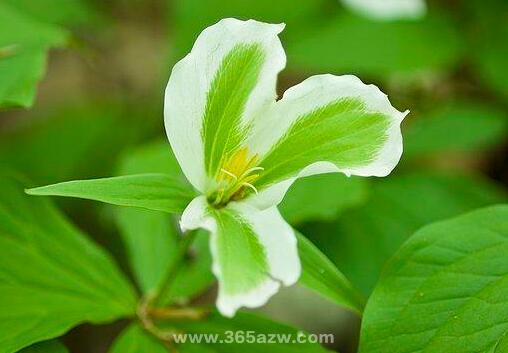
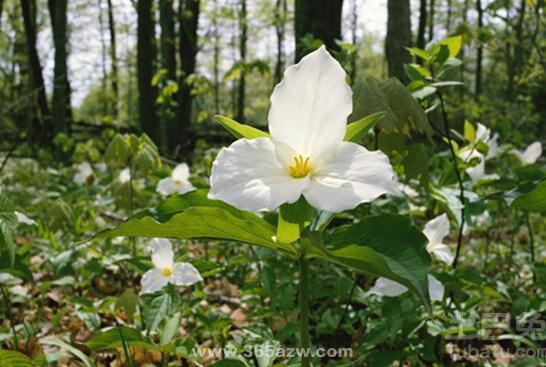
The pedicel of Trillium is 1-4 cm long; the outer tepals are ovate-lanceolate, green, 1.5-2 cm long and 5-9 mm wide; the inner tepals are white, rarely pale purple, ovate-lanceolate, 1.5-2.2 cm long and 4-6 (-10) mm wide; the style is 4-5 mm long; the anthers are 3-4 mm long, shorter than the filaments or nearly equal in length to the filaments, with a slightly protruding connective at the tip; the ovary is conical-ovate, 7-9 mm long and 5-7 mm wide.
Fruit
The berry of Trillium is spherical, 1.5-1.8 cm in diameter, blackish purple, with numerous seeds.
The flowering period of Trillium is April-June, and the fruiting period is July-August.
Pest and disease control
Trillium has strong stress resistance. In the early stage of artificial cultivation, there are relatively few pests and diseases, and generally only bed soil disinfection is needed. In the later stage, overwintering bud mildew and rhizome rot may occasionally occur. During and before the onset of the disease, quintozene can be used for foliar and soil surface spray control, with a total effective rate of 95%.
Propagation techniques
Sexual propagation. Sexual propagation is the use of Trillium seeds for propagation. Wash the harvested berries with water by rubbing, remove the peel and pulp, and dry them to obtain pure seeds. Then mix the seeds with river sand at a ratio of 1:5, stir evenly, and store indoors until sowing. In early to mid-November, take out the seeds that have undergone indoor stratification treatment, sieve them, and sow. The methods include broadcasting and drilling. In comparison, drilling can save more seeds, produce uniform seedlings, and facilitate seedling management. Before sowing, evenly spread a layer (10 cm) of decomposed and finely chopped barnyard manure on the seedbed surface, then make rows for drilling with a row spacing of 10 cm, using 200-250 seeds per row. After sowing, evenly spread a 2 cm thick layer of plant ash over the seeds.
The seeds of Trillium have the characteristic of dormancy and must undergo two vernalization stages in the soil before they can germinate. In addition, due to the low propagation coefficient, they are generally not used in field production. However, after years of research on seed breeding, certain breakthroughs have been made, and after certain treatments, the seeds can germinate in about half a year.
Asexual propagation. After the rhizome of Trillium is cut into pieces, the buds on it can sprout into small plants capable of independent life for asexual propagation. The propagation coefficient reaches more than 10, so it has production and utilization value. In late August, after the aboveground parts of Trillium wither, dig out the underground rhizome and cut it vertically into 4-8 pieces according to the direction parallel to the main axis of the rhizome, depending on its size. The cutting knife should be thin and sharp to avoid cracks at the cut surface and reduce infection. Immediately after cutting the rhizome into pieces, soak them in 0.5% metalaxyl for 1 min. The sowing land should be deep-plowed and sun-dried during the dog days, then the soil should be broken and made into beds, with a bed height of 15-20 cm and the bed surface shaped like a tile back. Before sowing, spray the bed surface with 2% metalaxyl until thoroughly wet as soil chemical disinfection. Open furrows 3-4 cm deep in the bed soil, apply 45000 kg/ha of decomposed cow dung, cover with 1 cm of soil, sow the cut pieces at a spacing of 15 cm x 10 cm, cover with 3 cm of soil, and build a shade shed with branches, with a light transmittance of 70%.
The above is the relevant introduction to growing Trillium, and we hope it is helpful to you.