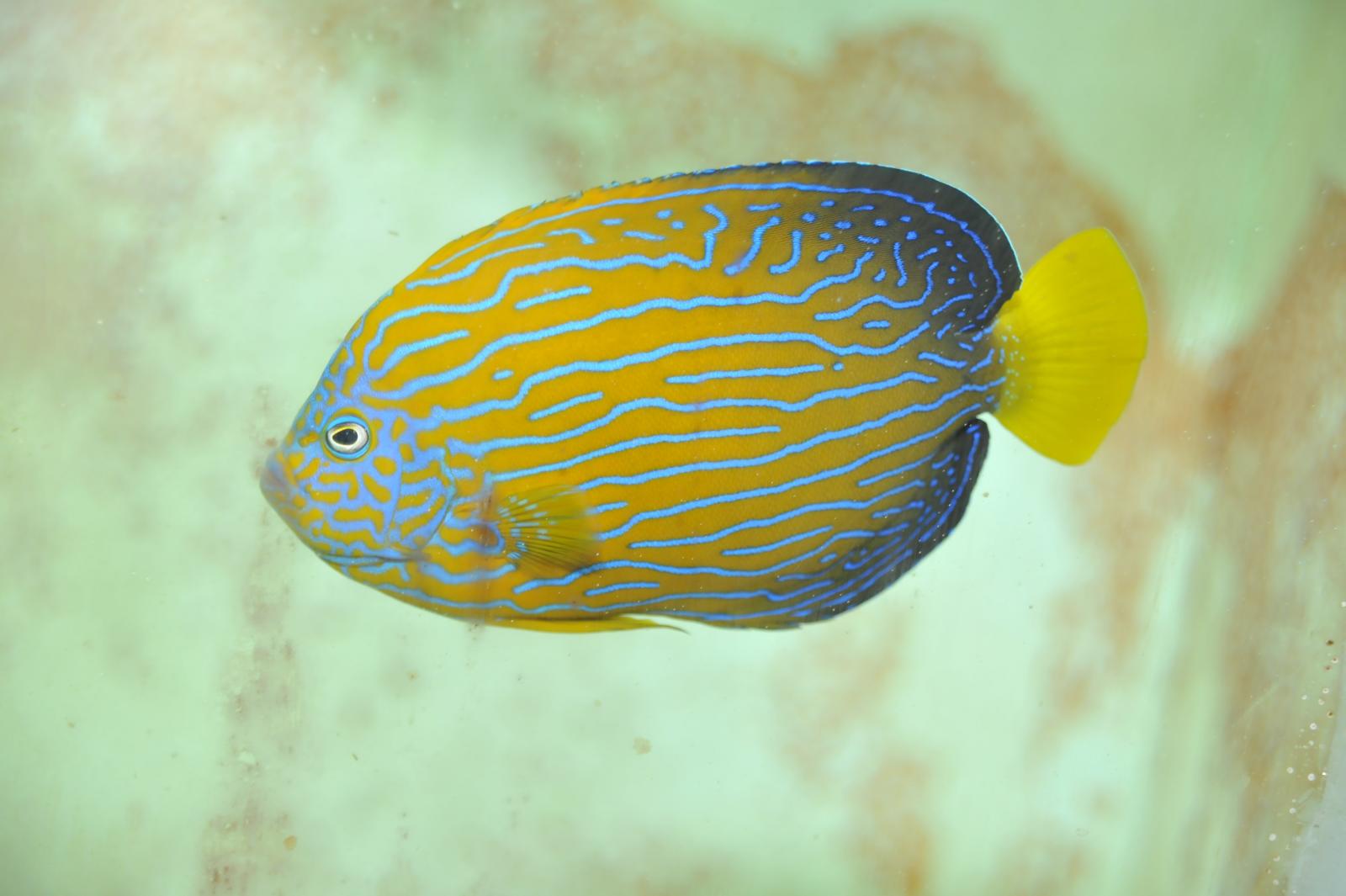
Breakthrough in Artificial Breeding of Blue-banded Angelfish Fry, Creating Value While Balancing Ecology
Brilliant colors and dazzling postures, with schools of fish swimming gracefully underwater, are extraordinarily therapeutic, and have also made the ornamental aquarium industry a star industry under trends such as the stay-at-home economy and physical and mental stress relief; according to statistics from the Food and Agriculture Organization of the United Nations (FAO), the annual output value of the global ornamental aquarium and related industries is as high as 15 billion US dollars, making it an internationally prominent star industry. However, under enormous global demand, natural resources are gradually being depleted.
Aiming at this business opportunity, the Aquatic Technology Research Institute of the Agricultural Technology Research Institute has developed a mass production model for high-economic-value ornamental aquarium species and, through a genomics application platform, assists molecular breeding of ornamental fish with special patterns. While increasing the market circulation of artificially bred species, it also injects vitality into Taiwan's marine ornamental aquarium industry.
Although the movie "Finding Nemo" is a fictional story, it instantly enabled a vast global audience of movie fans to understand the beauty and wonder of the underwater world. With the popularity of the movie, the clownfish "Nemo" and the blue tang "Dory" remain the most popular marine ornamental fish to this day, also driving an ornamental aquarium boom.
Although the ornamental aquarium market has promising prospects, blindly following trends to produce popular strains often brings only fleeting returns. In addition, although the entry threshold for the ornamental aquarium industry is much lower than that of the general aquaculture industry, due to its closed-off technical nature, outsiders often remain bewildered. Once they rashly invest, they often end up failing because of an imbalance between supply and demand.
In fact, every type of marine ornamental fish species has its own special production and rearing methods, including fish growth and rearing, and equipment maintenance, all of which involve many technical subtleties. Only by actually working hands-on on the technical side can one truly understand them.
Mastering the Key to Mass Production, Building Data to Create Efficiency and Value
In order to sustainably manage precious marine resources, and at the same time enable Taiwan, which is surrounded by the sea on all sides and possesses natural geographical advantages, to develop a local ornamental fish farming industry and create a vision of shared prosperity, the Aquatic Technology Research Institute of the Agricultural Technology Research Institute, through applying for resources from the Council of Agriculture's "Internationalization and Sustainable Development Plan for the Agricultural Bioeconomy Industry," invested years of observation and experimentation, identified the water quality conditions most suitable for cultivating fry and breeding fish schools, successfully developed the "Blue-banded Angelfish Mass Production Technology," and established a blue-banded angelfish germplasm bank. It continues to conduct simplified genome sequencing (RAD-seq) analysis as molecular marker-assisted breeding for blue-banded angelfish with special patterns. In the future, this can be extended and applied to increase the price and value of ornamental fish, and also increase the market circulation of artificially bred species.
Speaking of how blue-banded angelfish could successfully break through the bottleneck in mass production technology, Sun Yu-hsuan, assistant researcher at the Aquatic Technology Research Institute of the Agricultural Technology Research Institute, said, "It was actually quite difficult." She further shared, "In the early days, there were many folk 'experiences' of successful breeding on one's own, but because they lacked the support of scientific data, they were not easy to pass on. In 2003, the National Museum of Marine Biology and Aquarium in Pingtung invested in research related to artificial breeding of marine fish, hoping to solve the processes and problems encountered with the sources of fish in the ornamental aquarium market. Because most ornamental fish from the ocean are caught and sold from the sea, from the place of origin to distant terminal markets, after long-distance transport, usually fewer than 20% of the captured fish survive. By 2011, the research team successfully induced the blue-banded angelfish to spawn artificially for the first time. Unfortunately, the eggs could not grow and develop into fry. Moreover, the blue-banded angelfish is especially delicate, with an incubation time of only 15-18 hours. The rearing conditions during the period 'from larvae to juveniles' are the key to blue-banded angelfish mass production technology."
Therefore, after integrating water quality and environmental conditions and feed formulas and establishing a mass production model, and because it was also observed during the process of artificial breeding how precious data could be preserved and transformed to create higher value, this became the next key task.
Technological Support Strengthens the Competitiveness of Taiwan's High-Quality Aquatic Products
"The market price of one blue-banded angelfish is about more than 1,000 yuan, but for a blue-banded angelfish with a pattern variation, the price immediately rises tenfold!" added Shen Kang-ning, researcher at the Aquatic Technology Research Institute of the Agricultural Technology Research Institute. Because blue-banded angelfish with pattern variations are rare and hard to find, "We have already identified molecular markers related to special patterns through genome sequencing analysis, which can accelerate molecular breeding of blue-banded angelfish with special patterns. On the other hand, through phylogenetic analysis of gene sequences, we have also found species more closely related to the blue-banded angelfish in evolutionary terms. Offspring obtained through crossbreeding technology will be more market-specific and exclusive, which is beneficial to the development and internationalization of Taiwan's marine ornamental fish industry."
Breaking through the bottleneck of difficulty in marine fish breeding, successfully establishing a mass production platform for high-economic-value ornamental fish, further enriching the variety of marine ornamental fish species, and also reducing fishing pressure on wild populations, it is hoped that a mutually beneficial balance can be found between the aquarium market and marine conservation. In addition, through technology transfer, it will gradually be applied to the breeding and cultivation of other coral reef fish, increasing the competitiveness of Taiwan's ornamental aquarium industry and securing a place in the global market.